Project Info
A setting is a promise. When a product tells you that personalization is off, you would expect that nothing identifying you reaches its recommendation/personalization system right? But what if every setting, service and backend says it is off while one identifying event still crosses that boundary? With a coding agent these issues can be detected and repaired but how can you trust it to be fixed? As a developer, I have learned firsthand that it claiming "it's fixed" is indeed a claim, not a fact. This is the catch PromiseProof tackles: the agent that changed the code should not be the one that decides whether its own repair worked. PromiseProof separates those roles. GPT-5.6 investigates, Codex repairs, a human approves the exact patch and an unchanged deterministic verifier decides PASS. Instructions for Judges No account, API key or install is required to see the core idea. The verdict path uses no backend API, evidence upload or model call. Watch the five-stage walkthrough (a recorded run through all 5 steps: Observe, Investigate, Replay, Repair, Prove): https://promiseproof.alex0paiva0.workers.dev/walkthrough/ Challenge the proof yourself: https://promiseproof.alex0paiva0.workers.dev/verify/?judge=1 On load: PASS and BOUND_AND_REPRODUCED. Press Tamper OFF evidence: BROKEN_PROMISE, violation PP_IDENTIFIABLE_EVENT_LEAK, and the report you sealed a moment ago becomes STALE_OR_MISMATCH. Seal the failing result: it binds honestly as BROKEN_PROMISE. A report can bind a failure; it cannot manufacture a PASS. Download report.json and report.md, or load your own OFF and ON bundles under "Bring your own evidence." Reset to return to the original PASS. On load: PASS and BOUND_AND_REPRODUCED. Press Tamper OFF evidence: BROKEN_PROMISE, violation PP_IDENTIFIABLE_EVENT_LEAK, and the report you sealed a moment ago becomes STALE_OR_MISMATCH. Seal the failing result: it binds honestly as BROKEN_PROMISE. A report can bind a failure; it cannot manufacture a PASS. Download report.json and report.md, or load your own OFF and ON bundles under "Bring your own evidence." Reset to return to the original PASS. Inspect the bundled GitHub Action: https://github.com/AlexPaiva/PromiseProof/tree/submission-rc-03/.github/actions/verify What I built during Build Week PromiseProof started as an empty repository during the submission period. In one week I built the Signal Shelf reference application, two distinguishable cross-system defects, the deterministic evidence and evaluation layer, a bounded GPT-5.6 investigation, an authentic Codex source-repair workflow, exact human patch approval, isolated verification, the five-stage walkthrough, an external-evidence CLI, a hosted semantic challenge and a standalone GitHub Action tested on Windows, Ubuntu and macOS. The public commit history, the Build Week log, the pull requests and the immutable submission-final tag make that work inspectable. This is not a pre-existing platform with one new feature. The complete working implementation shown here was built, tested, productized and released during the Build Week window. See BUILD_WEEK.md and the immutable snapshot at tag submission-final.
Inspiration
A setting is a promise. When a product or service presents a control as off the users expect the system to honor it everywhere, not just on the screen. In the example of a distributed product the interface, browser storage, the network and the backend can each look correct on their own while the combined behavior quietly breaks the promise: one hidden path still behaves as if the setting were on. There is a second problem arriving fast: while coding agents can now investigate and repair failures like this the model that changed the code is not a trustworthy judge of whether the change actually kept the promise. I wanted to let AI do the open-ended work of diagnosis and repair, while making it structurally impossible for a model to declare its own success.
What it does
PromiseProof takes one concrete user-facing promise, "when personalization is off, nothing that identifies the user should reach recommendations" and then turns it into a deterministic check, and carries a real failure of that promise through a complete repair-acceptance loop: Observe: A Playwright journey and independent network capture catch one identifiable request crossing the service boundary while personalization is off. Broken promise. Investigate: GPT-5.6 proposes ranked competing causes and selects one allowlisted diagnostic replay, within strict limits. Replay: Deterministic code runs the chosen replay and records the facts. Repair & approve: Codex prepares a constrained two-file patch containing the source repair and a focused regression test in a disposable worktree. A human reviews the exact diff and approves it by its digest. Prove: The approved patch is applied only in a fresh worktree and an unchanged Playwright journey and deterministic evaluator decide PASS. And a judge can verify all of it directly: watch the five-stage lifecycle, tamper one meaningful observation (using the live challenge page), see the prior sealed report become stale, see the current evidence become BROKEN_PROMISE, seal an honest failing report, download JSON and Markdown proof and run the same authority through the CLI or a GitHub Action. How I built it GPT-5.6 investigates Receives a sanitized, versioned dossier through the OpenAI Responses API. Proposes two to four ranked competing hypotheses. Selects one of two allowlisted factual replays through a strict function call. Its result schema has no verdict field and no free-form cause field. It never sees the seeded fixture, source paths, logs, or root-cause labels. Codex repairs Produces an authentic constrained two-file patch containing the source repair and a focused regression test. Works in a disposable git worktree with a restricted writable surface through the pinned Codex SDK. Codex also ran repeated red-team reviews that surfaced the original free-text-cause and verdict-language weakness, which led to the ID-only investigation schema and the strict report validation the verifier uses today. A human approves Reviews the exact patch and approves it by its digest in a real terminal. Nothing merges automatically, no model approval. The unchanged verifier decides The same Playwright journey and deterministic evaluator that caught the break. Checks OFF, Reload, ON, Browser and Control. Models are structurally excluded from PASS. Adoption surfaces: a hosted browser verifier, a repository-local CLI and a self-contained GitHub Action tested as a standalone consumer on Windows, Ubuntu and macOS. No model call runs in the verdict path on any surface. Challenges I ran into Two failures with the same visible symptom: An initialization race and a preference-propagation failure both break the same OFF promise, but they produce different evidence, different violation codes and require a different diagnostic replay. One flag cannot explain both and one fix cannot silence the other. Preventing a false green: Disabling all personalization must fail and not pass. OFF must stay protected while ON functionality keeps working, and the contextual recommendation feed must stay useful. The check is designed so "turn everything off" cannot satisfy the promise. Keeping AI useful without granting it authority: GPT-5.6 can reason about uncertainty but cannot declare success. Codex can prepare a patch but cannot merge or approve it. Only unchanged deterministic evidence determines PASS. Making the proof portable: Evidence is canonicalized and bound with SHA-256 to a pinned evaluator fingerprint, and check reproduces the complete report rather than trusting hashes, so a stale or forged report is rejected. Accomplishments I'm proud of Built the complete product within the Build Week window as a solo developer. Two distinguishable seeded failures with different evidence and violation codes. Two allowlisted diagnostic replays. One authentic, human-approved Codex source repair. Five independent verification clauses. Three developer surfaces: browser, CLI and GitHub Action. The GitHub Action tested as a standalone consumer on Windows, Ubuntu and macOS. Byte-identical browser and CLI gate reports for the same evidence. A hosted semantic tamper challenge that runs entirely in the browser. Complete report reproduction rather than hash-only checking. Zero model-owned verdicts and zero model calls in the verifier verdict path. An immutable submission-final snapshot of the complete submission. What I learned The most useful lesson to me was that integrity and correctness are two different things. A report can be perfectly attached to its evidence and still honestly say that the promise is broken. While binding proves that a report is faithful to its evidence it does not (and should not!) manufacture a passing verdict. I also learned that bounded AI is not weaker AI. GPT-5.6 stays valuable precisely because it investigates uncertainty, while its inability to award PASS is what protects the result. Finally, the hard part of AI-assisted repair is not producing a patch. It is building an acceptance process that proves the exact approved patch fixed the restricted state without breaking the permitted one.
What's next
Build deterministic evidence-producer adapters so more apps can emit compatible evidence. Validate the architecture against a second real application. Add another contract family only after independent validation. Improve developer onboarding around normalized evidence production. Explore reusable typed interfaces once more than one integration proves the abstraction. No promise of universal support, automated evidence collection or arbitrary contracts. Testing and supported platforms Hosted, no rebuild: https://promiseproof.alex0paiva0.workers.dev/verify/?judge=1 Repository-local CLI: npm run promiseproof -- gate|verify|check GitHub Action: uses: AlexPaiva/PromiseProof/.github/actions/verify@submission-rc-03 Install for local runs: npm ci then npx playwright install chromium (Chromium is only needed for the walkthrough tests, not for the verifier!). Supported platforms: the CLI is directly verified on Windows and the bundled Action is exercised on Windows, Ubuntu and macOS. Local no-key checks: npm run demo:rehearse, then npm run test:external and npm run test:action. Current limitations One synthetic reference application (Signal Shelf), synthetic by design so one broken promise is visible and repairable end to end. Not a legal or regulatory compliance statement. Exactly one external contract family is supported: activity-personalization/v1. External evidence is evaluated but not collection-attested. Binding proves a report matches its evidence and the pinned evaluator source but it does not prove the evidence was collected honestly. Integrity is repository-level and content-addressed. It is not a signature, notarization, certification or third-party attestation. The main branch stays intentionally seeded-broken so the red-to-green repair can be demonstrated, production is not automatically repaired.
🛡️ PromiseProof
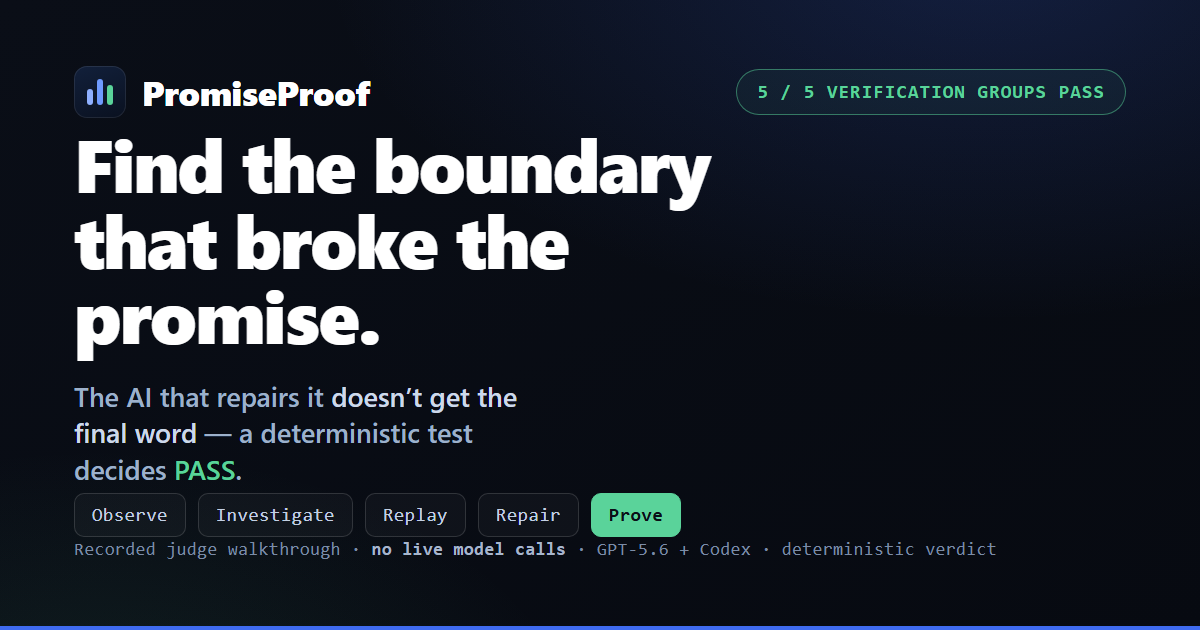
When software breaks a promise, the AI that repairs it doesn't get the final word.
GPT-5.6 investigates. Codex repairs. Neither decides PASS.
A human approves the exact patch. An unchanged deterministic verifier decides whether the promise is actually fixed.






▶ Live demo · ⚡ Challenge the proof · Judge Start Here · Walkthrough · How it works · Run it in CI
Contents
- The 30-second version
- See the proof
- The problem
- Who decides it is fixed
- Try it yourself
- Use it on your own project
- How it works
- GPT-5.6 and Codex
- Architecture
- Limitations
The 30-second version
- A user turned personalization off. The interface, the browser storage, and the backend all reported the same thing: off.
- One identifiable request still crossed into recommendations. The product had quietly broken the promise it showed the user.
- GPT-5.6 investigated within strict limits, Codex proposed a real source repair in isolation, and a human approved the exact change.
- The same unchanged test that caught the break decided whether the repair worked, not a model. You can challenge that verdict yourself in the browser, and drop the identical check into your CI.
Most tools confirm that your tests pass. PromiseProof answers the one question a model should never answer about its own work: is the fix actually real?
See the proof
Three states, no setup: the verifier passes, breaks under a tamper, and the same authority gates your CI. Same evaluator, no model in the verdict path, nothing uploaded.
The full lifecycle, from broken promise to proof, plays in order in the five-stage walkthrough.
The problem
A user turns personalization off. The UI says off. Browser storage says off. The backend says off. And yet one identifiable request still crosses the boundary to the recommendation service.
Monitoring can show that a promise broke. PromiseProof carries that evidence through bounded diagnosis, constrained repair, and independent verification, and it never lets the one thing that might be wrong, a model, declare itself correct.
It turns an "off means off" promise into an executable check, helps locate the implementation boundary that broke it, lets AI investigate and propose a repair, then hands the verdict to an unchanged deterministic test.
Who it is for
PromiseProof is for product, QA, privacy, reliability, and platform engineers responsible for user-facing controls that cross browser, storage, network, and backend boundaries. It turns an ambiguous report like "OFF did not behave like OFF" into reproducible evidence and a bounded diagnostic action, so a team finds the responsible subsystem sooner. As coding agents start changing repositories on their own, it also gives those teams an acceptance gate that is inspectable, human-approved, and reproducible in the CI they already trust.
Why this is more than a privacy test
The personalization toggle is the proving example, not the limit of the idea. User-facing promises routinely cross the interface, storage, network, and backend at once, and every one of those surfaces can look locally correct while the combined behavior is wrong. A monitor can surface that contradiction. PromiseProof is what happens next: it carries the contradiction through bounded diagnosis, a real source repair, exact human approval, independent acceptance, full report reproduction, and CI enforcement, without ever letting the model that proposed the fix certify it. It supports one contract family today, activity-personalization/v1, and the mechanism is built to generalize; the honest scope is stated in Limitations.
Who decides it is fixed
A model may investigate and repair. Deterministic evidence keeps the verdict.
The final investigation schema has no verdict field. GPT-5.6 proposes and ranks candidate causes and requests one allowlisted diagnostic replay. Codex proposes a constrained two-file repair in a disposable worktree. A human approves the exact patch by its fingerprint. Then an unchanged Playwright journey and deterministic evaluator, the very ones that caught the break, decide PASS or FAIL.
The AI never grades its own work. That is the whole point. The authority table and the tests that enforce it are in JUDGE_START_HERE.md.
Why the patch is small
The approved repair is intentionally small, and that is the point. Generating two changed files is not the hard part. The hard part is proving that the correct implementation boundary changed, that the restricted OFF behavior is now protected, that the permitted ON behavior still works, that the applied patch is exactly what the human approved, and that neither model was able to certify its own code. A one-line fix carried through that chain proves more than a large patch a model graded itself.
| Verified fact | Current release |
|---|---|
| Distinguishable seeded failures | 2 |
| Allowlisted factual replays | 2 |
| Authentic approved Codex repair | 1 |
| Independent verification clauses | 5 |
| Developer surfaces | Browser, CLI, GitHub Action |
| Action runner operating systems | Windows, Ubuntu, macOS |
| Model-owned verdicts | 0 |
| Model calls in the verifier path | 0 |
Try it yourself
Three ways in, none of them require an API key.
1. Watch the complete lifecycle. The five-stage walkthrough replays one authentic run: Observe, Investigate, Replay, Repair, Prove. The GPT-5.6 and Codex execution is authentic and recorded, not re-run live for remote judges.
2. Challenge the proof. Open the hosted verifier (no login, no key, everything runs in your browser):
- On load:
PASSandBOUND_AND_REPRODUCED. - Press Tamper OFF evidence: the same evaluator returns
BROKEN_PROMISEwithPP_IDENTIFIABLE_EVENT_LEAK, and the report you sealed a moment ago becomesSTALE_OR_MISMATCH. - Seal the failing result: it binds honestly as
BROKEN_PROMISE. A report can bind a failure; it cannot manufacture a PASS. - Download report.json / report.md, or load your own OFF and ON bundles under "Bring your own evidence."
- Reset to return to the original PASS.
3. Run it in CI. Drop the same verifier into any workflow with no npm install, no browser, and no key:
- uses: AlexPaiva/PromiseProof/.github/actions/verify@submission-rc-03
  with:
    mode: gate
    off_evidence: artifacts/personalization-off.json
    on_evidence: artifacts/personalization-on.json
    output_directory: artifacts/promiseproof
The step fails on BROKEN_PROMISE (exit 2) and still leaves report.json and report.md behind.
4. Reproduce a sealed receipt, with nothing to generate first. The repo ships a committed report and the evidence it was computed from. After npm ci, regenerate that report byte for byte:
npm run promiseproof -- check \
  --report artifacts/verify/passing-gate.report.json \
  --off artifacts/verify/passing-off.example.json \
  --on artifacts/verify/passing-on.example.json
# BOUND_AND_REPRODUCED (exit 0)
Swap in the committed artifacts/verify/broken-off.example.json and gate returns BROKEN_PROMISE (exit 2). No init, no scaffolding, no key. Full CLI, exit codes, and exact scope are in PromiseProof Verify below.
Use it on your own project
If your app can emit the supported OFF and ON evidence for this contract, pick the surface that fits how you work. The evidence shape is defined in ADOPTION.md.
| You want to | Do this |
|---|---|
| Try it with zero setup | Open the hosted verifier, then load your own OFF and ON bundles under "Bring your own evidence" |
| Gate a change locally | npm run promiseproof -- gate --off off.json --on on.json |
| Reproduce a report from evidence | npm run promiseproof -- check --report report.json --off off.json --on on.json |
| Fail CI on a broken promise | Add the GitHub Action step, pinned to @submission-rc-03 |
The evidence envelope, the report format, exit codes, and the trust boundaries are all in ADOPTION.md. One contract family is supported today, activity-personalization/v1, and that guide shows the exact bundle shape and how to produce it.
What was built in one Build Week
PromiseProof is new work, built July 14 to July 21, 2026, with a linear history a judge can walk from tag to tag:
- Jul 14 deterministic foundation: the synthetic app, the real browser-to-backend boundary, and the first seeded defect proven red.
- Jul 15 bounded GPT-5.6 investigation over a sanitized dossier.
- Jul 16 authentic, human-approved Codex source repair in a disposable worktree.
- Jul 17 CI hardening and the judge walkthrough experience.
- Jul 20 to 21 the public product: hosted verifier, external CLI, report reproduction, the cross-platform GitHub Action, and the judge and adoption guides.
The full record, tags, and honest limitations are in BUILD_WEEK.md.
How it works
flowchart LR
    O["1. Observe"] --> I["2. Investigate"] --> R["3. Replay"] --> P["4. Repair"] --> V["5. Prove"]
    style O fill:#0c111c,stroke:#3f6bf0,color:#e8edf6
    style I fill:#0c111c,stroke:#6f9bff,color:#e8edf6
    style R fill:#0c111c,stroke:#6f9bff,color:#e8edf6
    style P fill:#0c111c,stroke:#e0a63b,color:#e8edf6
    style V fill:#0c111c,stroke:#5ad39a,color:#e8edf6
Authority stays with deterministic code and the human at every step: the model investigates read-only and never returns a verdict, the human approves the exact patch, and the unchanged evaluator alone decides PASS.
- Observe. Signal Shelf, a synthetic app, has personalization OFF everywhere the user can see. Playwright captures the journey and the real network traffic. One identifiable request crosses the service boundary while OFF, producing
PP_IDENTIFIABLE_EVENT_LEAK. Broken promise. - Investigate. GPT-5.6 reads a sanitized, versioned dossier, proposes and ranks two-to-four candidate causes, and requests one replay from a fixed allowlist. Read-only. It never sees which fixture is seeded, and its final schema cannot carry a verdict.
- Replay. Deterministic code executes the chosen probe (
inspect_startup_order) and records the facts: collection started before the saved preference finished hydrating. - Repair. Codex (pinned SDK, one turn) proposes a constrained two-file patch plus a focused regression test in a disposable git worktree. A human reviews the exact diff and types the digest-bound approval in a real terminal. Nothing merges automatically.
- Prove. The approved patch is applied only in a fresh disposable worktree. The unchanged Playwright journey and deterministic evaluator run the full matrix (OFF, Reload, ON, Browser, Control) and return PASS.
mainstays seeded-broken for the red-to-green demonstration.
Quick start (the judge path)
Requirements: Node.js 22.12+, npm 10+, Playwright Chromium.
npm ci
npx playwright install chromium
The no-key judge path (deterministic, offline, no API key required):
npm run demo:rehearse
This validates the recorded repair proof's tracked artifacts, applies the approved patch in disposable worktrees, and runs the unchanged verifier. It is a rehearsal of the recorded repair, not a fresh model run.
Browse the full experience locally:
npm run build:site        # builds landing (/) + walkthrough (/walkthrough/)
npx --yes serve@14.2.6 dist/site
Other paths that need no external model or API calls, and no OpenAI credits (they do use local loopback HTTP between the browser and the synthetic service):
npm run test:investigation:offline   # real evidence signatures + replays through a deterministic provider
npm run test:repair:offline          # prepares, approves, applies and verifies the repair in disposable worktrees
npm run test:judge:unit              # the walkthrough's evidence/interaction unit checks
npm run test:judge:interface         # browser-level walkthrough and accessibility checks
On Windows systems that block PowerShell's
npm.ps1, usenpm.cmd/npx.cmd.
Try PromiseProof Verify
The lifecycle above repairs a promise without ever letting a model own the verdict. PromiseProof Verify exposes that same unchanged evaluator so anyone can re-derive the result from evidence, in the browser or from the CLI.
Hosted Judge Mode, no login and no API key, runs locally in your browser:
It opens on a passing OFF/ON gate bound to the pinned evaluator source. Tamper a load-bearing OFF observation and the same evaluator returns BROKEN_PROMISE (PP_IDENTIFIABLE_EVENT_LEAK), while the report you sealed a moment earlier no longer reproduces (STALE_OR_MISMATCH). The files you select stay in the page.
Repository-local CLI, no model call in the verdict path:
npm run promiseproof -- init --out .promiseproof

npm run promiseproof -- gate \
  --off .promiseproof/passing-off.example.json \
  --on .promiseproof/passing-on.example.json \
  --out .promiseproof/report

npm run promiseproof -- check \
  --report .promiseproof/report/report.json \
  --off .promiseproof/passing-off.example.json \
  --on .promiseproof/passing-on.example.json
verifyandgateexit0PASS,2BROKEN_PROMISE,3INVALID_EVIDENCE,1usage or execution error.checkexits0BOUND_AND_REPRODUCED,4STALE_OR_MISMATCH,3INVALID_REPORT_OR_EVIDENCE,1usage or execution error.
GitHub Action, drop the verifier into any workflow with no npm install, browser, or key:
- uses: AlexPaiva/PromiseProof/.github/actions/verify@submission-rc-03
  with:
    mode: gate
    off_evidence: artifacts/personalization-off.json
    on_evidence: artifacts/personalization-on.json
    output_directory: artifacts/promiseproof
The step fails on BROKEN_PROMISE and still leaves report.json and report.md behind. @submission-rc-03 is the immutable release tag that contains the Action; @main also works if you prefer to track the branch. Details in the Action README.
What it is, stated exactly:
- One supported contract family:
activity-personalization/v1. - Externally supplied evidence is not collection-attested; PromiseProof does not claim to know how it was gathered.
- Reports bind the validated evidence to the pinned evaluator source by content digest.
checkre-runs the evaluator and compares the complete regenerated report, not only its hashes, so a report with correct digests but an invented verdict fails to reproduce.- The verifier path makes no GPT-5.6 or Codex call.
- Signal Shelf still demonstrates the complete investigation and repair lifecycle above; the verifier is the reproducible check at the end of it.
The full developer guide is in ADOPTION.md.
The two seeded defects
Signal Shelf carries two independently selectable defects. Both break the same OFF promise in different ways, produce different evidence, and require different diagnostic actions, so a single flag cannot explain both, and one fix cannot silence the other.
| Seeded fixture | OFF evidence after reload | Only violation | Verified replay |
|---|---|---|---|
| Initialization race | UI/storage/backend OFF; contextual feed; one captured identifiable request + matching service receipt | PP_IDENTIFIABLE_EVENT_LEAK | inspect_startup_order |
| Propagation failure | UI/storage OFF; backend ON; contextual feed; zero activity | PP_PREFERENCE_NOT_PERSISTED | inspect_preference_roundtrip |
ON is a control in both fixtures: one correlated identifiable request reaches the recommendation service and the behavioral feed stays functional, which proves a fix cannot simply switch recommendations off.
The propagation seed is deliberately stronger than a missing click handler: a real OFF PUT crosses HTTP and receives an ordinary OFF acknowledgement and receipt, but an independent GET still returns ON. A test that checked only the write response would pass; the replayed write/read round trip catches the broken promise.
Architecture
PromiseProof is one small, strict TypeScript workspace:
src/client: vanilla TypeScript UI, startup ordering, and the visible evidence panel.src/server: Express API, fixed recommendation data, in-memory state, isolated fixture injection.src/shared: evidence schema, the canonical evaluator, and the whitelisted replay selector.src/investigation: versioned dossier and result contracts, strict runtime schemas, the GPT-5.6 Responses API provider, deterministic validation, a closed replay dispatcher, a bounded runner, and the sanitized audit artifact.src/repair: live-receipt eligibility, a pinned Codex SDK boundary, exact inspection policy, disposable-worktree orchestration, a semantic diff firewall, real-TTY approval, fresh-worktree verification, digest-boundnot_runretirement, recovery, and deterministic receipts.src/judge: the self-contained, JS-rendered walkthrough (main.ts+styles.css) served at/walkthrough/.tests: Playwright journeys, independent network capture, contract tests, diagnostic replays, deterministic providers, leakage checks, live smoke paths, repair boundary tests, and the offline two-worktree journey.
The browser and service communicate over real HTTP. Contextual requests carry no user ID and suppress the referrer. Feed assertions require rendered DOM item IDs to match backend recommendation receipts, and missing DOM evidence cannot be papered over with server data. Fixture selection is an out-of-band server setting: it is not accepted through the page URL, is absent from PromiseEvidence, and is not an input to the replay selector.
The investigation boundary
The investigation makes exactly two provider calls and at most one replay execution:
- Deterministic code builds
InvestigationDossierV1. GPT-5.6 must call the sole strict function,run_diagnostic_replay, with two-to-four proposed ranked hypothesis titles in opaque slotsh1throughh4, relative confidence estimates, evidence references, a purpose, and one of two allowlisted replays (inspect_startup_orderorinspect_preference_roundtrip). - Runtime validation rejects malformed output, unknown tools, unknown replay IDs, dangling or duplicate references, zero or multiple tool calls, and reserved verdict language, then recursively freezes the accepted argument object before a closed dispatcher runs exactly one existing factual replay.
- The replay report is normalized and returned in a second call. GPT-5.6 may update only the existing hypothesis IDs (confidence, status, references) and must return the fixed limitation codes
single_replay_scope,synthetic_evidence_scope,diagnostic_not_verdict. There is no free-form cause field and no verdict field. Project code renders the codes with fixed prose.
GPT-5.6 never receives the selected fixture, source paths, logs, screenshots, or root-cause labels. Deterministic TypeScript and Playwright alone decide whether the promise passed.
GPT-5.6 and Codex
PromiseProof is built on exactly what these models are good at, and bounded by exactly what you should not trust them with. GPT-5.6's structured reasoning and strict function-calling are what make the investigation capable while keeping its authority bounded: the model reasons over a sanitized dossier and ranks competing causes, yet it can act only through one strict tool call into a fixed allowlist, and its result schema has no field in which to write a verdict. The usual worry about an LLM, that it grades its own work, is designed out rather than hoped away. Codex's agentic, multi-file editing is what turns a diagnosis into a real fix: a constrained two-file source patch plus a focused regression test, prepared in isolation. The models do the open-ended reasoning and code work; a deterministic evaluator, not either model, keeps the verdict.
GPT-5.6 is part of the runtime product architecture. It receives a sanitized, versioned dossier, proposes and ranks diagnostic hypotheses, and selects exactly one allowlisted factual replay through a strict function call. After deterministic code runs that replay, it may update only the existing hypothesis IDs using allowlisted evidence references. It cannot run an arbitrary command, choose an unregistered replay, or determine the product verdict.
Codex is the engineering collaborator used to build the project. It helped implement and review the synthetic app, real-HTTP evidence capture, the deterministic evaluator, the two distinguishable defects, Playwright controls and expected-red verification, the bounded investigation schemas, provider and dispatcher, adversarial tests, and the milestone documentation. Codex also ran repeated red-team audits that found the original free-text-cause and verdict-language weakness. The current ID-only final schema and replay-citation rules are the resulting design correction. Command output, retained artifacts, Git diffs, and protected-file hashes, not a model's claim, verify that work.
PromiseProof contains one recorded, human-approved Codex repair that passed unchanged Playwright and deterministic verification in a fresh disposable worktree. main remains intentionally seeded-broken for the red-to-green demonstration. The exact 2,311-byte approved patch and sanitized verification record are tracked in docs/evidence/milestone-04-authentic-repair.
Reproducibility and evidence
Everything a judge needs is verifiable without an API key. The recorded diagnosis is an authentic GPT-5.6 run through OpenAI's Responses API; the repair is an authentic Codex SDK run with a logged thread id and the approved patch's fingerprint. It happened once; the offline commands replay that recorded evidence and re-run the check, so the verdict is deterministically reproducible.
The repository fingerprints the retained artifacts and verifies their internal consistency against the approved patch and verification receipts. This is repository-level integrity evidence, not third-party provider attestation, an important and deliberate distinction.
More ways to validate. None of these spend OpenAI credits except the explicit live investigation at the end:
npm test                        # health, control, detector and replay assertions
npm run test:determinism        # 5 fresh OFF + 5 fresh ON contexts per fixture
npm run test:expected-red       # both unchanged verifiers must exit exactly 1 with only their PP_ code

# paid: one live GPT-5.6 investigation, needs OPENAI_API_KEY
npm run investigate:live:race
The full milestone record, live-receipt details, and limitations live in BUILD_WEEK.md; canonical scope and forbidden shortcuts in AGENTS.md.
Tech stack
TypeScript (strict), Playwright (browser journeys and independent network capture), Express (synthetic service), OpenAI GPT-5.6 Responses API (bounded investigation), Codex SDK (constrained repair), Vite and esbuild (build), Cloudflare Workers (static hosting).
Limitations
- Signal Shelf is synthetic. It exists to make one broken promise visible and repairable end to end; it is not a real product, and PromiseProof makes no legal or regulatory compliance claim.
- The integrity evidence is internal and repository-level, not external provider attestation.
- The full investigation-and-repair lifecycle and the elevated repair sandbox are directly verified on Windows 10 x64 (Node 22, Playwright Chromium); macOS and Linux use the same cross-platform primitives but are not yet claimed as verified for that lifecycle. The reusable verifier surface a team actually adopts, the bundled GitHub Action, is exercised on Windows, Ubuntu, and macOS runners.
- The authentic Codex repair provider is intentionally restricted to a trusted, administrator-provisioned elevated Windows sandbox and fails closed, so it never falls back to a weaker backend.
License
MIT © Alex Paiva
▶ Try the live demo · Built for OpenAI Build Week 2026 · Developer Tools
Analysis
View
Metric
- 87

Figures cover GitHub contributors during the hackathon window. A co-authored commit counts in full for each author, so per-member totals add up to more than the whole-team figures.
Technology
- CSSIn code
- ExpressIn code
- HTMLIn code
- OpenAIIn code
- TypeScriptIn code
- Node.jsClaimed
5 of 6 appear in the indexed code. 1 claimed on Devpost could not be matched to code, which may simply mean the tool leaves no trace in the repository.
AI coding agents
- CodexConfig
Detected from committed agent config files and commit authorship. Absence of a signal is not proof an agent was unused.
Codebase size
Source size
1.6 MB
Source files
138
Counts recognized source files only; vendored directories, binaries and lockfiles are excluded, so this is smaller than the repository on disk.
Repository
AlexPaiva/PromiseProof
181 files · 2.4 MB · @ 338d123
Structure
Interface
4 files · 2%Screens, components and styles rendered to the user.
API & routing
7 files · 4%Request entry points: routes, handlers and controllers.
Application logic
61 files · 34%Domain rules, services and shared utilities.
+6 more
Supporting
Layers are inferred from where files sit in the tree, not from reading the code. A project that names its directories unconventionally will read oddly here — open the file browser to check anything the diagram implies.
Languages
- TypeScript81%
- Markdown9%
- CSS5%
- HTML4%
- YAML1%
Share of indexed source by file size. Binary and vendored files are excluded.
Dependencies
package.json
npm · 12- @openai/codex-sdk
- express
- openai
- zod
- +8 more
Declared in the repository’s manifests at the indexed commit. A declared package is not proof it is used, and runtime dependencies are listed first.
This project’s features have not been analysed yet.
Export this project's context (description, README, evidence, key source files) to chat with an AI agent elsewhere.