Project Info
Inspiration
Here is a small moment that explains the whole project. A Class 8 student estimates how much rain a school roof can catch. She multiplies $160 \text{ m}^2 \times 100 \text{ mm} = 16{,}000$ litres, then "adds 80 percent efficiency" and writes 16,080 litres. A chatbot would hand her the correct 12,800 in two seconds. She would copy it, feel fine, and learn nothing about her own mistake. That moment is where most school AI goes wrong. It answers first, so the learner becomes a passenger. We started Kanni from the other end: the teacher. A better student chatbot helps one learner for one moment. A better planning tool helps one teacher prepare several routes through the same goal, anticipate the confusion before it happens, read how a student's thinking changed, and send one useful idea home to a family. So we built a product where AI does preparation and questioning, teachers make every decision, and the student has to do the actual thinking.
What it does
Kanni connects four people around one curriculum-grounded "learning studio." The administrator creates real accounts, maps each student to a responsible teacher and parent, and manages versioned curriculum packs. They see workflow status and AI costs, never private student work. The teacher picks a source the school is allowed to use, sets a goal and driving question, and gets a complete plan: success criteria, lesson sequence, misconception probes, differentiated routes, maker choices, and a family activity. The learner works through a fixed sequence: predict, build a first version, critique it, revise it, explain the change, reflect. Only after a real first attempt can they ask the thinking coach for help, and the coach replies with questions and small experiments, never the answer. In our saved flow, it asks things like "what units should appear after each multiplication?" and the student finds the 80 percent error herself. Her revision lands on 12,800 litres, with covered tanks, a first-flush path, and an overflow route she added on her own. The parent receives one teacher-reviewed home activity and one next question. The private draft, the AI text, and anything resembling a score or diagnosis never reach that page. The teacher's review decision is not a label. It changes one concrete thing: how much support the next studio starts with (guided, light, or independent).
How we built it
Next.js 16, React 19, strict TypeScript, PostgreSQL 18, Prisma 7, and Zod, deployed with Docker. The domain is a versioned state machine: every transition checks school, role, relationship, expected status, and record version. Privacy is enforced in the database queries themselves. The parent and administrator selects simply never include the submission fields, so there is nothing to leak at the page layer. The RAG path is deliberately small. Curriculum text is normalized, split into checksummed sections, and retrieved locally by relevance. GPT-5.6 Luna (through OpenRouter) handles two bounded requests per studio: one teacher plan drafted from up to six retrieved sections, and one set of thinking-coach questions built from the student's first attempt plus at most four sections. Every response must pass a strict Zod schema, and every citation must point at a section that was actually retrieved. One invented source ID and the entire draft is discarded. A second gate rejects answer-revealing language even when the structure is valid. How we collaborated with Codex The first version of this project was a static fractions lesson with four screens. It proved nothing. In one long Codex thread, we tore it out and rebuilt around the studio idea: new schemas, forward migrations, first-run school setup, role mapping, the plan editor, the evidence flow, the OpenRouter boundary, the evaluation set, and the test suites. Codex wrote fast; we spent our time on the decisions that shaped the product. Teachers are the lever. AI never completes student work. Production starts empty. Nothing calls a provider automatically. The best Codex moment was a bug hunt. Our clean-install browser test kept failing: setup looked correct, but the database stayed empty. Codex traced it to Prisma's PostgreSQL adapter choking on the void returned by pg_advisory_xact_lock, which silently rolled back the whole setup transaction. The fix kept the lock but called it through the execution API. The same test has passed ever since.
Challenges we ran into
Making agency concrete was the hardest design problem. A slogan about critical thinking costs nothing. A data model has to pay for it. That is why the submission stores six separate pieces of evidence instead of one final answer. Privacy across four roles was the second. A parent deserves context, not surveillance. We ended up writing separate relational select shapes per role and then asserting in browser tests that a unique sentence from the student's draft appears nowhere it shouldn't. Content rights changed the retrieval design too. Being able to read a textbook online is not permission to copy it. Kanni accepts original, CC BY, public-domain, or written-permission text, and forces known SCERT hosts to link-only treatment.
What we learned
RAG is mostly not retrieval. It is rights, versions, checksums, allowlisted citations, failure behavior, and a human deciding what ships. We also learned that AI support needs a removal plan: Kanni records whether the student opened help and lets the teacher fade support studio by studio. And a clean-database test tells the truth in a way seeded demos never do. Our main browser test builds the entire school through the same screens a real school would use. Today the project runs 61 unit tests, 51 deterministic evaluation cases, and a four-role browser flow, all without spending a single AI credit.
What's next
Before real school use: OIDC or SAML, MFA, password recovery, retention and deletion tools, and independent security and child-safety review. On the learning side: school-approved curriculum collections, embedding retrieval for larger packs, whole-class planning, and Malayalam copy reviewed by native speakers. Kanni currently supports one school per installation, Classes 6 to 9, and makes no claims about academic outcomes. It claims something smaller and testable: the student did the thinking, and everyone responsible can see it.
Kanni | കണ്ണി
Kanni is a teacher-first learning platform for Classes 6 to 9. A teacher starts with curriculum the school is allowed to use. A learner then predicts, makes, critiques, revises, explains, and reflects. The teacher reads that evidence and decides how much support should come next. A parent receives one reviewed home activity without receiving the learner's private draft.
The core idea is simple: AI can prepare support, but it must not do the learner's thinking or make the teacher's decision.
What is working
School administrator
- creates teacher, student, and parent accounts
- maps each learner to an assigned teacher and parent
- adds, versions, archives, and restores permission-safe curriculum packs
- sees studio handoff status and aggregate AI usage
- cannot read raw learner submissions
Teacher
- creates a learning studio for an assigned learner
- selects an active school curriculum pack or registers a permission-safe source
- receives a complete teacher-owned starting plan without calling AI
- can request one GPT-5.6 planning draft through OpenRouter
- reviews and edits success criteria, lesson sequence, differentiation, misconception probes, quick checks, interest routes, maker paths, Socratic prompts, reflection prompts, and the family activity
- publishes only after confirming a source review
- reads the learner's full thinking sequence and chooses the next scaffold level
Learner
- chooses an interest route and what to make
- predicts before beginning
- creates a first version before opening support
- can request one curriculum-grounded set of creative questions and small actions after making that first version
- finds a weakness, revises the work, and explains why the revision is stronger
- reflects on what can be done with less help next time
- receives the teacher's next question and future scaffold decision
Parent
- sees the learning goal, one teacher observation, and one reviewed activity
- sends a small response back to the teacher
- never receives the learner's prediction, draft, critique, revision, model text, score, rank, or diagnosis
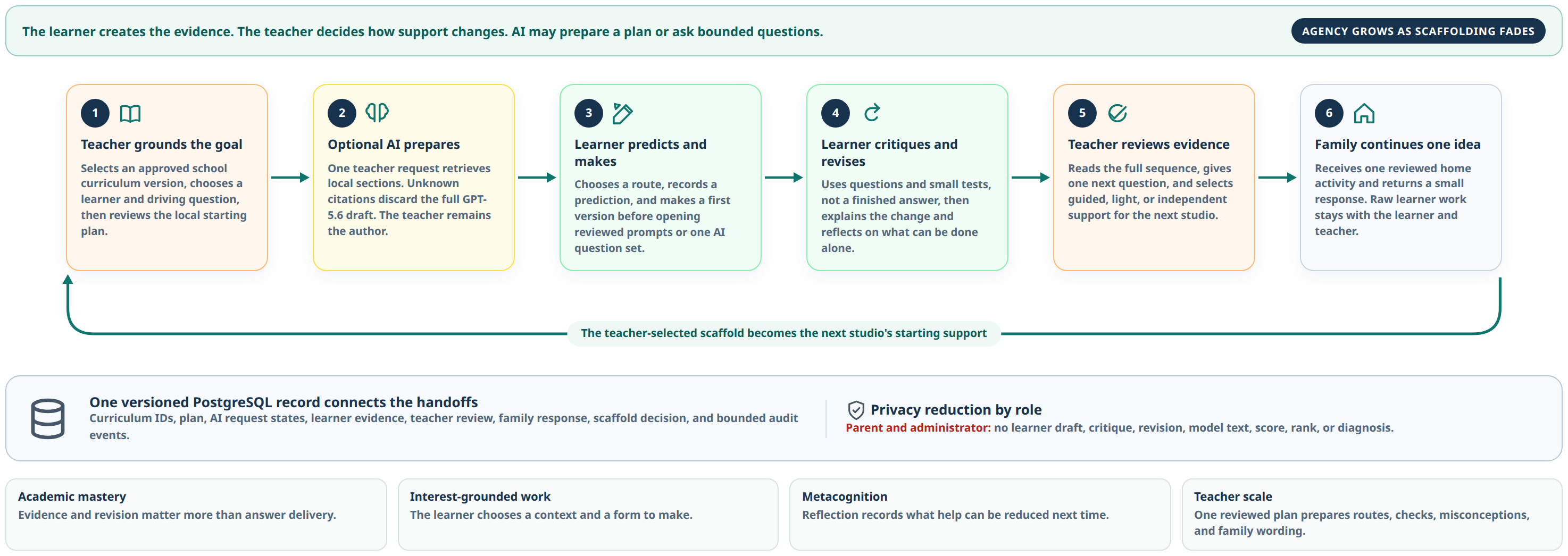
The connected learning loop
Administrator approves a versioned, permission-safe curriculum pack
    -> teacher selects the pack and defines the learning goal
    -> teacher reviews a local plan or requests one grounded GPT-5.6 draft
    -> learner predicts and makes before optionally requesting grounded thinking help
    -> learner critiques, revises, explains, and reflects
    -> teacher reviews the evidence and selects guided, light, or independent support
    -> parent receives one reviewed activity and responds
    -> the teacher's scaffold decision becomes the next studio's starting level
Every handoff checks the persisted stage and record version. Repeated or stale actions cannot skip a stage.
Why the AI is bounded
Kanni does not use a general student chatbot. It has two separate, explicit, and one-use provider calls per studio: a teacher planning draft and a student thinking coach after a first attempt.
When a teacher presses the AI planning button, Kanni:
- retrieves up to six sections from the curriculum pack stored for that studio;
- sends the goal, driving question, class, and retrieved sections to GPT-5.6;
- requires a strict Zod object with the complete teacher-plan structure;
- rejects the entire draft if any cited section ID was not retrieved;
- stores request status, token counts, latency, model, prompt version, and cost, but not the provider prompt or learner work;
- leaves publishing to the teacher.
When a student presses the thinking-coach button, Kanni:
- requires a first attempt of at least 60 characters;
- screens the attempt for personal data, high-risk text, and prompt injection;
- retrieves at most four relevant sections;
- sends only the goal, driving question, class, first attempt, and those sections;
- requires three or four question-and-action steps plus a self-check;
- rejects unknown citations, unsafe text, malformed output, and anything outside the strict object before the student sees it.
There is no automatic request, retry, provider fallback, web search, tool use, or model conversation history. Kanni never asks GPT-5.6 to produce a completed student answer. It does not add account names, family notes, passwords, membership records, or the learner's later critique, revision, explanation, and reflection.
The local plan remains usable when AI is off, rejected, over budget, or unavailable.
Clean Docker test build
The judge deployment starts with an empty PostgreSQL database. It does not create sample schools, hidden accounts, passwords, or learner records.
After the build-week-submission release tag is published:
docker compose -f compose.judge.yaml up -d --wait
Open http://localhost:3001. The first screen asks you to create the school and administrator. Use the administrator workspace to create the other three roles and connect the support circle. AI is off in this portable build, so it cannot spend provider credit.
Stop it with:
docker compose -f compose.judge.yaml down
Add -v only when you intentionally want to delete the local judge database and
repeat first-run setup.
No public hosting is required for this Education-category submission. The source repository and this Docker path give judges a complete local test route.
Local development
Requirements:
- Node 24, using the version in
.nvmrc - pnpm 11 through Corepack
- Docker with Compose
nvm install
nvm use
corepack enable
corepack pnpm install --frozen-lockfile
cp .env.example .env
docker compose up -d --wait db
corepack pnpm db:migrate:deploy
corepack pnpm dev
Open http://localhost:3000. Kanni redirects an empty installation to /setup.
There is no seed command. Create accounts through the administrator workspace.
Production-style Docker deployment
Create deployment-specific settings first:
cp .env.production.example .env.production
corepack pnpm env:production:check
./deploy.sh deploy
The production Compose stack builds separate migration and application targets,
runs migrations before the application starts, keeps PostgreSQL on an internal
network, drops container capabilities, uses read-only application filesystems,
and exposes the app on APP_HOST:APP_PORT. The post-build release check removes
local environment files and stale development cache from the standalone artifact;
Docker injects runtime configuration through Compose instead.
Useful commands:
./deploy.sh status
./deploy.sh logs app
./deploy.sh backup
./deploy.sh stop
Kanni does not configure TLS or an ingress rate limit. Put a TLS reverse proxy in front of any shared deployment and keep AI disabled until the external request and spend controls are in place. Complete first-run setup while the application is still bound to loopback, before making the reverse proxy public.
Optional OpenRouter configuration
Codex credits pay for work done in Codex. They cannot pay for OpenRouter or OpenAI API traffic. Runtime model calls need a separate OpenRouter balance.
Set these only after creating a provider key, a hard spend limit, and an ingress rate limit:
GROWTH_AI_PROVIDER=openrouter
GROWTH_AI_MODEL=openai/gpt-5.6-luna
OPENROUTER_API_KEY=your_provider_key
GROWTH_AI_ENABLED=true
GROWTH_AI_RATE_LIMIT_CONFIRMED=true
GROWTH_AI_SPEND_LIMIT_CONFIRMED=true
# Keep student AI off until the school has reviewed external student-data processing.
GROWTH_AI_STUDENT_HELP_ENABLED=false
GROWTH_AI_STUDENT_DATA_REVIEW_CONFIRMED=false
Allowed models are openai/gpt-5.6-luna and openai/gpt-5.6-sol. Luna is the
default for the bounded structured tasks. Each studio can claim one teacher plan
request. Student thinking-coach requests remain unavailable unless both separate
student flags are set to true after the school reviews provider data handling.
Each request also requires an adult to confirm that they are testing the feature
themselves or supervising the activity. The app sets store: false, excludes
providers that collect request data, disables provider fallback, and uses low
reasoning. Teacher output is capped at 3,200 tokens with a 40-second timeout;
student help is capped at 900 tokens with a 20-second timeout. Provider-reported
cost is recorded when available. Both allowed models are restricted to OpenRouter's OpenAI route because
that endpoint advertises every structured-output parameter used by Kanni. Current
GPT-5.6 endpoints return no route when Zero Data Retention is required, so Kanni
makes no ZDR claim. The request excludes account names, learner work, family notes,
and earlier model conversations. These technical controls do not replace the
school's legal and child-safety review before any real-student use.
Do not run the live evaluation casually. It makes one paid request and requires an explicit confirmation value:
RUN_LIVE_AI_EVALS=I_UNDERSTAND_THIS_SPENDS_OPENROUTER_CREDIT corepack pnpm eval:live
Prepare the saved recording flow
The video can use one complete, read-only learning flow instead of spending time typing on camera. Start the production Docker stack, keep the four existing role accounts and their teacher-parent mapping, then run:
KANNI_RECORDING_FLOW_CONFIRMATION=I_UNDERSTAND_THIS_CREATES_ONE_SYNTHETIC_RECORDING_FLOW \
  docker compose -f compose.recording.yaml --env-file .env.production run --rm --build prepare
On a successful run, this command makes exactly two paid requests through the
configured OpenRouter model: one teacher plan and one student thinking-coach
response. Both results must pass the same schemas, source checks, and safety checks
as the application before the database is changed. The command then creates
Rainwater Resilience Lab with
original Kanni curriculum and clearly synthetic learner work. On a repeat run, it
replaces only an earlier studio carrying Kanni's recording-flow audit tag. A normal
studio with the same title is left untouched. It does not reset accounts, mappings,
passwords, or other studios. The one-off container enables student AI only for this
fixed synthetic request; it does not change the production application's
student-AI settings.
The completed studio stores the returned model, prompt versions, source IDs, token counts, latency, and provider-reported cost. It contains the full handoff from administrator to teacher, learner, teacher review, and parent response, so each role can be recorded without creating content during the video.
The first recording run also exposed a useful failure case: a schema-valid Luna response padded seven text fields with malformed glyphs at their maximum lengths. Kanni now rejects replacement characters, unexpected writing systems, invisible format controls, and text that reaches a declared output boundary. The saved flow keeps the real grounded plan and student questions, while a no-egress review task applies seven documented wording corrections and records a human-review audit event. That correction task has no provider key and makes zero AI requests.
Verification
Start the local database, then run:
corepack pnpm lint
corepack pnpm typecheck
corepack pnpm typecheck:compat
corepack pnpm test
corepack pnpm eval
corepack pnpm build
corepack pnpm test:e2e
corepack pnpm audit --audit-level=moderate
The Playwright suite resets only the isolated kanni_test database. It applies
all migrations and creates the school, users, mappings, curriculum, studio,
submission, teacher review, and family response through the real interface. It
also checks role denial, generic login errors, English and Malayalam switching,
360-pixel layout, reduced motion, parent and administrator privacy, and serious
or critical Axe findings. AI is disabled in the browser suite.
The unit suite has 61 tests. The deterministic evaluation set has 51 cases covering curriculum rights, retrieval, invented citations, learner agency, scaffold fading, unsupported requests, prompt injection, personal data, safety routing, role privacy, and Malayalam-English input. Live model evaluation is separate so ordinary tests do not spend money.
Security and privacy boundaries
- bcrypt password hashes and opaque, hashed server sessions
- HttpOnly, SameSite cookies, with Secure cookies in production
- school, role, and relationship checks on every read and write
- login throttling keyed by HMAC hashes
- Zod validation at form, AI, and environment boundaries
- no raw prompt or learner-text logging
- no analytics in this release
- no grading, ranking, diagnosis, stream selection, or career recommendation
- reviewed static safety routing for high-risk English and Malayalam text
- no SCERT textbook copying, screenshots, diagrams, questions, or logos
Read SECURITY.md, Privacy, and Terms before using real school data. Kanni is an independent OpenAI Build Week project. It is not affiliated with or endorsed by SCERT Kerala or the Government of Kerala.
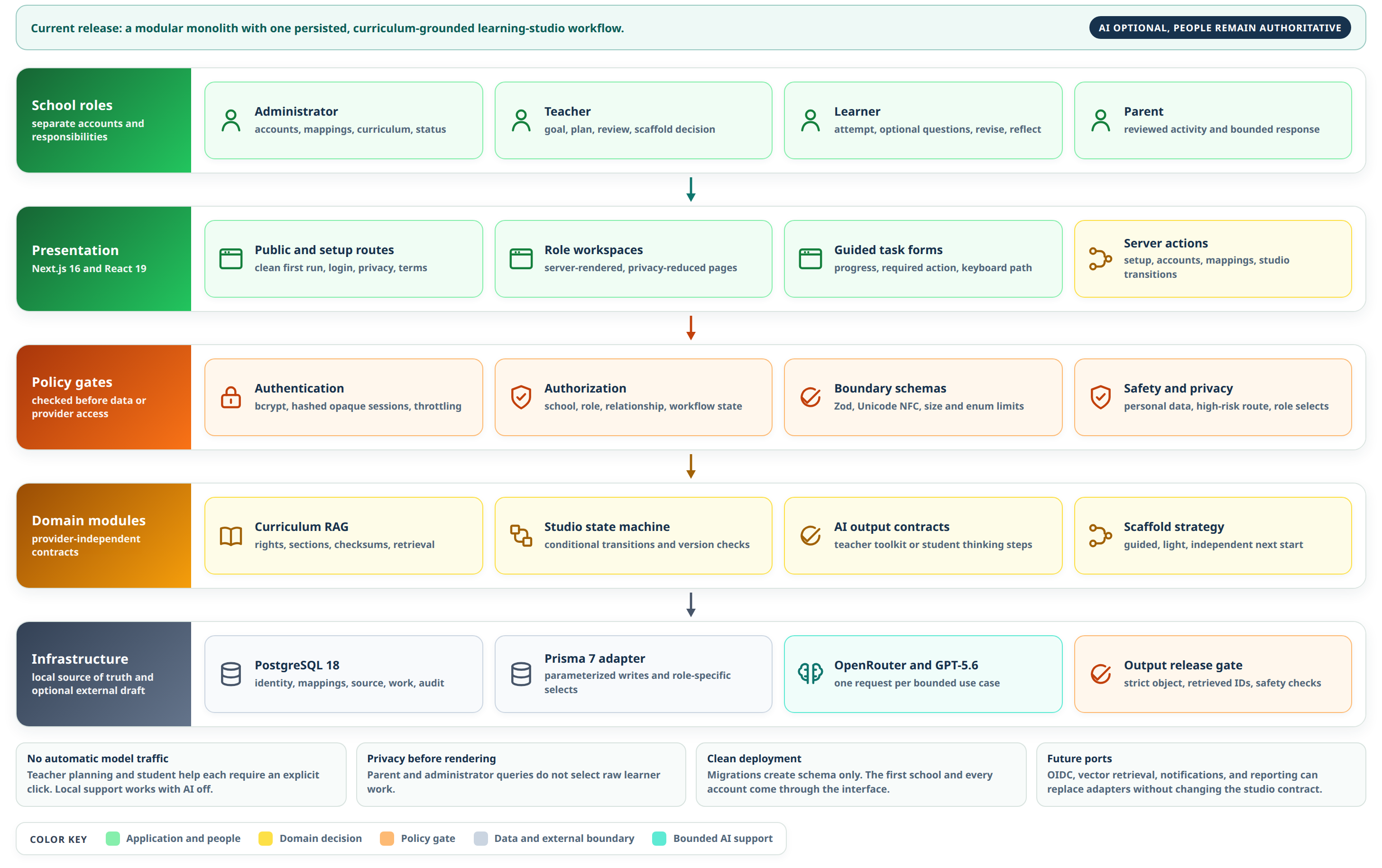
System structure
app/                      Next.js routes, server actions, and role workspaces
components/               accessible forms and learning-studio interfaces
lib/curriculum/           source rights, normalization, sections, retrieval, citations
lib/studio/               schemas, local plan, grounding, and workflow transitions
lib/ai/                   versioned prompt contexts, capability policy, and GPT-5.6 adapter
lib/safety/               personal-data, high-risk, and prompt-injection screens
prisma/                   schema and forward-only migrations
eval/                     deterministic cases and published results
tests/unit/               domain and boundary tests
tests/e2e/                clean-install four-role browser flow
docs/                     system design and rendered architecture diagrams
submission/               Devpost copy, video script, captions, and reviewer notes
PostgreSQL is the source of truth. React state is used only for form steps. AI is an optional adapter behind validated domain contracts, not the owner of workflow state.
How Codex contributed
This repository was built through one primary Codex thread. Codex helped inspect and replace an early static lesson prototype, define the learning-studio state machine, write the Prisma migration, implement clean setup and role mapping, create the RAG and AI validation boundaries, build each role workspace, and write the unit, evaluation, and browser suites.
Human decisions set the product direction and limits. In particular:
| Problem | Codex contribution | Human decision | Result |
|---|---|---|---|
| The first build felt like a static lesson | Traced hardcoded content and replaced the domain and screens | Make teachers the main lever and learner agency the outcome | A reusable curriculum-grounded studio |
| A generic tutor could answer for the learner | Added the first-attempt gate, bounded thinking-coach schema, and predict, make, critique, revise, explain, reflect contract | AI may ask and scaffold, but it may not complete student work | The student owns the evidence |
| School AI can hallucinate | Added local sections, retrieval, strict objects, and citation rejection | Discard unknown source IDs and require teacher review | Provider text cannot publish itself |
| Sample accounts made the deployment feel fake | Added transactional first-run setup and admin provisioning | Production must begin empty | No seed data or displayed credentials |
| Privacy differed by role | Added relation-scoped queries and E2E privacy assertions | Parents and administrators do not receive raw work | The handoff carries only what each role needs |
| A browser check exposed setup failure | Isolated a Prisma adapter error around an advisory lock | Keep the lock and fix the correct boundary | Clean setup works without weakening concurrency control |
GPT-5.6 is integrated as the optional teacher planning model through OpenRouter. Deterministic and browser verification do not call it. The final README and submission should report a live model result only after the explicit paid live evaluation has actually been run.
Current limits
- one school per installation
- Classes 6 to 9 in the current interface
- one assigned teacher and parent used for each studio handoff
- school-provided text sources, with deterministic section retrieval instead of a vector database
- no SSO, MFA, password recovery, account suspension interface, file upload, speech input, analytics, or notification service yet
- fixed Malayalam copy still needs a native-speaker release review
- real-child testing is outside the Build Week scope
These are release boundaries, not claims of statewide readiness or learning effectiveness.
Licenses
Code is MIT licensed in LICENSE. Original Kanni teaching prompts, planning templates, interface copy, safety cards, and evaluation cases are CC BY 4.0 under CONTENT-LICENSE.md. A school remains responsible for the rights and retention policy of any curriculum it enters.
Analysis
View
Metric
No commits on this project resolved to a GitHub account.
Technology
- CSSIn code
- HTMLIn code
- Next.jsIn code
- PostgreSQLIn code
- PythonIn code
- ReactIn code
- SQLIn code
- Tailwind CSSIn code
- TypeScriptIn code
- Vercel AI SDKIn code
- DockerClaimed
- Node.jsClaimed
- OpenAIClaimed
10 of 13 appear in the indexed code. 3 claimed on Devpost could not be matched to code, which may simply mean the tool leaves no trace in the repository.
AI coding agents
- CodexConfig
Detected from committed agent config files and commit authorship. Absence of a signal is not proof an agent was unused.
Codebase size
Source size
811 KB
Source files
117
Counts recognized source files only; vendored directories, binaries and lockfiles are excluded, so this is smaller than the repository on disk.
Repository
Arnol-P-S/kanni
154 files · 3.4 MB · @ 740a9b7
Structure
Interface
36 files · 23%Screens, components and styles rendered to the user.
+4 moreAPI & routing
1 file · 1%Request entry points: routes, handlers and controllers.
Application logic
27 files · 18%Domain rules, services and shared utilities.
+3 moreData & schema
9 files · 6%Schema definitions, migrations and data access.
Supporting
Layers are inferred from where files sit in the tree, not from reading the code. A project that names its directories unconventionally will read oddly here — open the file browser to check anything the diagram implies.
Languages
- TypeScript50%
- YAML29%
- Markdown9%
- CSS8%
- SQL3%
- HTML2%
- Other (2)0%
Share of indexed source by file size. Binary and vendored files are excluded.
Dependencies
package.json
npm · 35- @fontsource/noto-sans
- @fontsource/noto-sans-malayalam
- @openrouter/ai-sdk-provider
- @prisma/adapter-pg
- @prisma/client
- ai
- bcryptjs
- dotenv
- lucide-react
- next
- pg
- react
- react-dom
- server-only
- zod
- +20 more
Declared in the repository’s manifests at the indexed commit. A declared package is not proof it is used, and runtime dependencies are listed first.
This project’s features have not been analysed yet.
Export this project's context (description, README, evidence, key source files) to chat with an AI agent elsewhere.