Project Info
Inspiration
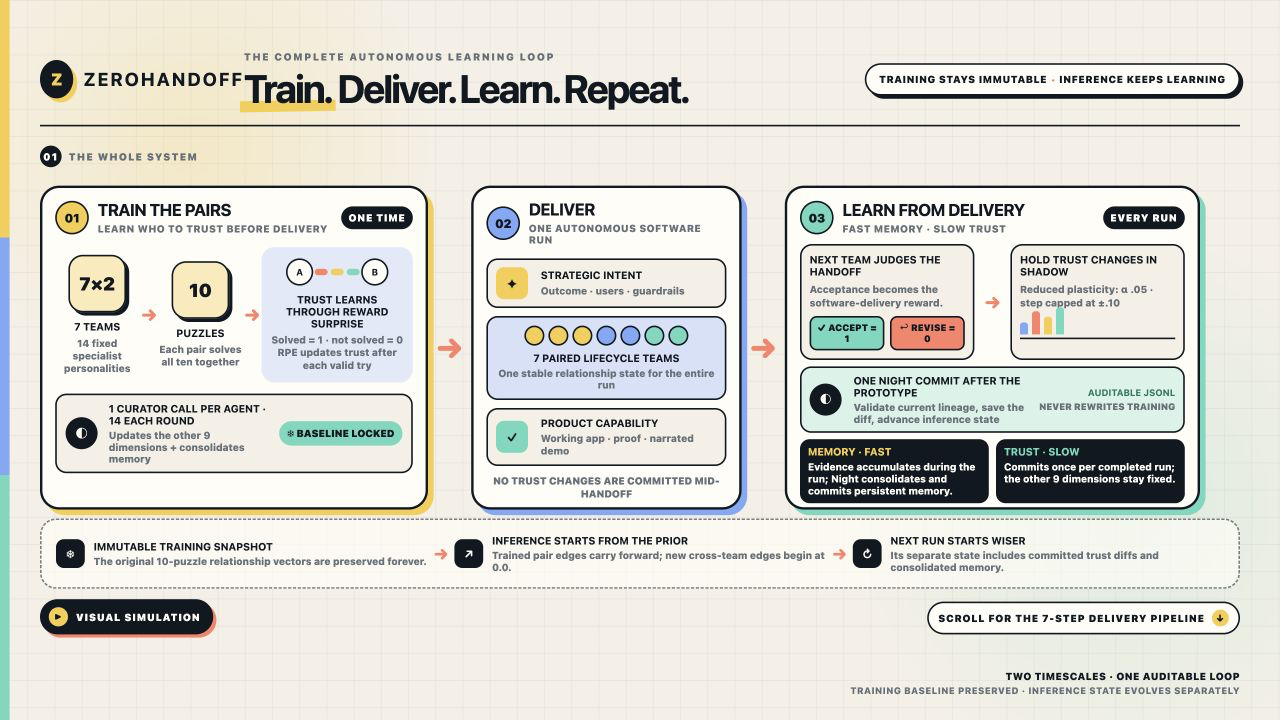
Humans learn who to trust through experience. We asked whether AI agents could do the same while turning one short product request into tested software, with no human handoffs. ZeroHandoff has 7 teams of 2 Agents each that work together to deliver enterprise products, teams are: SENSE → MODEL → COMPOSE → DECIDE → SIMULATE → EXECUTE → OBSERVE
What it does
ZeroHandoff gets a user idea for a product as input and gives back a working app + video demo as output, coordinates 14 GPT-5.6 Sol PRE-TRAINED agents in 7 two-agent teams. Pre-Training Before delivery, each team solves ten split-clue puzzles. Success or failure updates asymmetric trust (float value), while Curators maintain nine additional relationship dimensions and memory. Training completed 70 team episodes with 63 puzzles solved, producing an immutable relationship baseline. During delivery, trust helps resolve disagreements. Teams reward accepted handoffs with 1 and rejected handoffs with 0. Updates remain pending until the prototype finishes, when one Night Curator validates and commits reduced-plasticity trust and consolidated memory.
How we built it
Using Codex, we created typed artifact contracts, 14 agent configurations, isolated workspaces, schema-constrained GPT-5.6 Sol calls, deterministic quality gates, repair loops, artifact-lineage tracking, immutable training state, continual learning, JSON logs, browser verification, and checksummed delivery packages. The final experiment built EchoLedger, which turns customer-support calls into evidence-linked problems and assigned follow-up actions. The run completed all seven stages with 81 agent calls, 32 gates, 18 repairs, a 147-file delivery bundle, and an interactive demo. Challenges and lessons Our hardest problem was ensuring learning reflected what really happened. One failed handoff was initially lost during a resume. We preserved the invalid history, restored the last verified state, implemented atomic persistence, and reran it. EchoLedger’s final rewards—[1, 1, 1, 1, 0, 1]—retain that real rejection and repair. We learned that dependable multi-agent systems require more than roles and prompts. They need relationships, memory, contracts, lineage, repair, and evidence.
What's next
We plan to support more coding environments, test hundreds of enterprise handoffs, and expand governance and observability. The vision: one strategic intent enters, a trusted autonomous organization builds the product, and every decision remains inspectable.
ZeroHandoff — Autonomous Software Delivery
One short build request in. A working, tested application and narrated demo out.
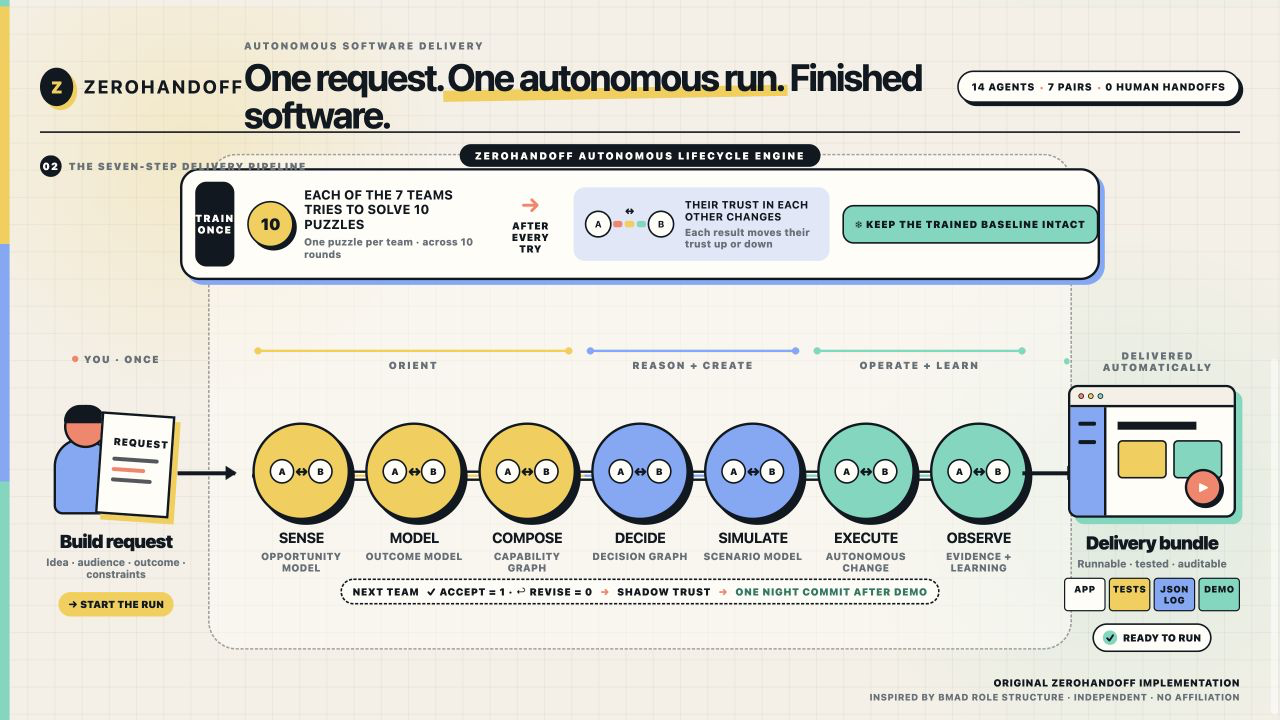
ZeroHandoff is an autonomous software-delivery pipeline for the OpenAI Build Week Developer Tools track. A person describes only what they want built, for whom, the desired outcome, and any constraints. Codex turns that request into a sequence of deliverables without human handoffs:
Build Request → Opportunity Model → Outcome Model → Capability Graph → Decision Graph → Scenario Model → Autonomous Change → Evidence + Learning → Demo
Seven two-agent lifecycle cells—SENSE, MODEL, COMPOSE, DECIDE, SIMULATE, EXECUTE, and OBSERVE—own those seven stages, respectively. Each pair forms independent judgments and passes one versioned artifact forward. These compact artifacts are designed for agent-to-agent execution instead of long-form specifications, planning ceremonies, or human handoff documents. Codex preserves project memory, enforces quality gates, and routes failed contract checks through bounded repair loops.
Every run produces an auditable delivery bundle:
- a runnable application with source and setup instructions;
- automated tests and quality-gate evidence;
- append-only JSON logs covering timestamps, runtime and model configuration, the immutable training baseline, run-start inference state, handoff rewards, shadow deltas, night commit, decisions, gates, repairs, artifacts, and the final outcome; and
- a generated narrated video demo.
Setup and running
Supported platforms. The full ZeroHandoff engine supports macOS and Linux with Python 3.11+, Node.js 22+, npm, Chrome/Chromium, FFmpeg, and Codex CLI 0.144.0+ authenticated with GPT-5.6 Sol access. The prebuilt EchoLedger sandbox works on any desktop with a modern browser and a local static-file server.
Fastest judge test — no install or rebuild
The repository includes the production build from the final autonomous run:
python3 -m http.server 8000 --directory submission/sandbox/echoledger/dist
Open http://127.0.0.1:8000. EchoLedger requires no account, backend, API key,
network service, or rebuild. Select Complaint · 02:31, redact evidence
EV-015, inspect the recurring signal, assign its action, export the local case
brief, and reset the fictional experience.
Install the complete engine
python3 -m venv .venv
.venv/bin/pip install -e '.[dev]'
cd ui
npm ci
npm run build
cd ..
.venv/bin/python -m zerohandoff.cli --repo . doctor --live
Run without model calls
This deterministic path exercises training, orchestration, gates, repair, artifact handoffs, demo assembly, and bundling without spending model credits:
.venv/bin/python -m pytest -q
.venv/bin/python -m zerohandoff.cli --repo . puzzles validate
.venv/bin/python -m zerohandoff.cli --repo . train --adapter fixture --rounds 10
.venv/bin/python -m zerohandoff.cli --repo . run \
  --request tests/fixtures/build_request.json --adapter fixture
Run the real Codex pipeline
The checked-in trained baseline means judges do not need to retrain. From the cloned repository root, activate the installed environment and launch Codex:
source .venv/bin/activate
codex
Then, inside the Codex chat, enter:
$run-pipeline
Build a local React application for [audience] that [desired outcome].
Constraints: [non-negotiable boundaries].
Do not run the internal Python delivery command manually. The $run-pipeline
skill collects one Build Request, validates the frozen baseline and current
inference lineage, then invokes the engine and runs all seven stages, demo
generation, and bundling with GPT-5.6 Sol. Use $pipeline-status inside Codex
to inspect progress. To observe delivery in the local Control Room, open a
second terminal from the repository and run:
.venv/bin/python -m zerohandoff.cli --repo . serve --port 8765
Then open http://127.0.0.1:8765.
Sample data, outputs, and verification
tests/fixtures/build_request.jsonis the agent-free sample request.data/puzzles.jsonlanddata/puzzle_stats.jsonare the deterministic ten-puzzle training corpus and validation summary..zerohandoff/frozen/latest.jsonis the checked-in immutable relationship baseline; real delivery starts from it rather than retraining.submission/sandbox/echoledger/src/domain.tsandsubmission/sandbox/echoledger/public/audio/echoledger-el1042.wavcontain EchoLedger's entirely fictional local transcript/domain fixtures and synthetic recording. No real customer information is included.- Each run is written to
.zerohandoff/runs/<run_id>/, including versioned artifacts,logs/*.jsonl, the runnable app, narrated demo, checksums, anddelivery_bundle.nosync/. Versioned continual-learning commits are under.zerohandoff/learning/commits/.
Verify the tracked judge package, training/run completion, trust invariants, checksums, sandbox, and media streams with:
python3 scripts/submission_package.py verify
More internal commands and recovery behavior are in the judge guide and runbook.
Trust training supports the pipeline; it is not the product itself. Before delivery, a separate ten-round, solver-validated puzzle pilot trains asymmetric directed trust through reward prediction error and one single-prompt Night Curator call per agent after each round. The resulting ten-dimensional vectors form an immutable trained baseline for software-delivery inference: trust alone selects authority, while a deterministic policy compiler turns up to three strong non-trust dimensions into qualitative collaboration guidance without exposing raw scores. See the visual explainer or the source specification for the full design.
Inference copies that baseline into a separate evolving state. Trained pair
edges begin at their learned values; new cross-team edges begin at 0.0.
Each next team gives a binary handoff reward—accept 1, request revision 0—but
trust stays stable during the run. One extra-high-reasoning Night Curator then
commits reduced-plasticity trust (α=0.05, step cap ±0.1) and consolidated
memory once the prototype completes. The nine non-trust dimensions and the
original training JSON remain unchanged forever.
Codex was both the build environment and the hackathon reference runtime. It
accelerated the typed contracts, orchestration engine, agent configurations,
gates, repair/resume logic, browser proof, demos, and regression suite; GPT-5.6
Sol powers the fourteen specialists and Curators. The human chose the learning
rules, immutable-training/evolving-inference boundary, seven agent-native
artifacts, reduced-plasticity continual learning, zero post-authorization human
handoffs, and Codex-only hackathon scope. The deeper build story and ready-to-use
submission copy are in submission/.
Use $run-pipeline, $pipeline-status, and $train-trust from Codex chat.
Internal commands and the Control Room are documented in the runbook.
ZeroHandoff is an independent original implementation conceptually inspired by the BMad Method. It does not copy or redistribute BMad source, prompts, agent definitions, names, or branded assets, and is not affiliated with or endorsed by BMad Code, LLC.
Explore: visual pipeline · system design · execution plan · trust architecture · judge guide · submission package · project idea · tracked constraints · MIT license
Analysis
View
Metric
No commits on this project resolved to a GitHub account.
Technology
- CSSIn code
- FastAPIIn code
- HTMLIn code
- PythonIn code
- ReactIn code
- TypeScriptIn code
- Node.jsClaimed
6 of 7 appear in the indexed code. 1 claimed on Devpost could not be matched to code, which may simply mean the tool leaves no trace in the repository.
AI coding agents
- CodexConfig
Detected from committed agent config files and commit authorship. Absence of a signal is not proof an agent was unused.
Codebase size
Source size
1006 KB
Source files
90
Counts recognized source files only; vendored directories, binaries and lockfiles are excluded, so this is smaller than the repository on disk.
Repository
diegocp01/enterprise_build
215 files · 18.2 MB · @ adf8238
Structure
Interface
12 files · 6%Screens, components and styles rendered to the user.
Application logic
120 files · 56%Domain rules, services and shared utilities.
+10 moreData & schema
18 files · 8%Schema definitions, migrations and data access.
Supporting
Layers are inferred from where files sit in the tree, not from reading the code. A project that names its directories unconventionally will read oddly here — open the file browser to check anything the diagram implies.
Languages
- Python59%
- Markdown16%
- HTML15%
- TypeScript6%
- CSS3%
- Shell0%
- Other (1)0%
Share of indexed source by file size. Binary and vendored files are excluded.
Dependencies
pyproject.toml
pypi · 8- fastapi
- jsonschema
- Pillow
- pydantic
- uvicorn
- +3 more
submission/sandbox/echoledger/package.json
npm · 7- react
- react-dom
- +5 more
ui/package.json
npm · 7- @vitejs/plugin-react
- react
- react-dom
- vite
- +3 more
Declared in the repository’s manifests at the indexed commit. A declared package is not proof it is used, and runtime dependencies are listed first.
This project’s features have not been analysed yet.
Export this project's context (description, README, evidence, key source files) to chat with an AI agent elsewhere.