Project Info
Inspiration
There are more learning resources than ever, but one question is still difficult to answer: "What should I learn next?" Most AI tools and online courses can answer questions or recommend content, but they rarely provide a learning plan that evolves with you. As goals, skills, or available study time change, those plans quickly become outdated. We wanted to build something different—an AI coach that stays with the learner throughout the journey instead of generating a one-time roadmap. That idea became PathPilot AI.
What it does
PathPilot AI turns a career goal into a personalized learning roadmap. Instead of creating a single static plan, it uses a multi-agent workflow: Planner creates the initial roadmap. Critic reviews the roadmap for quality and feasibility. Revision improves the roadmap based on the feedback. As learners make progress or update their goals, PathPilot adjusts the roadmap while keeping completed work. Every recommendation also includes an explanation so users understand why the AI suggests each step. Other features include: Explain Why Adaptive Replanning Strategy Comparison Journey Dashboard Trusted Resources PDF Export Shareable Roadmaps
How we built it
PathPilot AI was built with: OpenAI Responses API GPT-5.6 React + Vite ASP.NET Core (.NET 8) Azure Vercel Remotion GPT-5.6 powers the multi-agent workflow. It generates personalized learning plans, critiques and improves them, explains recommendations, compares learning strategies, and adapts roadmaps as learners make progress. Codex played a major role during development. It helped us implement features faster, debug React and ASP.NET Core code, refine the Remotion video pipeline, fix recording alignment and subtitle positioning, and iterate quickly on the final demo.
Challenges we ran into
One of the biggest challenges was keeping learning plans both personalized and consistent. When users change their goals or available study time, the roadmap should adapt without making them start over. Finding the right prompting strategy to preserve previous progress while generating coherent updates took many iterations. Creating the demo was another challenge. Besides building the application itself, we spent considerable time producing a polished presentation with synchronized narration, subtitles, screen recordings, and interactive highlights using Remotion.
What we learned
This project reminded us that building an AI product is about much more than choosing the right model. Good user experience comes from combining strong prompting, thoughtful workflow design, and clear explanations that help users trust AI recommendations. We also learned how much faster development becomes when using Codex for implementation and debugging, allowing us to spend more time improving the product instead of fighting small technical issues.
What's next
We see PathPilot AI as more than a roadmap generator. Our goal is to turn it into a long-term AI learning companion. Next, we plan to explore: Long-term learner memory Calendar and task integration Progress analytics Community learning Mobile applications Deployments for universities and organizations We believe AI should do more than answer questions—it should help people continue learning with confidence over time.
PathPilot AI
An adaptive AI learning coach that plans, critiques, explains, tracks, and replans personalized learning journeys.
Plan with rigor. Learn with context. Adapt without losing progress.
PathPilot AI turns a learner's goal, experience, schedule, and preferences into a critic-audited learning journey. It combines GPT-5.6 workflows with deterministic local systems for progress, strategy comparison, achievements, trusted resources, PDF export, and privacy-conscious sharing.
The problem
Learning advice is often generic, static, and disconnected from execution. Course lists rarely adapt when available time changes, completed work is forgotten, and learners are left without an explanation of why a skill or project matters. Even a strong initial roadmap can become outdated as circumstances change.
The solution
PathPilot behaves like an adaptive learning coach rather than a one-time roadmap generator. It:
- builds a personalized, phased plan;
- audits feasibility, workload, prerequisites, timeline, and project difficulty;
- revises weak plans before presenting them;
- preserves completed work during strategy changes and replanning;
- explains individual skills, milestones, and recommended projects;
- adapts remaining work when learner constraints change; and
- connects planning to persistent progress, achievements, and next actions.
Product Tour
Start with the learner’s goal
PathPilot introduces the product as an adaptive AI learning coach: it plans a path, challenges the draft, and delivers a refined roadmap instead of a generic list of links.
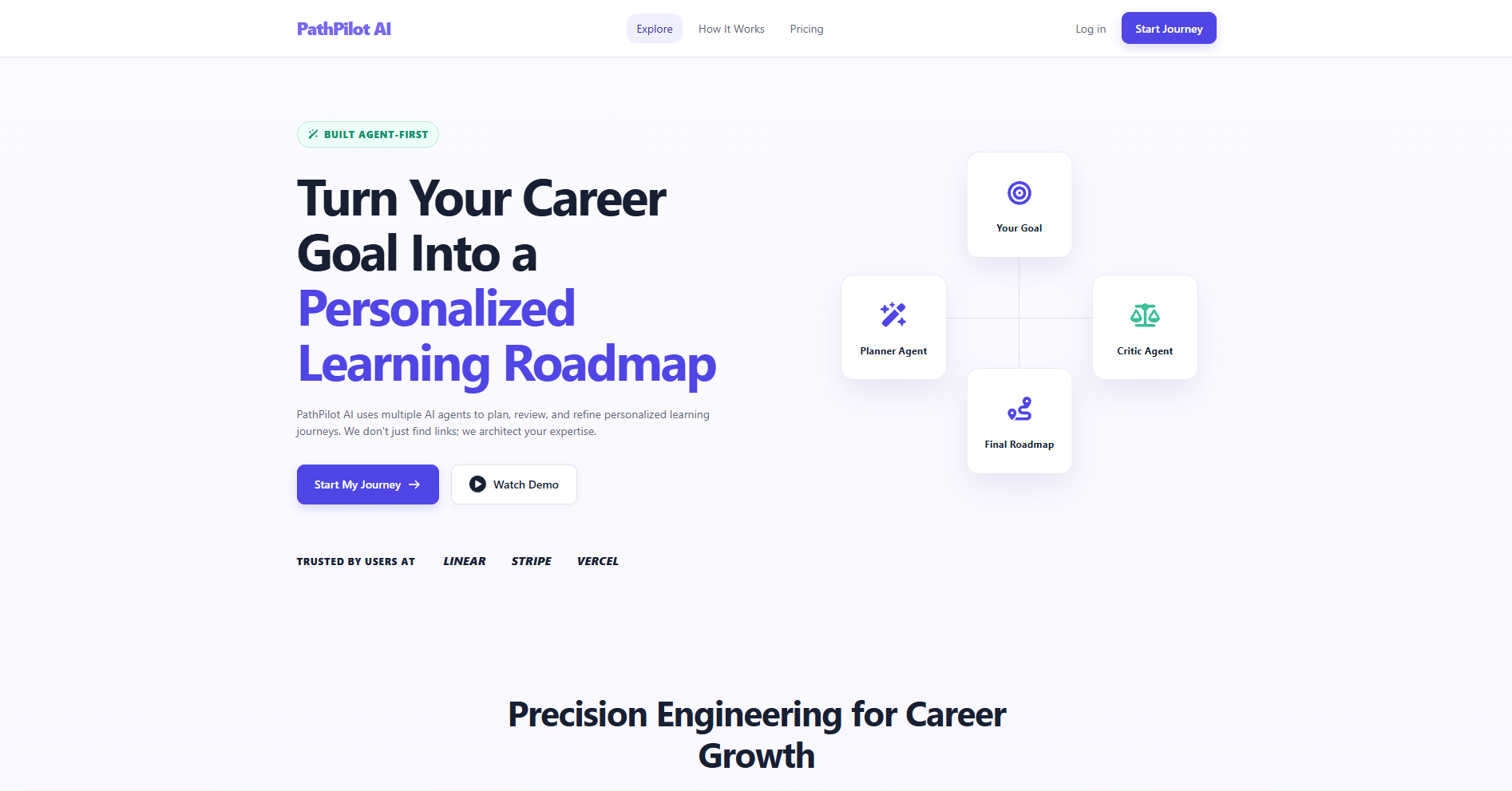
When a valid saved journey exists in the current browser, the Landing page shows its goal, selected strategy, and last-updated date with a Continue Journey action. Creating another journey remains available, but PathPilot asks for confirmation before replacing the saved roadmap.
Create a personalized journey
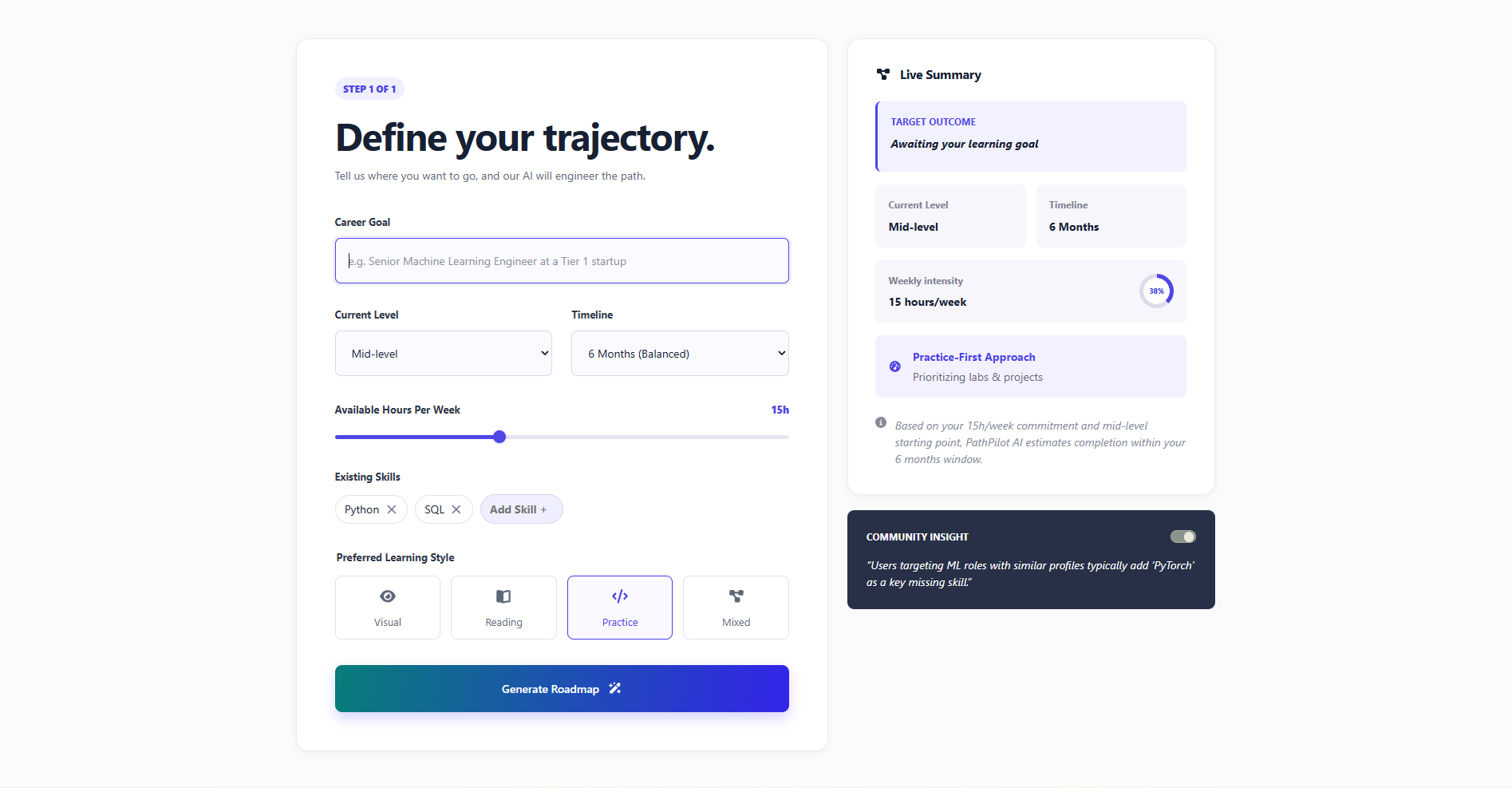
The learner defines a goal, starting level, timeline, weekly availability, existing skills, and preferred learning style. A live summary makes the constraints clear before generation begins.
Planner → Critic → Revision
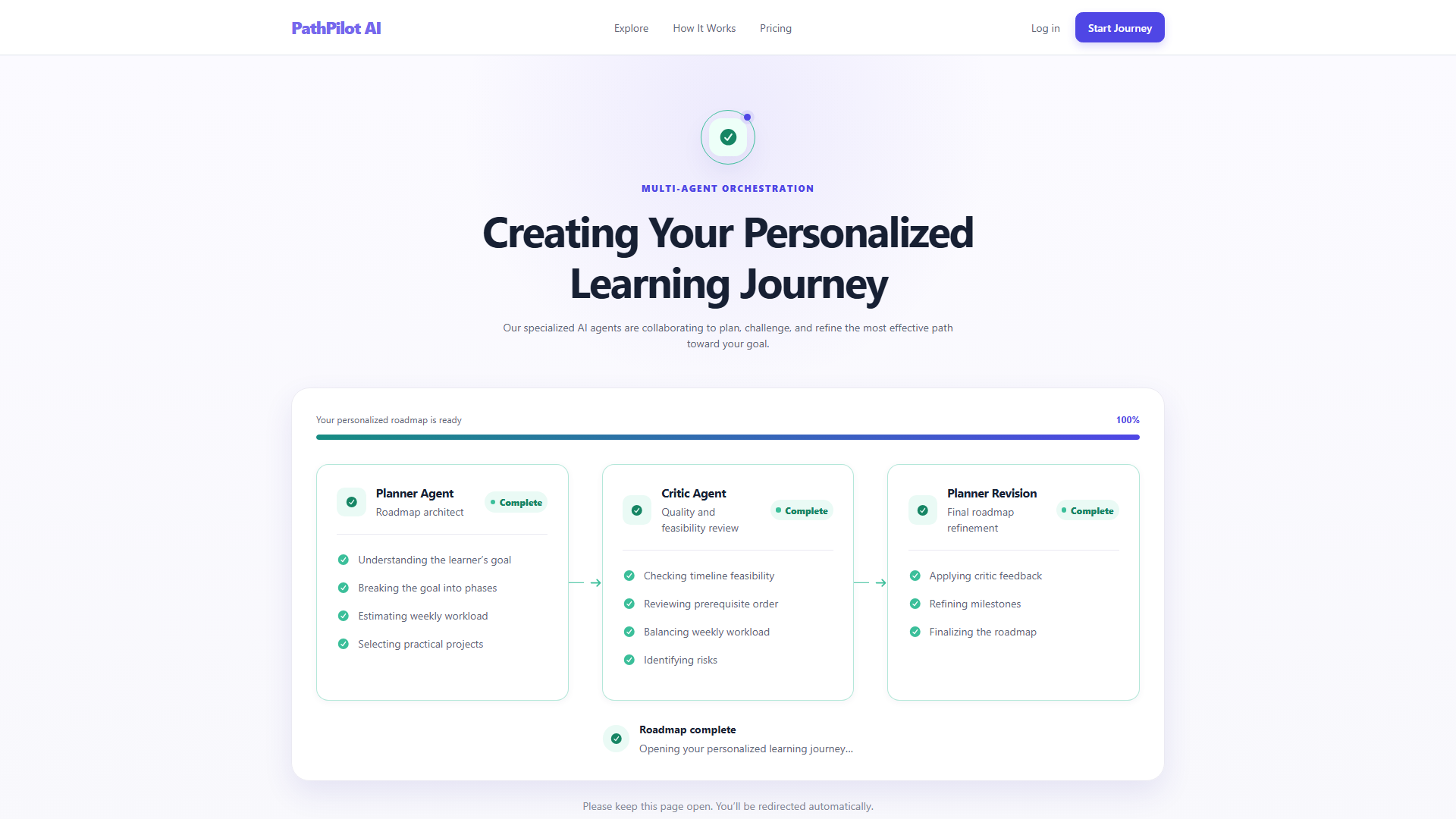
Initial generation is an explicit sequential workflow: Planner drafts, Critic audits feasibility and prerequisite order, and Revision returns the validated final plan. The Processing page is driven by flushed Server-Sent Events for each real stage start and validated completion; it does not mark stages complete with timers. These are orchestrated request stages, not autonomous background agents.
Roadmap overview, AI Coach, and learner progress
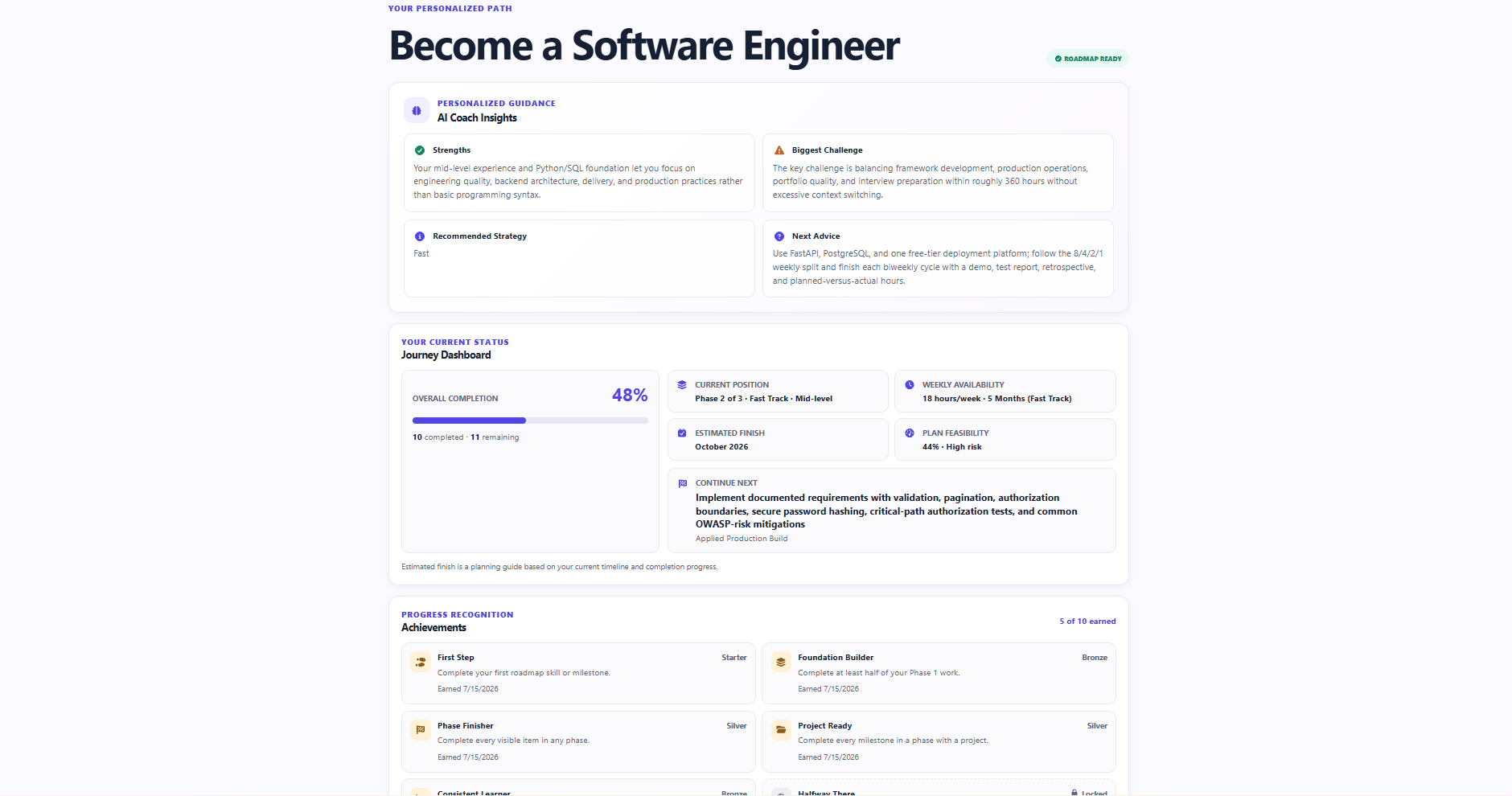
The hero preview above brings the core experience together: personalized AI Coach Insights, current progress, next action, estimated finish, feasibility, and earned achievements. It turns the generated plan into a journey the learner can continue over time.
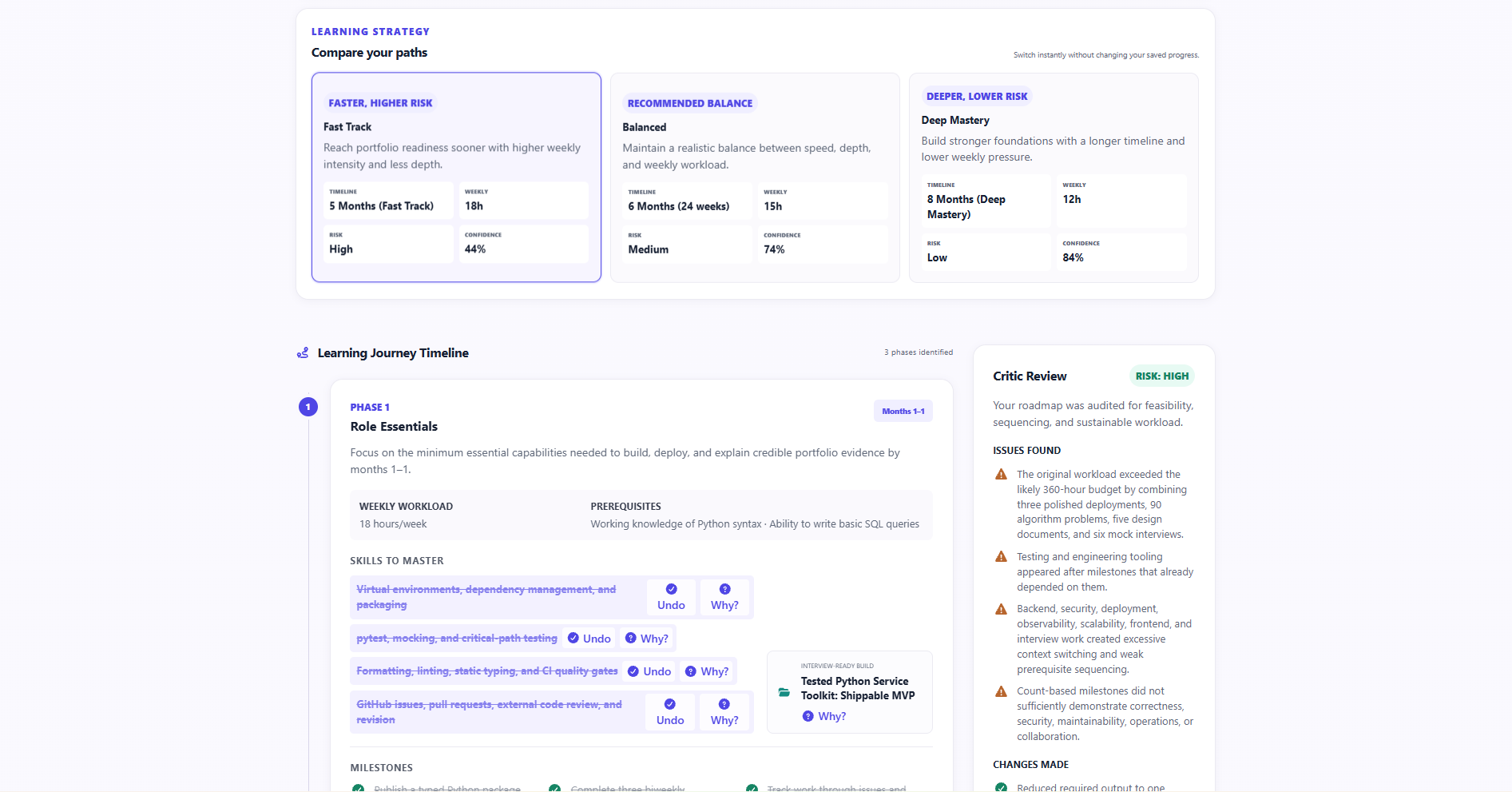
Compare Fast, Balanced, and Deep strategies
Learners can compare meaningful trade-offs in speed, workload, depth, risk, confidence, phase content, and project scope. Switching is deterministic and preserves completed-item credit.
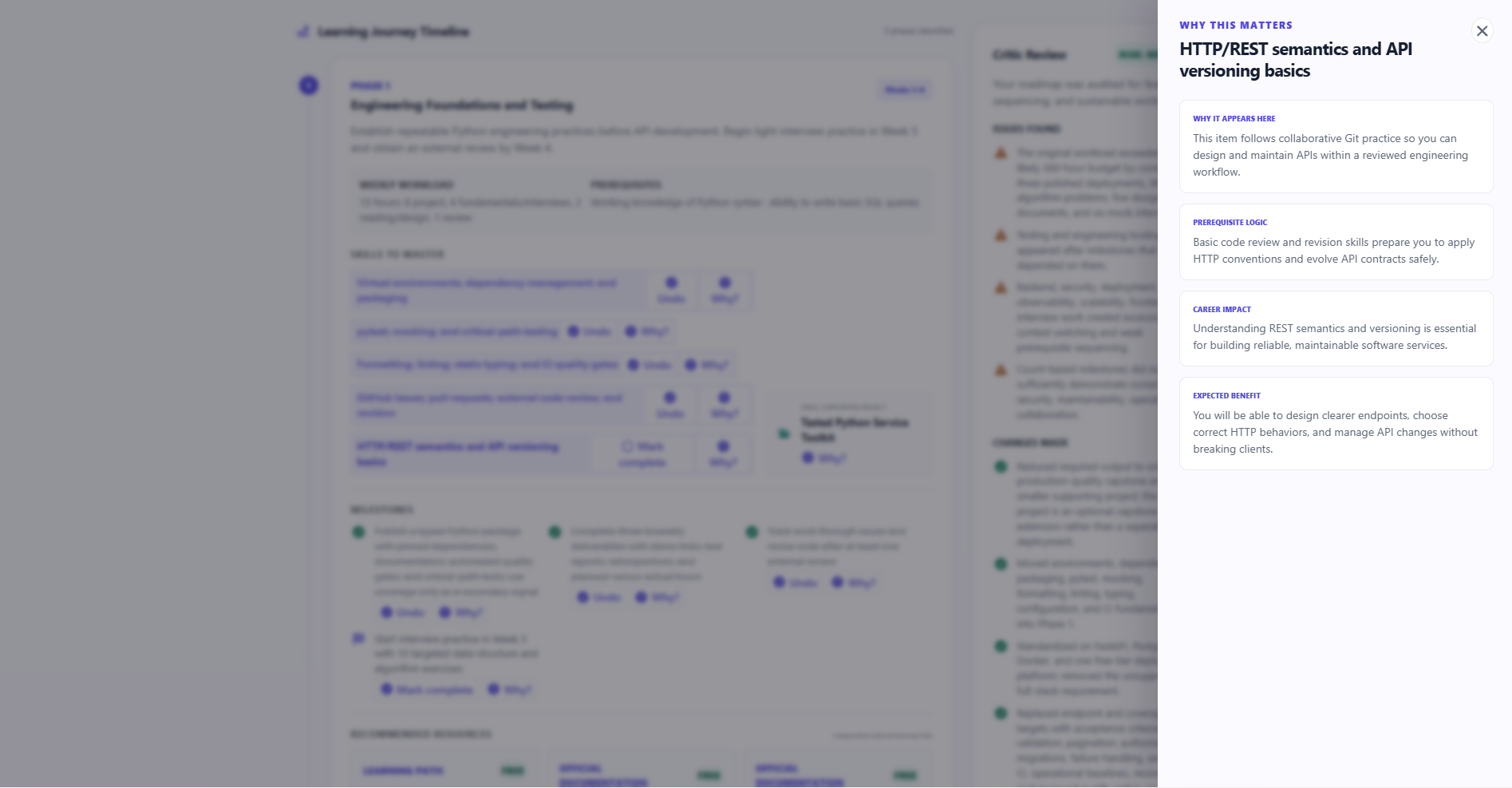
Understand why each item matters
Explain Why gives contextual reasoning for a selected roadmap item, including its prerequisite role, career impact, and expected benefit, while keeping the roadmap visible.
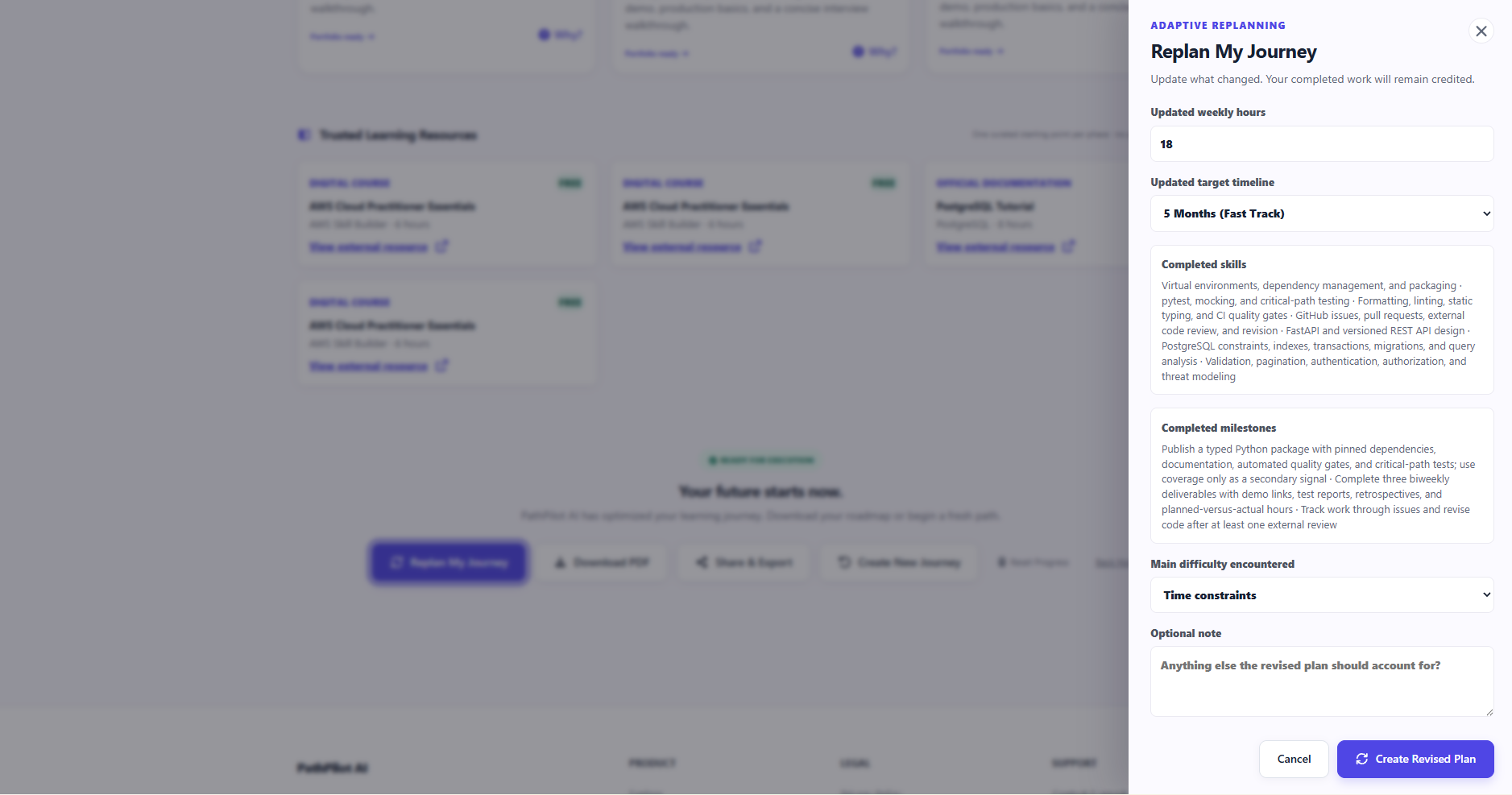
Adapt without losing completed work
The replan panel captures changed time constraints and learner difficulty while making completed skills and milestones explicit. Completed work remains immutable; only unfinished work is eligible for revision.
The saved replan result clearly summarizes what changed, why it changed, and the updated workload, timeline, risk, and confidence without resetting progress or strategy selection.
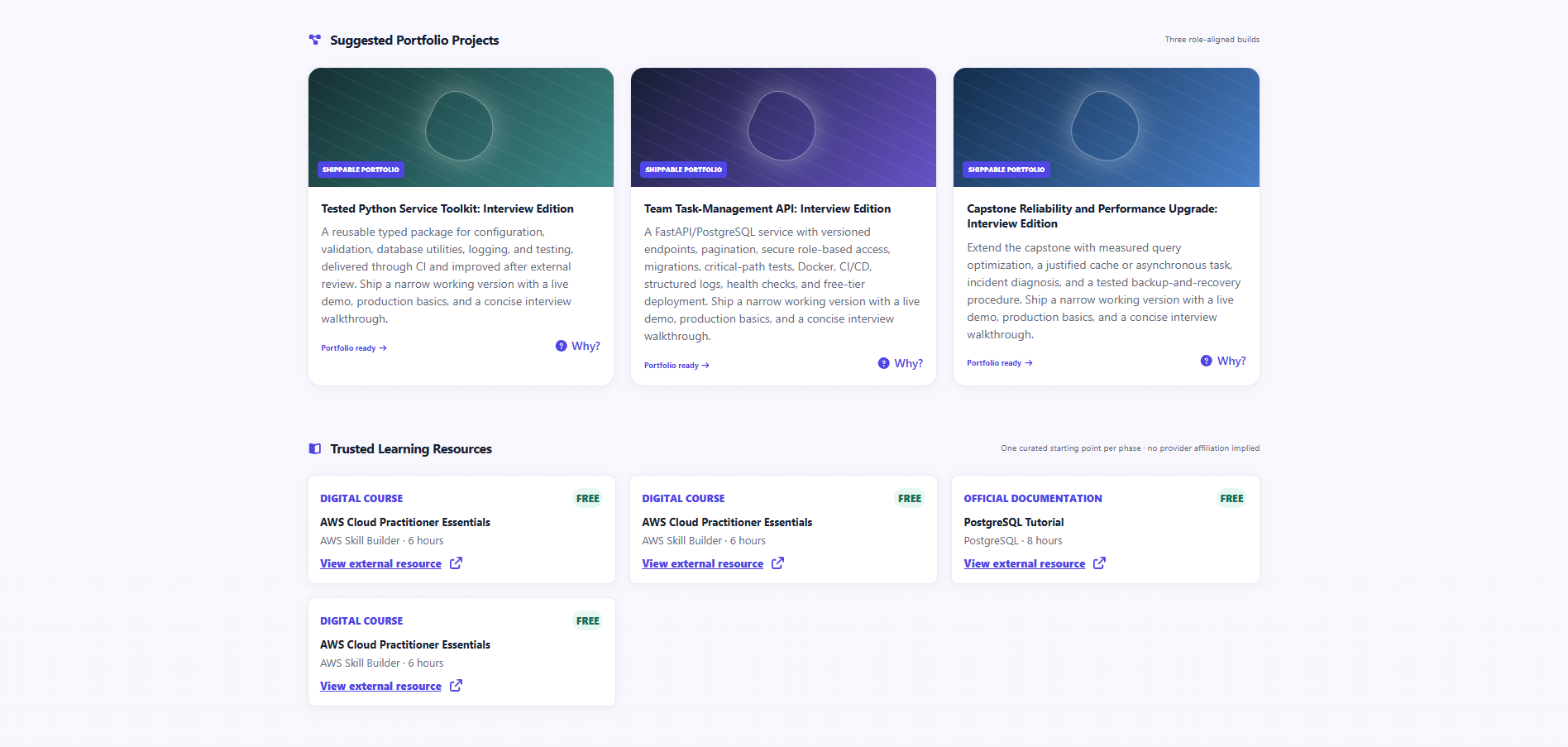
Learn with trusted resources
Each phase is grounded in a deterministic catalog of reputable providers. Recommendations explain their skill match and strategy fit rather than relying on generated or invented links.
Export a professional roadmap
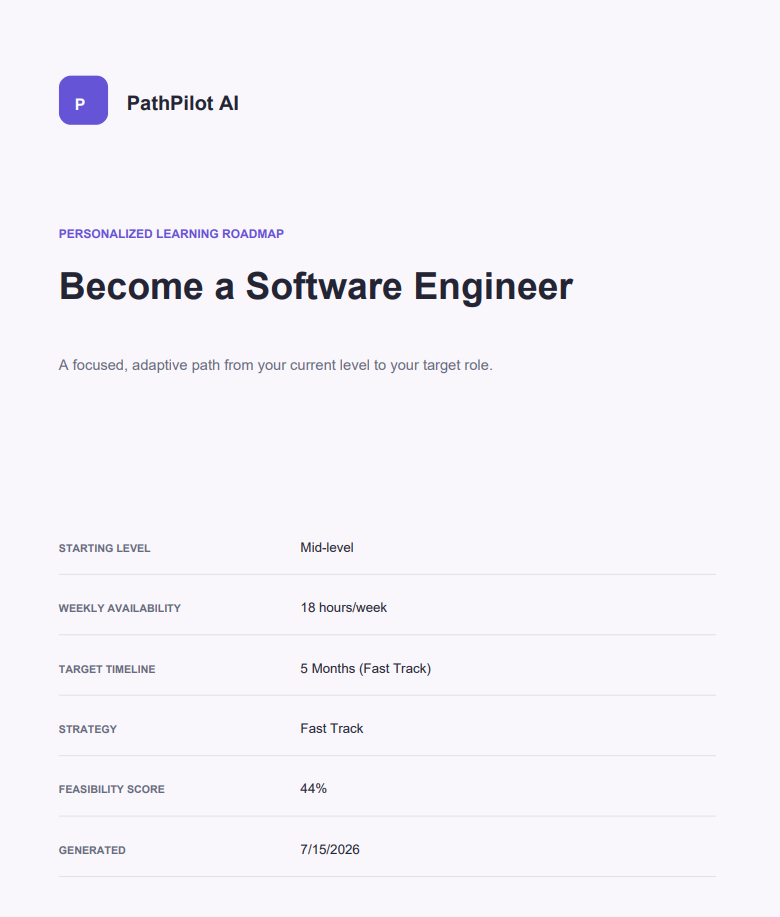
PathPilot generates a structured multi-page PDF containing the coach summary, progress, phases, projects, and recommended resources—not a screenshot of the webpage.
Share honestly and privately
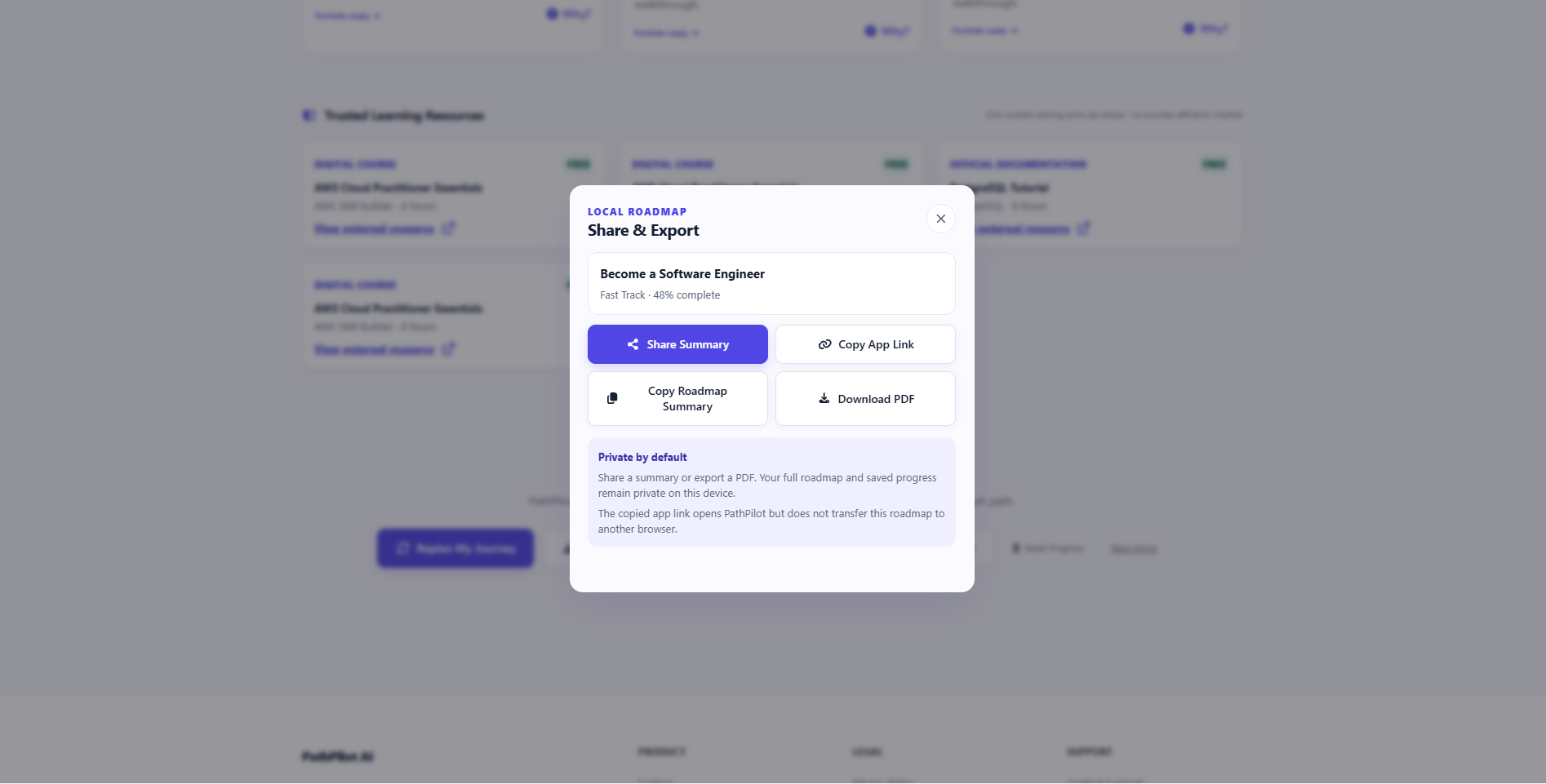
Share & Export supports a concise summary, safe app link, copied roadmap summary, and PDF download. The UI makes clear that the full roadmap and saved progress remain local to the current browser.
Responsive on mobile
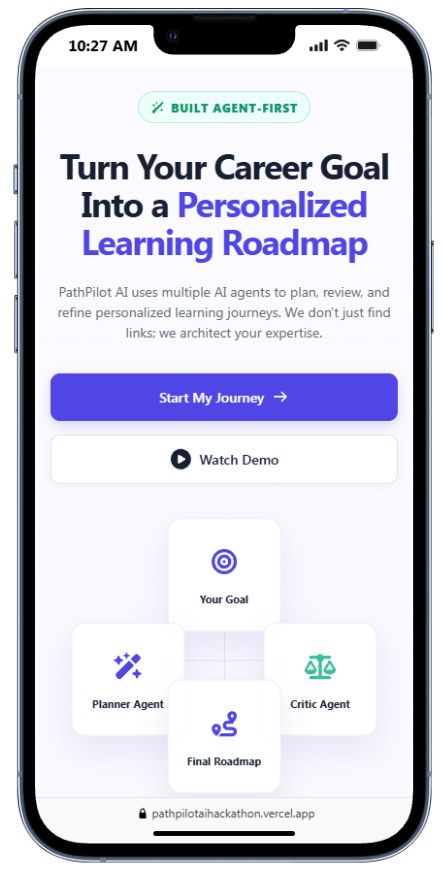
The same product story and staged AI workflow remain readable on a narrow mobile layout, with touch-friendly actions and no dependency on a desktop-only experience.
Core user flow
flowchart LR
    A["Profile"] --> B["Planner"] --> C["Critic"] --> D["Revision"]
    D --> E["Personalized Roadmap"] --> F["Track Progress"]
    F --> G["Explain Why"] --> H["Adaptive Replanning"]
    H --> E
Key features
- GPT-5.6 Planner → Critic → Revision workflow using the OpenAI Responses API
- Strict Structured Outputs validated against the existing roadmap schema
- Personalized AI Coach Insights generated with the roadmap
- Alternative Roadmaps: Fast Track, Balanced, and Deep Mastery
- Adaptive Replanning that revises unfinished work while preserving completed items
- Explain Why for skills, milestones, phase projects, and suggested portfolio projects
- Learner Memory and browser-persistent local progress
- Continue Journey with validated direct-route and browser-restart restoration
- Progress Tracking with reversible skill and milestone completion
- Journey Dashboard with current status, estimated finish, and next action
- Achievement Badges derived deterministically from meaningful progress
- Trusted Resource Recommendations from a curated local catalog
- Professional PDF Export built as a document rather than a page screenshot
- Share & Export: Share Summary, Copy App Link, Copy Roadmap Summary, and Download PDF
- Responsive, accessible UI with keyboard support, focus management, status announcements, and reduced-motion handling
Share & Export does not create a cloud-hosted public roadmap. The app link opens PathPilot, while the full roadmap and saved progress remain local to the current browser.
What makes PathPilot different
- The roadmap is critic-audited before delivery, rather than returned as an unchecked first response.
- Adaptive Replanning responds to changed time constraints without rerunning the full initial workflow.
- Completed items are immutable during replan validation and remain credited across strategy variants.
- Recommendations can be explained in their local roadmap context.
- Learners can compare explicit speed, depth, workload, risk, and confidence trade-offs.
- Resource suggestions come from a deterministic catalog of trusted providers rather than invented links.
- Progress, next actions, and achievements turn a generated plan into a persistent journey.
- AI is used where judgment adds value; predictable local features remain deterministic and cost-free.
Architecture
flowchart TB
    User["Learner"] --> Frontend["React + Vite frontend<br/>Vercel"]
    Frontend --> API["ASP.NET Core .NET 8 API<br/>Azure App Service"]
    API --> Controller["RoadmapsController"]

    subgraph AI["AI-backed workflows"]
        Controller --> Planner["Planner stage"]
        Planner --> Critic["Critic stage"]
        Critic --> Revision["Revision stage"]
        Controller --> Replan["Adaptive Replan service"]
        Controller --> Explain["Explain Why service"]
        Planner --> Responses["GPT-5.6 Responses API"]
        Critic --> Responses
        Revision --> Responses
        Replan --> Responses
        Explain --> Responses
    end

    subgraph Local["Deterministic browser systems"]
        Memory["Learner memory + progress<br/>localStorage"]
        Achievements["Achievement storage<br/>localStorage"]
        Strategy["Canonical roadmap + strategy state<br/>localStorage"]
        Explanations["Explanation cache<br/>localStorage"]
        Resources["Trusted resource catalog + matcher"]
        PDF["jsPDF export service"]
        Share["Share & Export service"]
        Session["Transient generation + route handoff<br/>sessionStorage"]
    end

    Frontend <--> Memory
    Frontend <--> Achievements
    Frontend <--> Strategy
    Frontend <--> Explanations
    Frontend --> Resources
    Frontend --> PDF
    Frontend --> Share
    Frontend <--> Session
Initial roadmap generation, Adaptive Replanning, and Explain Why are AI-backed. Progress, achievements, strategy derivation, resource matching, PDF export, and Share & Export are deterministic browser features and do not call OpenAI.
The canonical roadmap, selected strategy, strategy-specific replan overrides, learner progress, achievements, and explanation cache are restored from validated localStorage records. sessionStorage remains in use only for transient generation-attempt and reset markers plus the immediate route-state handoff; it is not the source of browser-restart persistence.
Multi-agent roadmap workflow
The agents are explicit sequential stages inside one request workflow; they are not autonomous background workers.
sequenceDiagram
    actor User
    participant Frontend as React Frontend
    participant API as ASP.NET Core API
    participant Planner
    participant Critic
    participant Revision
    participant OpenAI as OpenAI Responses API

    User->>Frontend: Submit learner profile
    Frontend->>API: POST /api/roadmaps/generate/stream
    API-->>Frontend: planner_started (SSE)
    API->>Planner: Create compact draft
    Planner->>OpenAI: Structured Planner request
    OpenAI-->>Planner: Draft roadmap JSON
    Planner->>API: Validate Planner output
    API-->>Frontend: planner_completed (SSE)
    API-->>Frontend: critic_started (SSE)
    API->>Critic: Review draft feasibility
    Critic->>OpenAI: Structured Critic request
    OpenAI-->>Critic: Concise critique JSON
    Critic->>API: Validate Critic output
    API-->>Frontend: critic_completed (SSE)
    API-->>Frontend: revision_started (SSE)
    API->>Revision: Apply all critic feedback
    Revision->>OpenAI: Structured Revision request
    OpenAI-->>Revision: Final RoadmapResponse JSON
    Revision->>API: Validate schema and semantics
    API-->>Frontend: revision_completed (SSE)
    API-->>Frontend: completed + final RoadmapResponse (SSE)
    Frontend-->>User: Display and store active journey locally
Every SSE event is flushed after it is written. A stage-completed event is emitted only after that stage’s response has passed the required parsing and validation. A failure event identifies the active stage without marking later stages complete.
Progress, timeouts, and cancellation
- Initial generation uses one guarded SSE request with a 210-second frontend timeout. React StrictMode subscribers share the same in-flight request, and only the visible Retry action starts a fresh attempt.
- The Processing page keeps the current backend stage active and shows a finalizing state after Revision while it waits for the completed roadmap event; it does not invent timer-based completion.
- Adaptive Replanning has an independent 180-second frontend timeout, blocks duplicate submissions, makes no automatic retry, and leaves the current roadmap visible if it fails.
- The backend OpenAI HTTP client uses a 200-second timeout and propagates request cancellation. Confirmed client disconnects stop downstream processing; safe timeout, cancellation, configuration, validation, and upstream-failure details are returned through the applicable SSE failure event or
ProblemDetailsresponse.
Adaptive workflow
flowchart LR
    A["Learner progress or constraint change"] --> B["POST /api/roadmaps/replan"]
    B --> C["Lock completed items"]
    C --> D["GPT-5.6 revises unfinished work"]
    D --> E["Strict schema + preservation validation"]
    E --> F["Updated roadmap<br/>progress preserved"]
Adaptive Replanning uses one normal GPT-5.6 revision call. It does not rerun Planner, Critic, and Revision, and it does not alter completed-item identity or text.
Technology stack
Frontend
- React and JavaScript/JSX
- Vite
- React Router
- Regular CSS
- Font Awesome Free for React
- jsPDF
- Vercel
Backend and AI
- ASP.NET Core Web API on .NET 8
- OpenAI Responses API
- GPT-5.6
- Strict Structured Outputs
- Azure App Service
Persistence
localStoragefor the canonical saved roadmap, selected strategy, strategy-specific replans, learner memory, progress, achievements, and explanation cache- Validated roadmap hydration on direct
/roadmaploads, refreshes, and browser restarts using storage version, journey identity, roadmap structure, and learner-memory matching - Landing-page Continue Journey restoration from the same validated persistence path
sessionStorageonly for transient generation attempts, new-journey reset markers, and the immediate roadmap navigation handoff- No database and no authentication in the MVP
Validation
- Deterministic frontend tests with Node's test runner
- ESLint
- Vite production build
- .NET restore, build, and Release publish validation
Production links
- Frontend: https://pathpilotaihackathon.vercel.app
- Backend health: https://pathpilot-ai-api-2026-agbtbaahced0aff0.centralus-01.azurewebsites.net/health
The health endpoint is independent of OpenAI and returns only service health information.
Repository structure
PathPilot-AI/
├── frontend/
│   └── path_pilot_AI/          # React + Vite application
├── backend/
│   └── PathPilot_AI/
│       ├── PathPilot_AI.sln
│       └── PathPilot_AI_API/   # ASP.NET Core .NET 8 API
├── docs/
│   ├── ARCHITECTURE.md
│   ├── CODING_RULES.md
│   ├── PROJECT_SPEC.md
│   ├── PROMPTS.md
│   ├── screenshots/
│   └── ui/                     # Original visual references
└── README.md
Local setup
Frontend
cd frontend/path_pilot_AI
npm install
Create or update .env:
VITE_API_BASE_URL=http://localhost:5072
Then start Vite:
npm run dev
Backend
cd backend/PathPilot_AI/PathPilot_AI_API
dotnet restore
dotnet user-secrets set "OpenAI:ApiKey" "YOUR_API_KEY"
dotnet user-secrets set "OpenAI:Model" "gpt-5.6"
dotnet run --launch-profile http
The UserSecretsId is configured in the API project. API keys must never be committed to source control.
When the key is absent, Development can use deterministic mock services. Production returns a clear service-unavailable error instead of silently using mock AI.
Environment variables
Frontend
| Name | Development example | Production example |
|---|---|---|
VITE_API_BASE_URL | http://localhost:5072 | Azure App Service API origin |
Share & Export derives the safe app link from the current browser origin and route; no separate public-app URL variable is used.
Backend
| Azure/App Setting | Purpose | Example |
|---|---|---|
OpenAI__ApiKey | Backend-only OpenAI credential | YOUR_API_KEY |
OpenAI__Model | Required model name | gpt-5.6 |
AllowedOrigins__0 | First allowed frontend origin | https://pathpilotaihackathon.vercel.app |
ASPNETCORE_ENVIRONMENT | Runtime environment | Production |
Additional origins can use AllowedOrigins__1, AllowedOrigins__2, and so on. Never commit real credentials.
Testing and build commands
Frontend commands run from frontend/path_pilot_AI:
npm run lint
npm run build
npm test
Backend commands run from backend/PathPilot_AI:
dotnet restore
dotnet build
dotnet publish -c Release
Security and privacy
- The OpenAI API key is backend-only and read from User Secrets or environment configuration.
- Learner roadmaps, progress, achievements, strategy state, and cached explanations are stored locally in the browser.
- Copied URLs contain no learner profile or roadmap content.
- Copy App Link opens PathPilot but does not transfer the roadmap to another browser.
- Share Summary and Copy Roadmap Summary happen only after a user action.
- Development diagnostics exclude API keys, full prompts, full learner data, and full model output.
- Public API failures use safe
ProblemDetailsresponses without production stack traces. - Production does not silently fall back to mock AI when configuration is missing.
Cost-conscious AI design
- Strict output schemas constrain every AI response.
- Compact, stage-specific prompts request only required fields.
- Reasoning effort is set to
nonewhere supported by the implemented workflows. - Progress, achievements, strategy variants, resource matching, PDF export, and Share & Export make no AI calls.
- Explain Why results are cached by journey and stable item ID.
- Duplicate generation and replan submissions are guarded in the frontend.
- Adaptive Replanning uses one normal request rather than rerunning the initial three stages.
- Each initial Planner, Critic, or Revision stage allows at most one retry for eligible incomplete output, invalid JSON, or structured-output validation failures.
- Cancellation, refusal, authentication, billing, quota, rate-limit, and other non-retryable failures do not trigger another AI request. Adaptive Replanning and frontend requests are not retried automatically.
Current Limitations
- Roadmaps, learner progress, strategy selection, and related journey state are currently stored in the user's browser using
localStorage. - Saved data persists across refreshes and browser restarts on the same browser and device.
- Journey data does not currently synchronize across browsers or devices.
- Clearing browser storage, using private browsing, changing domains, or switching devices may make saved journey data unavailable.
- PathPilot does not currently require user accounts or use cloud storage for learner journeys.
- PDF export is a human-readable document only; it cannot restore roadmap or progress state.
Future Improvements
- Optional account-based synchronization
- Multi-device access
- Portable journey backup and restore using structured JSON
- Cloud persistence with user-controlled privacy settings
- Improved collaboration and sharing controls
How OpenAI accelerated development
PathPilot AI was built with both GPT-5.6 and Codex.
GPT-5.6
GPT-5.6 powers the application's AI workflows. It generates personalized learning roadmaps, critiques and improves plans, explains recommendations, compares learning strategies, and adapts roadmaps as learners progress.
Codex
Codex accelerated development throughout the project. It helped implement React components, debug ASP.NET Core APIs, refine the Remotion production pipeline, improve UI behavior, fix recording alignment and subtitle positioning, and rapidly iterate on the final demo. By shortening the implementation and debugging cycle, Codex allowed us to spend more time improving the product experience.
Built for OpenAI Build Week
PathPilot AI was built for OpenAI Build Week using GPT-5.6 through the Responses API and Codex-assisted development. Its initial AI workflow is Planner → Critic → Revision. Adaptive Replanning and Explain Why are separate, focused AI workflows.
Deterministic frontend systems complement the AI: learner memory, progress, achievements, strategy variants, trusted-resource matching, PDF export, and Share & Export. This separation keeps predictable features fast, private, and cost-conscious without overstating the system as an autonomous agent fleet.
Project status
- Frontend deployed on Vercel
- Backend deployed on Azure App Service
- Production flow smoke-tested
- Local-only persistence retained as an intentional hackathon MVP limitation
PathPilot provides planning guidance and does not guarantee employment, certification, or learning outcomes.
Analysis
View
Metric
- 49

Figures cover GitHub contributors during the hackathon window. A co-authored commit counts in full for each author, so per-member totals add up to more than the whole-team figures.
Technology
- C#In code
- CSSIn code
- HTMLIn code
- JavaScriptIn code
- ReactIn code
- TypeScriptIn code
- OpenAIClaimed
- VercelClaimed
6 of 8 appear in the indexed code. 2 claimed on Devpost could not be matched to code, which may simply mean the tool leaves no trace in the repository.
AI coding agents
No AI coding agent signals were found in this repository.
Detected from committed agent config files and commit authorship. Absence of a signal is not proof an agent was unused.
Codebase size
Source size
529 KB
Source files
158
Counts recognized source files only; vendored directories, binaries and lockfiles are excluded, so this is smaller than the repository on disk.
Repository
JasonPG2007/PathPilot-AI
286 files · 5.4 MB · @ 953b5c2
Structure
Interface
62 files · 22%Screens, components and styles rendered to the user.
API & routing
1 file · 0%Request entry points: routes, handlers and controllers.
Application logic
140 files · 49%Domain rules, services and shared utilities.
Data & schema
5 files · 2%Schema definitions, migrations and data access.
Supporting
Layers are inferred from where files sit in the tree, not from reading the code. A project that names its directories unconventionally will read oddly here — open the file browser to check anything the diagram implies.
Languages
- JavaScript43%
- Markdown20%
- C#17%
- CSS15%
- TypeScript5%
- HTML0%
Share of indexed source by file size. Binary and vendored files are excluded.
Dependencies
frontend/path_pilot_AI/package.json
npm · 18- @fortawesome/fontawesome-svg-core
- @fortawesome/free-regular-svg-icons
- @fortawesome/free-solid-svg-icons
- @fortawesome/react-fontawesome
- jspdf
- react
- react-dom
- react-router-dom
- +10 more
video/package.json
npm · 9- @remotion/cli
- @remotion/media
- @remotion/transitions
- react
- react-dom
- remotion
- +3 more
Declared in the repository’s manifests at the indexed commit. A declared package is not proof it is used, and runtime dependencies are listed first.
This project’s features have not been analysed yet.
Export this project's context (description, README, evidence, key source files) to chat with an AI agent elsewhere.