Project Info
Inspiration
Teachers get exit ticket scores back and can see who missed question 4. Working out why takes longer than the prep period they have. I wanted to build the thing that answers why, and then I wanted a number telling me how often it was right.
What it does
Takes a CSV of a class's quiz responses. Maps each wrong answer to a named misconception from the Eedi taxonomy (2,587 labels), then aggregates a class profile ranked by how many students each misconception affects and writes a reteach plan. Then it builds a recheck quiz. GPT-5.6 writes the stem, SymPy computes the correct answer, and an executable buggy-math rule generates the distractor. Every finished item goes back through diagnosis blind. Items that fail to map to their target misconception are rejected. Output: a static HTML class report, a Markdown reteach plan, and a verified recheck quiz. How I built it Codex built the core over three days: benchmark harness, executable rules, factory, report renderer. GPT-5.6 runs at inference time for three cached misconception hypotheses, rerank and verification over a fixed local candidate pool, stem extraction, factory item generation, and reteach writing. Retrieval is local: BGE-large hybrid plus a TF-IDF arm, combined with reciprocal-rank fusion. That keeps the baseline free and lets the GPT-5.6 contribution be measured on its own. SymPy grounds every computable answer. GPT responses are cached by model, prompt, and reasoning effort, and the cache is committed, so anyone can regenerate the report and the metrics without an API key. All of this ran on gpt-5.6-luna. I picked the cheap model on purpose: the whole point is a teacher running this on every exit ticket for every class, and that only works if one class costs cents. The lift comes from the retrieval stack: three cached hypotheses, hybrid retrieval, rerank and verify. I never benchmarked terra, so I don't know whether the bigger variants do better. Challenges I ran into The retrieval-only baseline wasn't actually retrieval-only. use_rerank=False skipped the rerank call but still ran the GPT-5.6 hypothesis arm, so the number I was calling "local embeddings alone" had GPT in it. That inflates the lift, which is the entire headline claim. I added an early return so the flag kills the whole GPT path, wrote a guard test for that boundary, then replayed all 716 held-out items with CLASSLENS_OFFLINE=1 and no GPT client instantiated. It came back 54/716 @1 and 143/716 @3, matching the published 7.5% and 20.0%. The lift was clean, but I had no way to know that until I could run the baseline with the client physically absent. Accomplishments that I'm proud of Diagnosis on 716 held-out real Eedi pairs: local retrieval 7.5% @1, GPT-5.6 best arm 41.1% @1 and 55.4% @3. A +33.5-point lift, 95% CI +27.8 to +38.9. Executable rules reproduce the exact distractor a real student picked 71 times out of 258 (27.5%), with parse failures counted in the denominator. The factory accepted 10 of 33 items and rejected 23, with the rejection reason logged for each one and shown in the report. What I learned Writing the benchmark before tuning against it killed several changes that felt like wins. A k=50 candidate pool didn't beat k=25 on recall@25. A high-effort selector variant didn't move accuracy@1. Both would have shipped on intuition. Rejection has to be visible or verification is decorative. The factory only became worth anything once the 23 failures sat in the report next to the 10 successes.
What's next
Grammar coverage is what caps distractor reproduction. 41.1% of eligible items parse, and 67.0% of those reproduce correctly, so widening the parser moves the headline without touching a single transform. After that, more Algebra-1 rules, then geometry, and an importer for LMS quiz exports.
ClassLens
Turn a class's wrong answers into tomorrow's lesson — and verify the fix before a student sees it.
ClassLens takes a class's responses to an Algebra-1 diagnostic quiz and maps each wrong answer to a named misconception (grounded in the Eedi misconception taxonomy), with measured accuracy on held-out official Eedi diagnostic item–distractor mappings. It then encodes the class's top misconceptions as executable buggy-math rules, and runs a factory that manufactures a verified recheck quiz provably targeting them. Output: a class report (static HTML), an editable reteach plan (Markdown), and the recheck quiz.
Built with Codex and GPT-5.6 for OpenAI Build Week. Track: Education.
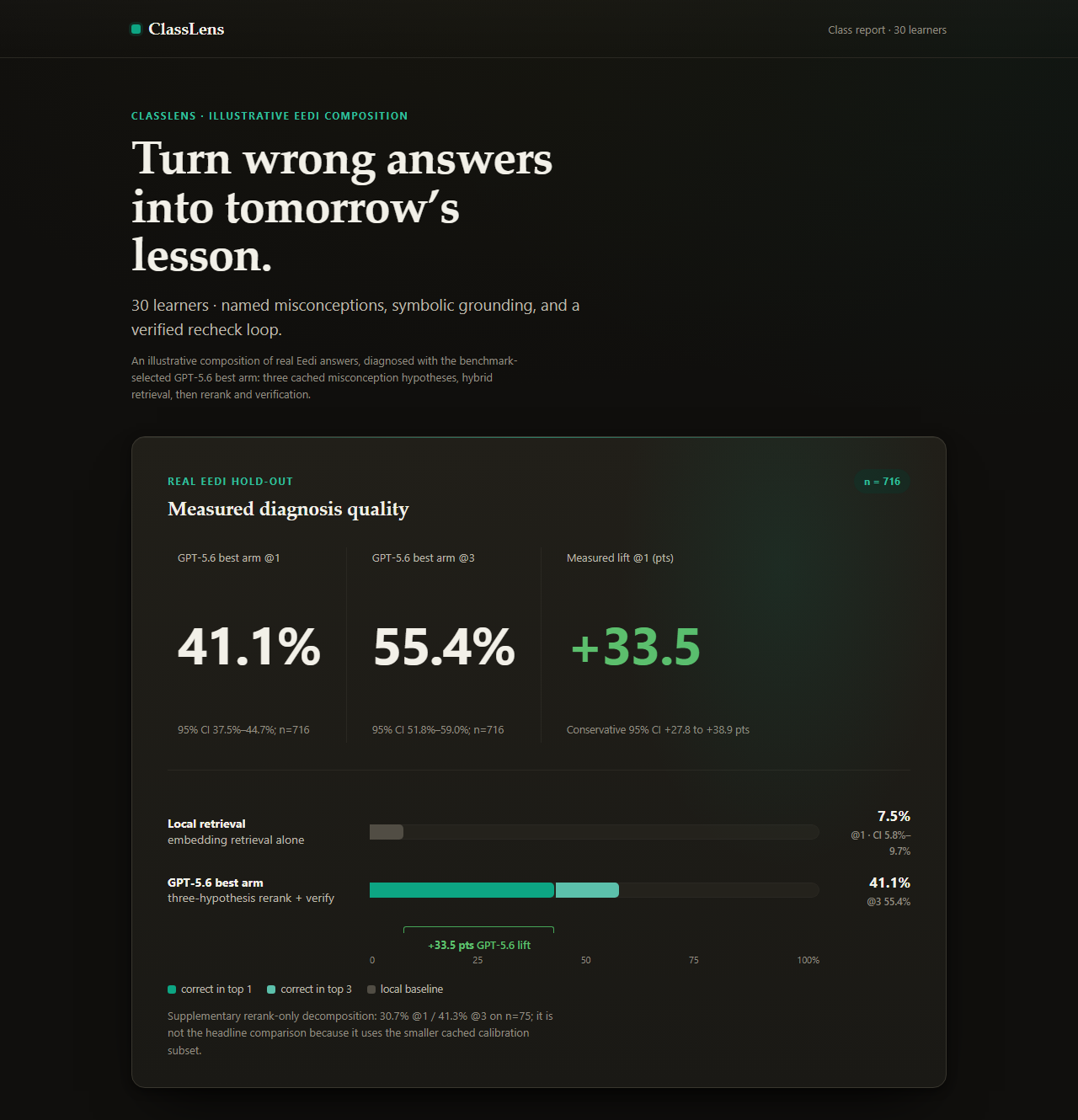
Judge snapshot: GPT-5.6 Luna’s selected three-hypothesis arm achieved 41.1% @1 / 55.4% @3 on n=716 real held-out Eedi pairs, a +33.5-point audited @1 lift over local retrieval. Executable rules achieved 41.1% grammar coverage × 67.0% in-grammar fidelity = 27.5% strict reproduction (71/258), and the blind factory accepted 10/33 (30.3%) items while visibly rejecting 23 attempts.
See it with zero setup — view the live report (no clone needed), or open the committed examples/sample_report.html directly. It is the pre-rendered judge-facing artifact; it does not run the pipeline or call an API.
Status: all core CLI paths are implemented and locally tested. Retrieval has completed its held-out calibration; factory and executable-rule measurements are seeded, bounded real-Eedi calibrations.
Why
Algebra 1 is the gatekeeper course, and teachers run the same daily loop — teach, quick-check, reteach — but cannot turn 150 exit-ticket responses into "what does this class actually misunderstand, and what do I reteach tomorrow" in a 20-minute prep. They see scores, not causes. ClassLens surfaces the causes, writes the reteach, and verifies the recheck questions actually target the diagnosed misconceptions.
How it works
- Ingest quiz questions + student responses from a CSV export.
- Diagnose — for each wrong answer, retrieve candidate misconceptions from the Eedi taxonomy (local embeddings) and use GPT-5.6 to rerank/verify the best match against the specific question and answer.
- Ground — verify computable items symbolically with SymPy, so correctness is checked, not guessed.
- Profile — aggregate a class-level misconception profile ranked by prevalence, with the students affected by each.
- Flag broken questions — where "wrong" answers reflect valid reasoning or ambiguity, flag the question, not the students.
- Reteach — GPT-5.6 writes an editable plan per top misconception: a worked example, the counterexample that breaks it, targeted practice, and a recheck item.
- Verify the recheck — the recheck items come from a factory: GPT-5.6 writes the stem, SymPy computes the correct answer, an executable buggy-math rule generates the distractor, and the diagnosis engine must map that distractor back to the intended misconception (blind) or the item is rejected and regenerated.
Design principle: ClassLens attaches to the invariant (misconceptions are curriculum-independent), not the variable (lesson plans, textbooks, formats). Bring your own questions in any format; it maps errors to a universal taxonomy. Narrow on subject, general across teachers.
Measured results
On a held-out split of official Eedi question–wrong-answer–misconception pairs:
- Final seeded 716-item held-out Eedi evaluation, seed 47: BAAI BGE-large hybrid local retrieval reached 7.5% @1 / 20.0% @3 (95% CI @1 5.8–9.7%). The selected three-hypothesis + GPT-5.6 Luna rerank arm reached 41.1% @1 / 55.4% @3 (95% CIs 37.5–44.7% / 51.8–59.0%) with 63.8% recall@25: a measured +33.5-point @1 lift with conservative 95% CI +27.8 to +38.9 points. The rerank-only arm is a clearly labeled supplementary n=75 decomposition (30.7% / 41.3% @1/@3), not the headline comparison. The earlier fixed 75-item retrieval calibration selected BGE-large hybrid plus three hypotheses (64.0% recall@25); k=50 did not improve that calibration, so the candidate pool remains 25.
- Executable-misconception distractor reproduction: 27.5% (71/258) across the full eligible seeded official-Eedi development set, after widening only grammar recognition against the same cached 258 GPT extractions. Grammar coverage is 41.1% (106/258) and in-grammar fidelity is 67.0% (71/106), so coverage × fidelity = strict rate. The strict rate remains the headline because parse misses are counted rather than hidden.
- Factory round-trip acceptance: 30.3% (10/33) across three executable misconception targets; 23 attempts were visibly rejected. Blind local retrieval hit the intended target on 10 of 26 viable attempts (38.5%) and missed it on 16, which is surfaced rather than hidden by target injection.
Executable-rule validation (full eligible set, n=258, seed 47)
| Rule | Funnel: eligible -> in-grammar -> reproduced | Coverage | Fidelity | Strict rate |
|---|---|---|---|---|
| same-operation-not-inverse | 41 -> 2 -> 1 | 4.9% | 50.0% | 2.4% |
| left-to-right priority | 27 -> 6 -> 5 | 22.2% | 83.3% | 18.5% |
| negative-times-negative | 24 -> 3 -> 3 | 12.5% | 100.0% | 12.5% |
| first-term-only expansion | 17 -> 7 -> 7 | 41.2% | 100.0% | 41.2% |
| multiply-by-index | 16 -> 10 -> 10 | 62.5% | 100.0% | 62.5% |
| add-fraction-denominators | 15 -> 9 -> 8 | 60.0% | 88.9% | 53.3% |
| positive-negative-is-positive | 15 -> 6 -> 4 | 40.0% | 66.7% | 26.7% |
| add-instead-of-expand | 12 -> 3 -> 1 | 25.0% | 33.3% | 8.3% |
| subtraction-is-commutative | 11 -> 4 -> 4 | 36.4% | 100.0% | 36.4% |
| double-instead-of-square | 31 -> 23 -> 13 | 74.2% | 56.5% | 41.9% |
| division-is-commutative | 17 -> 10 -> 5 | 58.8% | 50.0% | 29.4% |
| add-instead-of-multiply | 11 -> 8 -> 4 | 72.7% | 50.0% | 36.4% |
| reverse-inequality | 21 -> 15 -> 6 | 71.4% | 40.0% | 28.6% |
Class-aggregation robustness
Class prevalence is calculated from distinct affected learners rather than repeated responses, and identical (question, answer, explanation) pairs are deduplicated before runtime mapping. The report keeps per-question evidence and symbolically identified slips separate from named misconceptions, so a repeated answer pattern cannot silently inflate a reteach target. The shipped class is explicitly an illustrative composition of real Eedi answers, not a claim of longitudinal student data.
How GPT-5.6 is used
The retrieval-only baseline is local and never calls an API. GPT-5.6 writes three cached misconception hypotheses for the strongest retrieval arm, then reranks and verifies the fixed local candidate pool against each specific question and wrong answer; the held-out benchmark measures all three arms, and the runtime diagnose command ships that same selected best arm (three cached hypotheses + hybrid retrieval + rerank/verify), so the product runs the configuration the benchmark measured. Later runtime roles are structured stem extraction, factory-item generation, reteach generation, class summaries, and broken-question detection. Calls are cached by model, prompt, and reasoning effort; GPT-5.6 reasoning models do not accept a temperature parameter, so deterministic roles use its fixed default behavior. The default runtime model is gpt-5.6-luna for cost-disciplined batch diagnosis; gpt-5.6-terra is reserved for a small final comparison or difficult verification cases.
How Codex was used
Codex built the core of ClassLens over a three-day session: the benchmark harness, the executable misconception rules, the recheck factory, and the report renderer. The engineering decisions below were made or corrected in that thread.
Measurement discipline. Codex built the held-out benchmark before optimizing against it, then
corrected its own first ablation so both arms shared the same local candidate pool, accuracy@3
meant the first three ranked candidates, and evaluation order was seeded. The uncorrected early
numbers were discarded rather than reported. It later replayed the retrieval-only baseline with no
GPT client and reproduced exactly 54/716 @1 and 143/716 @3, confirming the published 7.5% / 20.0%
baseline and the +33.5-point lift were uncontaminated.
Retrieval calibration. Codex compared free local embedding models on a fixed held-out slice and
selected BGE-large hybrid on recall@25, added a TF-IDF lexical arm with reciprocal-rank fusion, and
tested a larger candidate pool. k=50 did not improve recall, so k=25 was retained. A high-effort
selector variant did not improve top-1 and was discarded.
Honest failure surfaces. Codex removed the factory's target-injection shortcut so retrieval misses and invalid rule outputs became visible rejection reasons, and made parse failures count against the executable-rule reproduction rate rather than being excluded from the denominator. Both choices lower the headline numbers and were kept anyway.
Correctness fixes it found. Option letters such as B are resolved to their actual answer text
before retrieval and diagnosis, preventing meaningless letter-only diagnoses in standard
multiple-choice exports. The rule validator compares symbolic equivalents rather than raw strings,
so 1/4 and 3/12 match.
Reproducibility. Every GPT-5.6 response is cached by model, prompt, and reasoning effort and
committed, so the published report and metrics can be regenerated with no API key. Setting
CLASSLENS_OFFLINE=1 makes any cache miss fail before a live request, which is how the offline
audits above were run.
Setup
Python 3.10+ is required (pyproject.toml is tested with Python 3.11). On Windows, keep the
checkout path short or enable long-path support before installing the local torch dependency.
# Windows PowerShell
py -3.11 -m venv .venv
.\.venv\Scripts\Activate.ps1

# macOS/Linux equivalent: python3.11 -m venv .venv && source .venv/bin/activate
python -m pip install -r requirements.txt
python -m pip install -e .
Copy-Item .env.example .env  # add OPENAI_API_KEY only for live GPT commands
ClassLens reads OPENAI_API_KEY from your environment (or a local .env, which is gitignored). No key is bundled with this repo — bring your own.
Get the data
See data/README.md — download the Eedi misconception dataset from Kaggle (accept the competition rules first). Data is gitignored.
Usage
Every CLI command below requires the Kaggle Eedi download described in data/README.md (at minimum,
the taxonomy; benchmark, validation, and factory commands also need their corresponding prepared splits).
For a zero-setup judge-facing artifact, open examples/sample_report.html
directly instead of rerunning the pipeline.
# Diagnose a class -> HTML report + Markdown reteach plan (best-arm GPT-5.6 diagnosis)
python -m classlens diagnose --responses examples/sample_class.csv --questions examples/sample_questions.csv --out report.html

# Regenerate the committed sample report from the local GPT cache only; any cache miss fails
# before a live call (PowerShell: $env:CLASSLENS_OFFLINE="1")
CLASSLENS_OFFLINE=1 python -m classlens diagnose --responses examples/sample_class.csv --questions examples/sample_questions.csv --out examples/sample_report.html --seed 47

# Fully local fallback (no GPT anywhere): retrieval-only diagnosis, offline reteach scaffold
python -m classlens diagnose --responses examples/sample_class.csv --questions examples/sample_questions.csv --out report.html --local-only

# Benchmark the diagnosis engine on held-out real Eedi data (accuracy@1/@3, GPT-5.6 lift)
python -m classlens bench

# Validate executable misconceptions against real Eedi distractors
python -m classlens validate-rules

# Generate + verify recheck items for a misconception
python -m classlens factory --misconception <id> --n 5
All commands that call the API support --limit N and --dry-run, and print a cost estimate first.
Suggested zero-cost planning checks:
python -m classlens validate-rules --dry-run --limit 12 --seed 47
python -m classlens factory --misconception 1507 --n 1 --limit 2 --dry-run --seed 47
After any fresh API run, inspect local token accounting with:
python -m classlens costs
The OpenAI billing dashboard remains the source of truth for charges; ClassLens records no prompt text in this ledger.
Sample data (run it without the full dataset)
examples/ contains a small illustrative class (30 anonymized learner IDs, 7 official Eedi Algebra-1 diagnostic questions plus one blind-verified factory recheck item, and 240 composed responses), the committed GPT-5.6-diagnosed report (sample_report.html / .md), two canonical verified recheck items across two distinct executable-rule targets (duplicates are intentionally omitted), and the cached validation summary behind the report. On this composition, 9 of the 10 distinct official-Eedi wrong answers are diagnosed to their official gold misconception label at rank 1 (10 of 10 within the top 3); the single rank-2 case is exactly the item the report flags for teacher review, and one further response is a SymPy-detected equivalent-answer slip rather than a misconception. The class's top two misconceptions are the two with blind-verified factory recheck items, so the diagnose -> reteach -> verified-recheck loop closes on real targets. The official competition release contains item/distractor labels, not row-level student histories; the composition is therefore clearly labeled as illustrative rather than claimed as raw individual-response data. The committed report is the zero-setup artifact; regenerating it requires the Eedi data and the local GPT cache (every call behind the committed report is cached, and CLASSLENS_OFFLINE=1 makes any cache miss fail before a live request).
Demo video
https://www.youtube.com/watch?v=n6QWy5xHBMY
Disclosures
- Uses the official Eedi "Mining Misconceptions in Mathematics" Kaggle competition release: 1,869 diagnostic questions, 4,370 labeled distractor pairs, and a 2,587-label misconception taxonomy. Dataset license and scope are recorded in
data/README.md; used per its terms.
License
MIT. See LICENSE.
Analysis
View
Metric
- 15

Figures cover GitHub contributors during the hackathon window. A co-authored commit counts in full for each author, so per-member totals add up to more than the whole-team figures.
Technology
- HTMLIn code
- OpenAIIn code
- PythonIn code
- CSSClaimed
3 of 4 appear in the indexed code. 1 claimed on Devpost could not be matched to code, which may simply mean the tool leaves no trace in the repository.
AI coding agents
- CodexConfig
Detected from committed agent config files and commit authorship. Absence of a signal is not proof an agent was unused.
Codebase size
Source size
303 KB
Source files
50
Counts recognized source files only; vendored directories, binaries and lockfiles are excluded, so this is smaller than the repository on disk.
Repository
V-3604/ClassLens
60 files · 642 KB · @ 3191fe1
Structure
Interface
1 file · 2%Screens, components and styles rendered to the user.
Application logic
27 files · 45%Domain rules, services and shared utilities.
Supporting
Layers are inferred from where files sit in the tree, not from reading the code. A project that names its directories unconventionally will read oddly here — open the file browser to check anything the diagram implies.
Languages
- Python57%
- HTML28%
- Markdown15%
Share of indexed source by file size. Binary and vendored files are excluded.
Dependencies
requirements.txt
pypi · 9- numpy
- openai
- pandas
- pytest
- python-dotenv
- scikit-learn
- sentence-transformers
- sympy
- tqdm
Declared in the repository’s manifests at the indexed commit. A declared package is not proof it is used, and runtime dependencies are listed first.
This project’s features have not been analysed yet.
Export this project's context (description, README, evidence, key source files) to chat with an AI agent elsewhere.