Project Info
Inspiration
One product decision should not become four platform rewrites. Today a team can design an interface in a visual tool and generate code very fast, but the meaning behind the design is soon lost inside different files. A rule such as keeping the main action easy to reach on a small phone must then be rewritten for Web, React, Expo and SwiftUI. I took inspiration from Figma and Paper because they make visual work feel direct and easy to understand. I wanted that same feeling in a system where product intent can also compile, run and prove itself. That is why I built IntentForm.
What it does
IntentForm keeps product intent as the source of truth. A brief becomes one validated Semantic Interface Graph that stores layout meaning, tokens, components, states, flows, accessibility intent and device behavior. The same graph creates deterministic output for Web, React, Expo and SwiftUI. The product has three connected workspaces. Design lets you edit the product visually while keeping its semantic structure visible. Code shows readable platform output and connects each file to the graph nodes that created it. Verify checks responsive behavior, accessibility, Runtime Parity and native evidence against the exact graph fingerprint. This matters because generated code is not proof that a product still follows the original decision. A valid graph, generated source, a successful build and correct runtime behavior are different levels of evidence. If the graph changes, old evidence becomes stale instead of silently proving a new build. Agents can suggest a small semantic change without taking control of the whole project. A person can inspect the exact diff, approve or reject it, verify the result and restore an earlier version. Try it The hosted Judge Mode gives reviewers a guided four minute tour with a complete sample project. It needs no account, API key, credits or test credentials. Reviewers can inspect the intent, compare every platform output, review evidence and test a safe repair workflow. Try the hosted version here: https://intentform-amber.vercel.app/studio?judge=1&step=design IntentForm is also open source. You can clone the repository, host the full application yourself and run the included validation commands. The repository also includes the IntentForm MCP server, so an MCP client can inspect project truth and work with the same bounded semantic actions without rebuilding the product. Source and setup instructions: https://github.com/metaforismo/IntentForm How I built it I built the whole project with Codex and GPT 5.6. I used Codex from the first idea to the final release for product planning, architecture, implementation, user experience, debugging, documentation, testing and release work. I used several Codex threads at the same time. Some threads implemented features while others reviewed the interface, tested browser and native output, searched for edge cases or audited release quality. Codex helped me organise these threads, compare their findings and continue until the important checks passed. Codex wrote and ran unit tests, browser tests, native checks and stress tests. The final release passes 551 unit tests, 29 production browser scenarios and a 10,000 node benchmark, together with type checks, production builds, native render checks and desktop package verification. I also used OpenAI ImageGen through Codex to create the IntentForm logo and visual assets. Inside IntentForm, GPT 5.6 handles the work that needs judgment. It can understand an unclear product brief and propose a constrained repair. The parts that must remain repeatable are deterministic: schemas, validation, compilers, fingerprints, semantic diffs, evidence, history and rollback are controlled by code. The main technologies are TypeScript, Next.js, React, Zod, Playwright, Electron, Expo tools and SwiftUI verification harnesses. Challenges The hardest challenge was keeping the same meaning across platforms with different layout, navigation, accessibility and safe area systems. It was not enough to make four screens that looked similar. Each output had to preserve the same product rule in a native way. The second challenge was honest verification. I needed the product to say “not run”, “stale” or “failed” when proof was missing instead of presenting a green result too early. That made the system more complex, but it also made every result easier to trust. The third challenge was using AI without hiding uncertainty. GPT 5.6 is strong at interpreting a brief and finding a useful repair, but the suggested change still needs a bounded diff, human approval and fresh evidence. My contribution I designed and built IntentForm independently, with Codex as my coding partner throughout the project. I defined the product direction and made the final architecture, design and release decisions. With Codex, I created the Semantic Interface Graph, the Design, Code and Verify workspaces, the four compilers, Judge Mode, the MCP server, the testing system, the documentation and the release workflow. What I learned I learned that AI is most useful when it works inside clear limits and can show its work. GPT 5.6 can understand intent and make a difficult judgment. Codex can plan, implement, test and review a large project. Deterministic systems can then make each result repeatable, inspectable and reversible. I also learned that good results do not come from one perfect prompt. Codex and GPT 5.6 improved a lot when I gave them focused skills, strong references, small acceptance criteria and real test evidence. They still needed careful steering, review and repeated browser, native and stress testing. Parallel threads were very useful, but only when each thread had a clear scope and the final results were checked against the same product truth. The biggest product lesson was that generated files should be treated as an output, not as the only source of truth. A semantic graph can connect the original decision, every generated target and the evidence that proves the current build. That connection is more valuable than generating code quickly and losing the reason behind it. What is next The next product step is full authentication and a clearer workspace for real teams. I also want to keep improving the visual interface, make complex states easier to read and reduce the amount of guidance needed for first time users. After that I want richer layout controls, more component registration, a deterministic Compose compiler, automatic native previews and optional collaboration. The long term goal is to make product intent portable across tools and platforms without giving an agent unlimited control. IntentForm does not translate pixels. It preserves product intent.
IntentForm is an open-source, local-first design environment where people and coding agents edit the same validated Semantic Interface Graph. It compiles that graph into readable React, responsive Web, Expo, and SwiftUI, then verifies each target against current evidence instead of treating generation as proof.
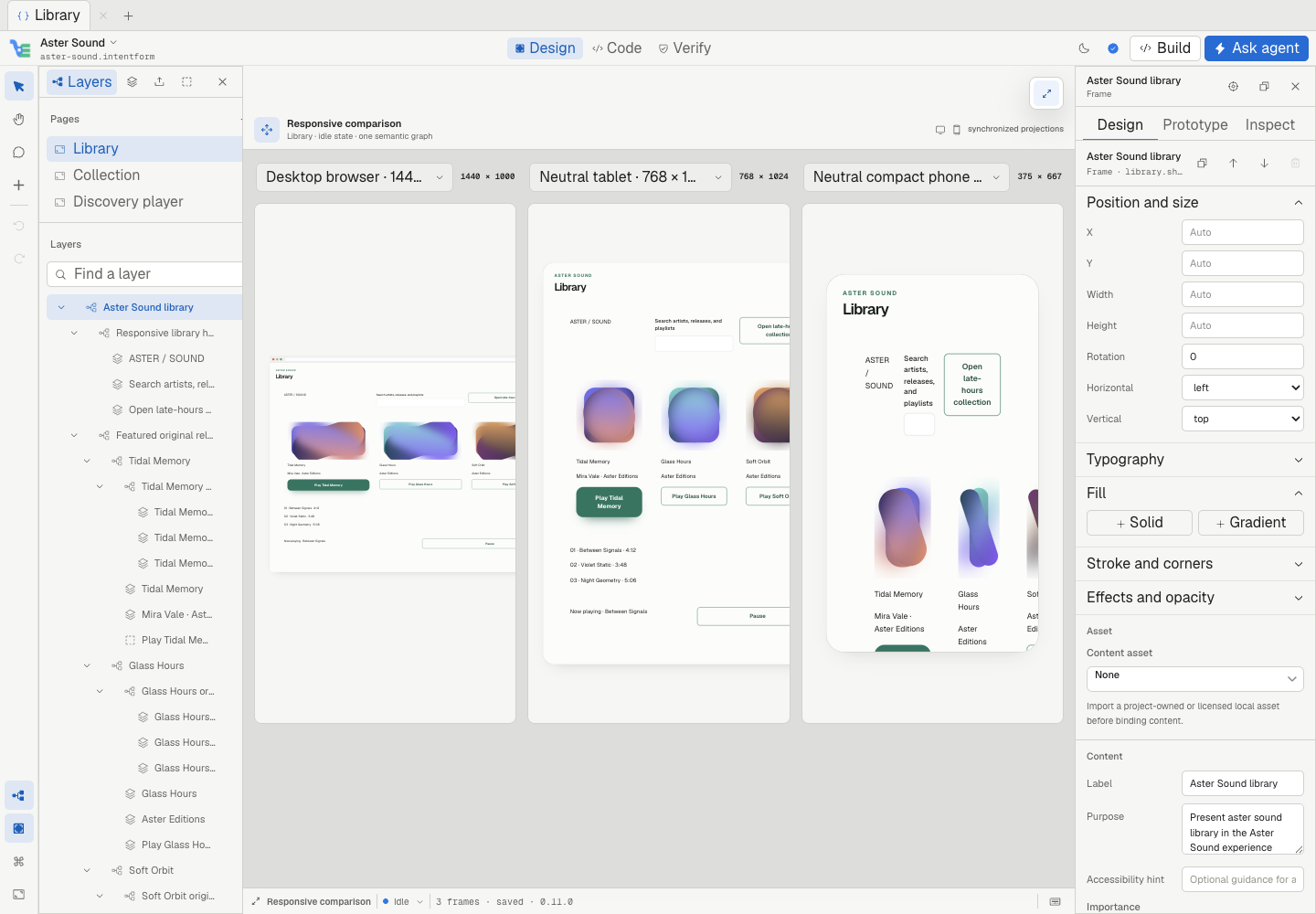
One-minute version: edit intent directly on the canvas, let an agent propose a bounded semantic transaction, review the exact diff, compile the accepted graph into Web, React, Expo, or SwiftUI, and verify each target against evidence bound to the current fingerprint.
Why IntentForm exists
Prompt-to-code tools usually bury design intent inside generated files. Traditional design tools usually stop before implementation. IntentForm keeps product intent as canonical, typed data between both worlds:
Human canvas edits ─┐
                    ├─> validated Semantic Interface Graph
Agent transactions ─┘              │
                                    ├─> React compiler ─> runnable app
                                    ├─> Web compiler ───> DOM/CSS runtime
                                    ├─> Expo compiler ──> iOS/Android export
                                    └─> SwiftUI compiler > native build/render
Generated files are integration artifacts, not the source of truth. Every accepted mutation is schema-validated, fingerprint-bound, attributable, reversible, and represented as a semantic diff.
Product today
| Area | Available now |
|---|---|
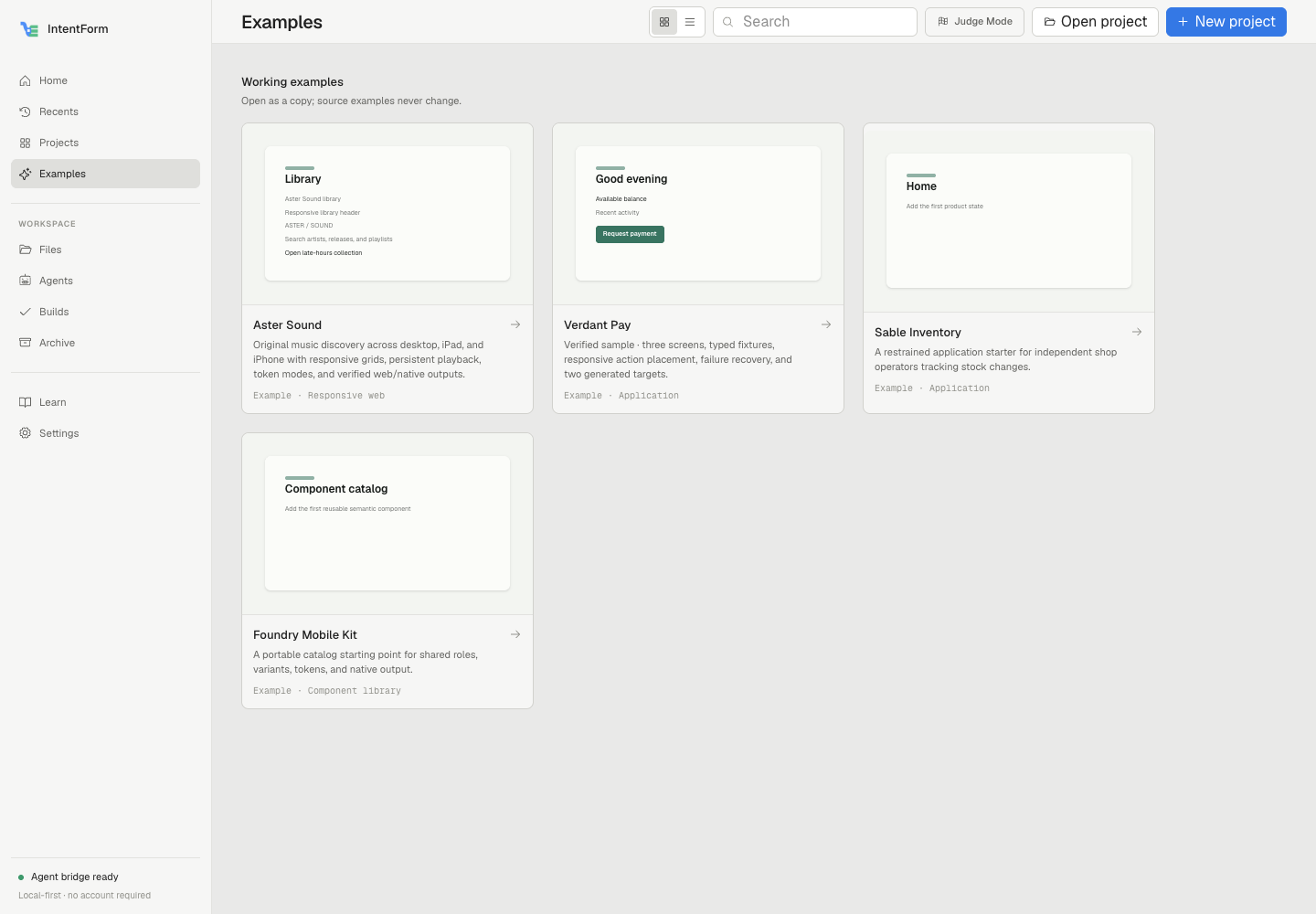
| Projects | Durable IndexedDB catalog, create/import/open, visual previews, search, grid/list views, folders, tags, rename, archive, recovery, migrations, multi-document tabs, dirty-close flows, and cross-window revision protection |
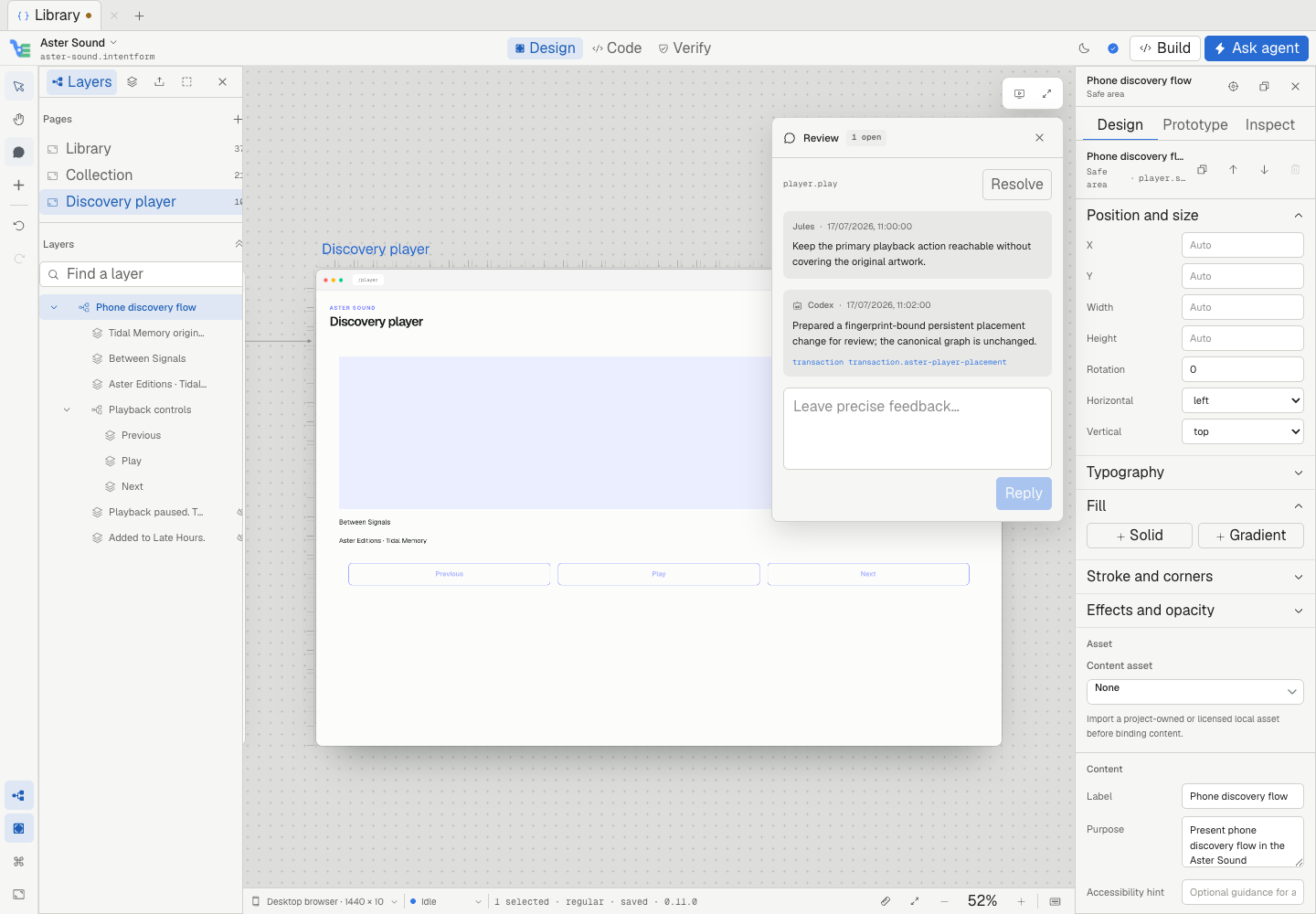
| Canvas | Infinite board, recursive layers, mixed selection, eight resize handles, rotation, snapping, keyboard movement, grouping, duplication, nested reparenting, conflict-safe inline text editing with IME/RTL support, context menus, clipboard and style clipboard, comments, flow preview, device chrome, and synchronized multi-device comparison |
| Layout | Stack, frame, list, grid tracks and span, wrap, overlay, split, scroll, safe area, adaptive, and freeform relations with deterministic layout indexes |
| Design systems | Components, instances, variants, states, slots, overrides, detach/reset, DTCG token modes, searchable token binding, licensed assets with integrity recovery, image placement, and SVG paint editing |
| Web workflows | Responsive frames and breakpoints, generated DOM/CSS runtime, sandboxed HTML/CSS import through computed styles, explicit unsupported-property diagnostics, runtime parity inspection, and source-to-canvas navigation |
| Native output | Deterministic React, Web, Expo Router, and SwiftUI compilers with readable generated files and target capability diagnostics |
| Agents | Local MCP resources and bounded tools, read-only default, exact file/page/selection scope, preview/commit/reject/revert transactions, semantic diffs, comments, history, checkpoints, and rollback |
| Evidence | Unit and integration tests, accessibility profiles, Playwright production smoke, responsive runtime checks, Expo iOS/Android exports, SwiftUI builds and Simulator accessibility/screenshots, desktop packaging, and a 10,000-node benchmark |
Design, Code, Verify
The product has three primary workspaces instead of a generation wizard:
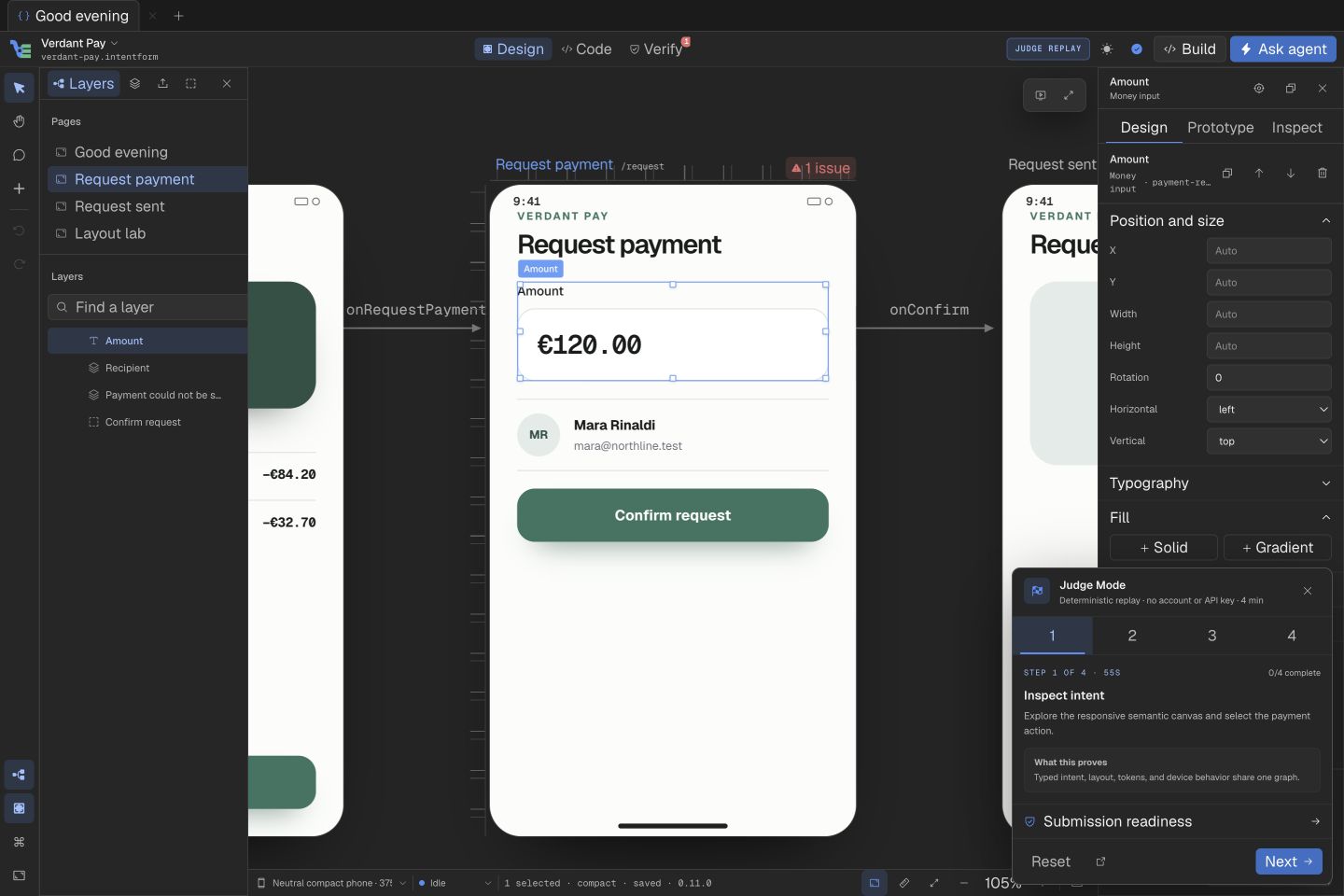
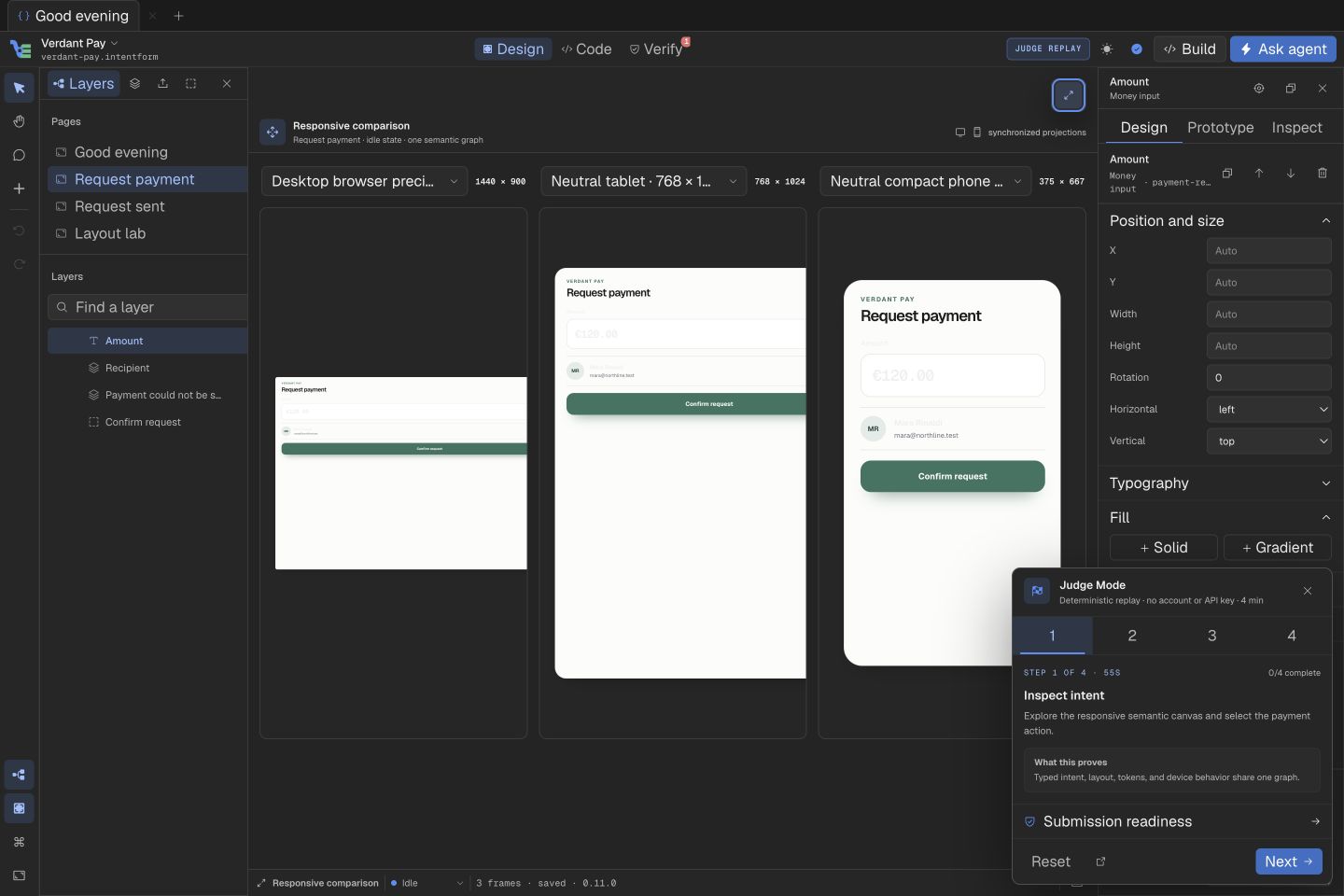
- Design keeps the semantic canvas, recursive layers, direct manipulation, properties, responsive projections, comments, and prototype flows in one editor.
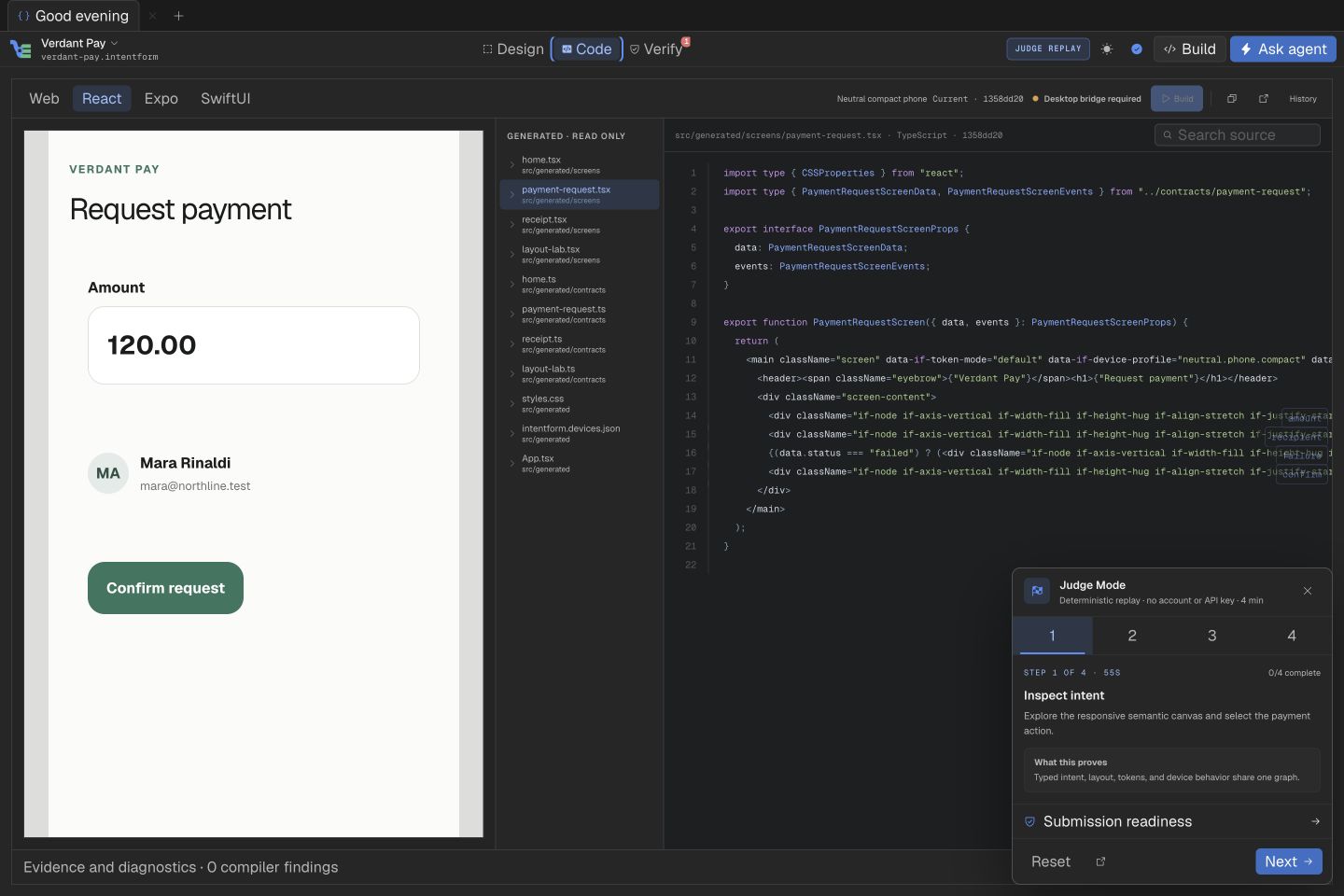
- Code shows deterministic target files beside the running projection, with exact node links and fresh build evidence.
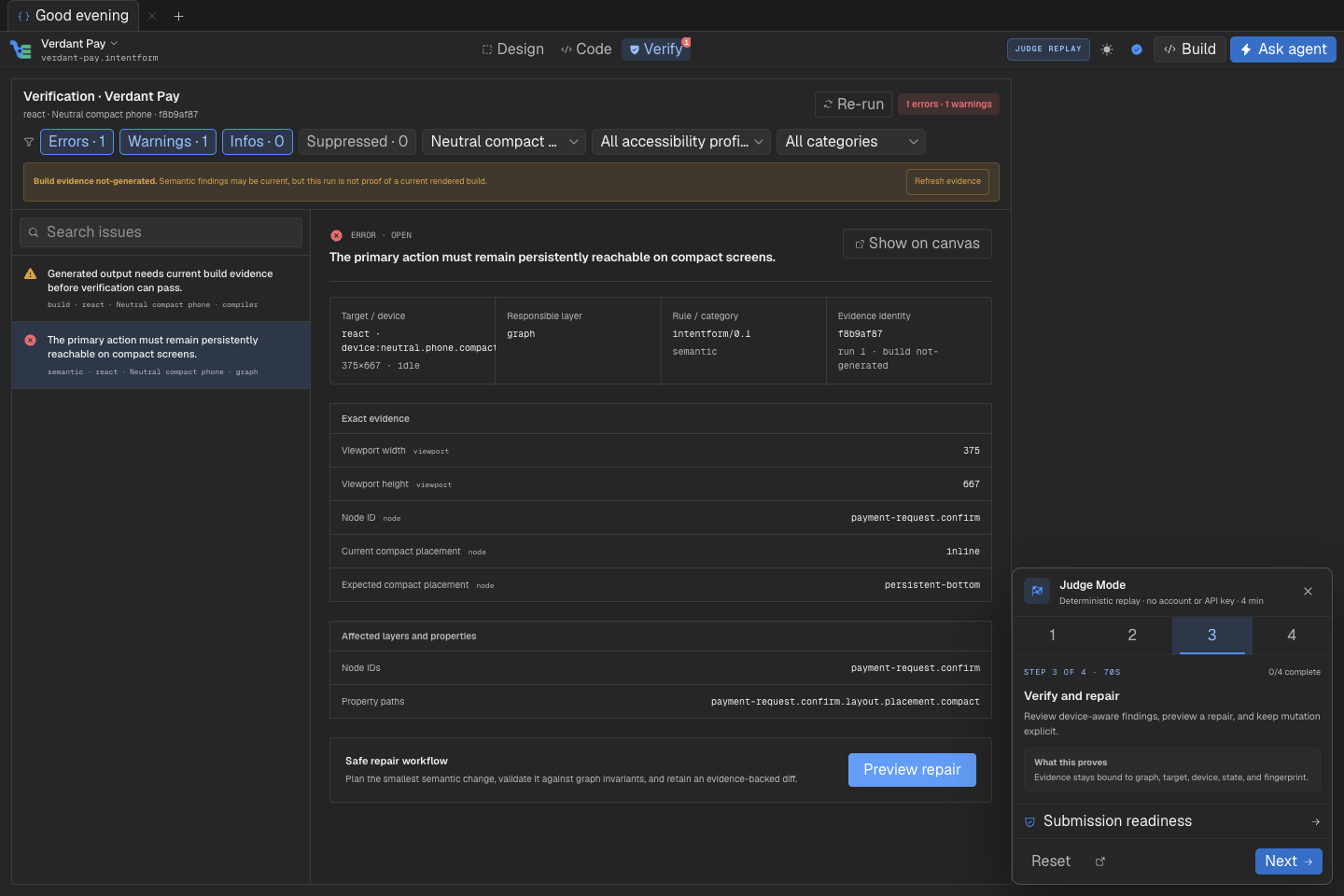
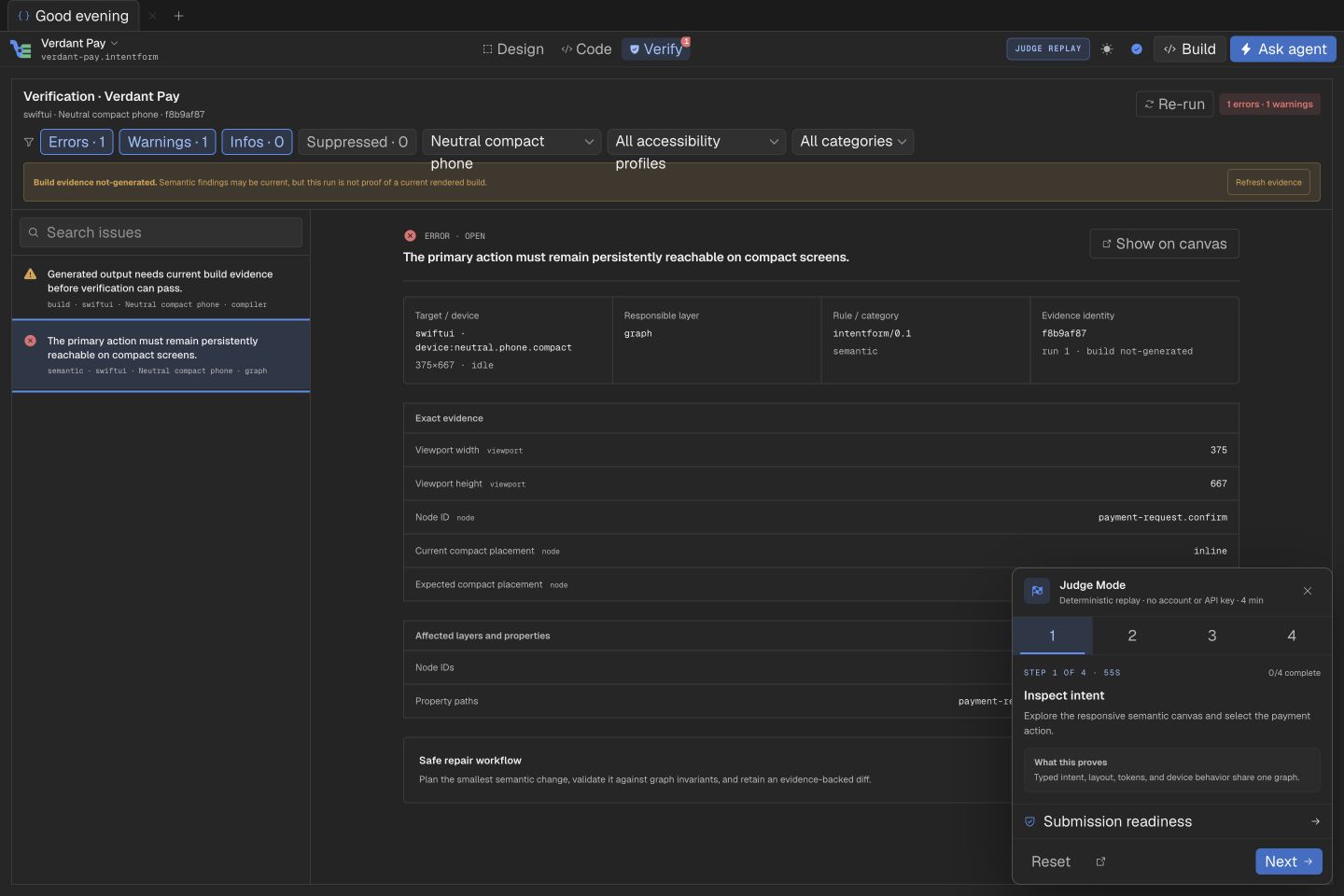
- Verify keeps semantic, responsive, accessibility, browser, Expo, SwiftUI, and desktop evidence separate by target and fingerprint.
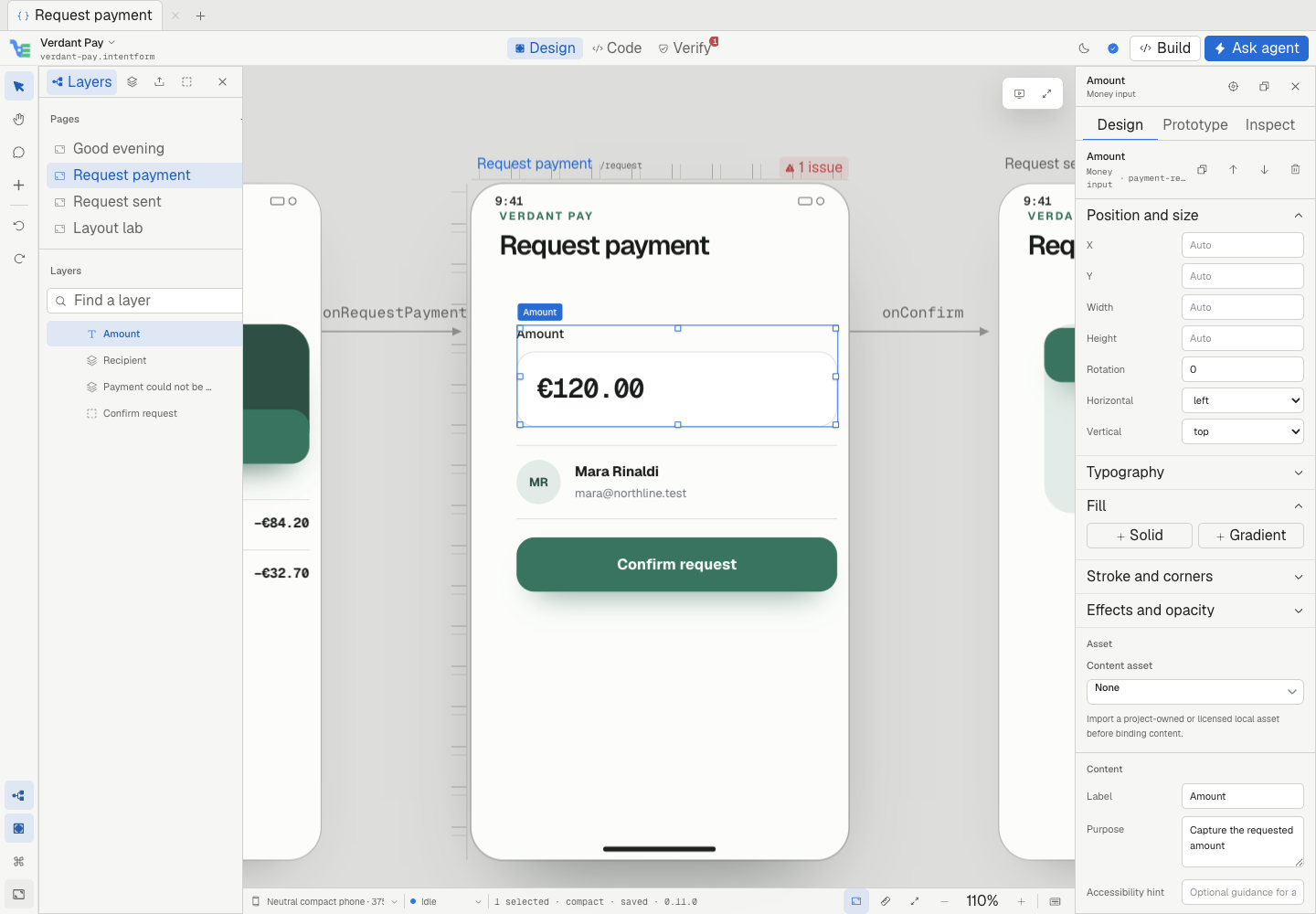
The editor chrome is deliberately neutral. Blue is reserved for selection and editing, green for connected or verified state, and the authored project keeps its own visual identity.
Judge demo
The public replay path takes about four minutes and requires no login, API key, account, or model call:
- Open Judge Mode.
- Inspect the validated Verdant Pay graph and make one semantic canvas edit.
- Continue to Code and inspect the generated target files and fingerprint.
- Continue to Verify, preview the bounded repair, apply it, and rerun the finding.
- Open submission readiness to distinguish live checks from owner-supplied video and Devpost fields.
- Reset or exit; Judge Mode never changes the durable project catalog.
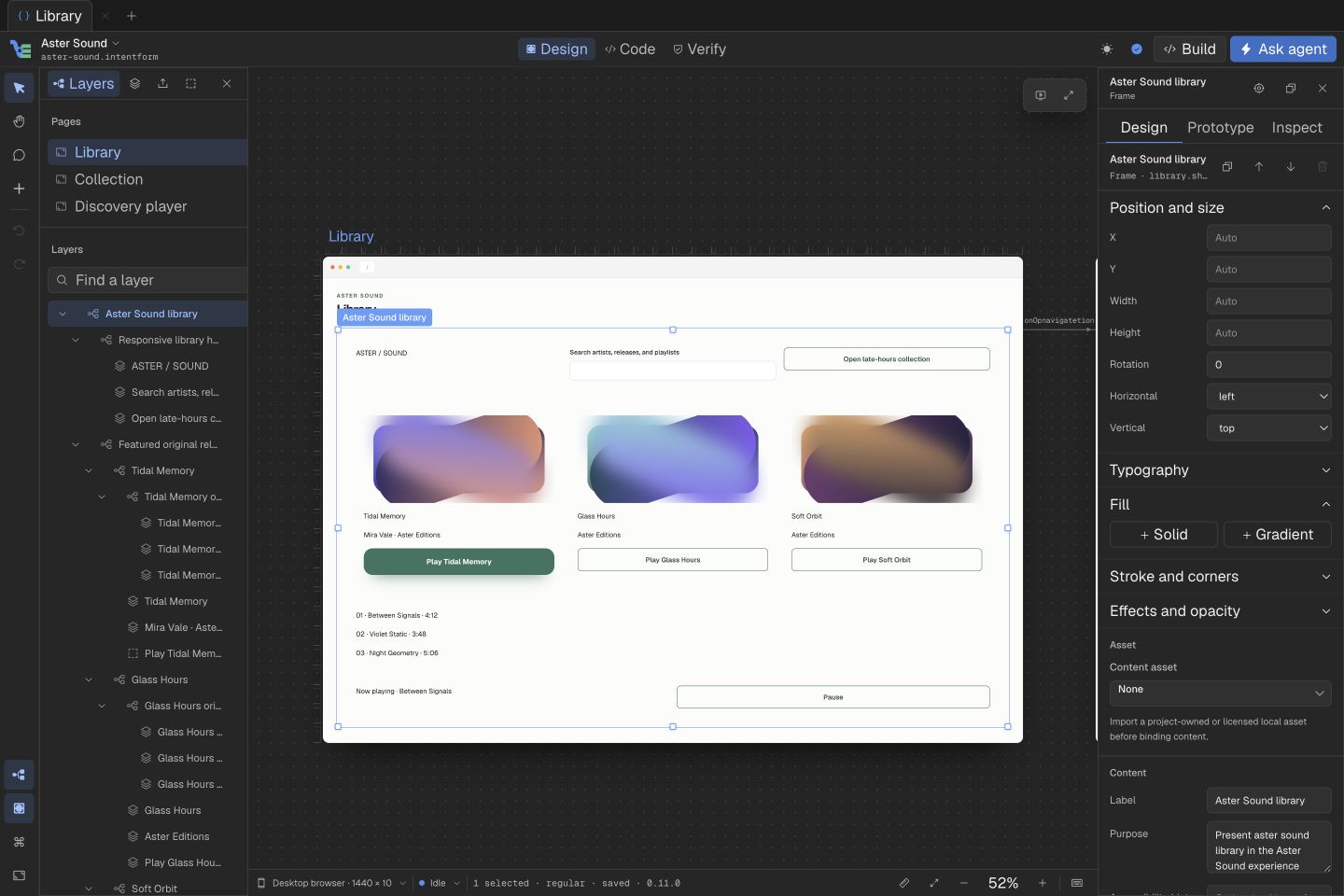
For the richer product tour, open Examples → Aster Sound. It includes original graph-native artwork, desktop/tablet/phone frames, components, token modes, prototype navigation, loading/empty/error/success states, and a comment linked to an agent transaction.
Submission gallery
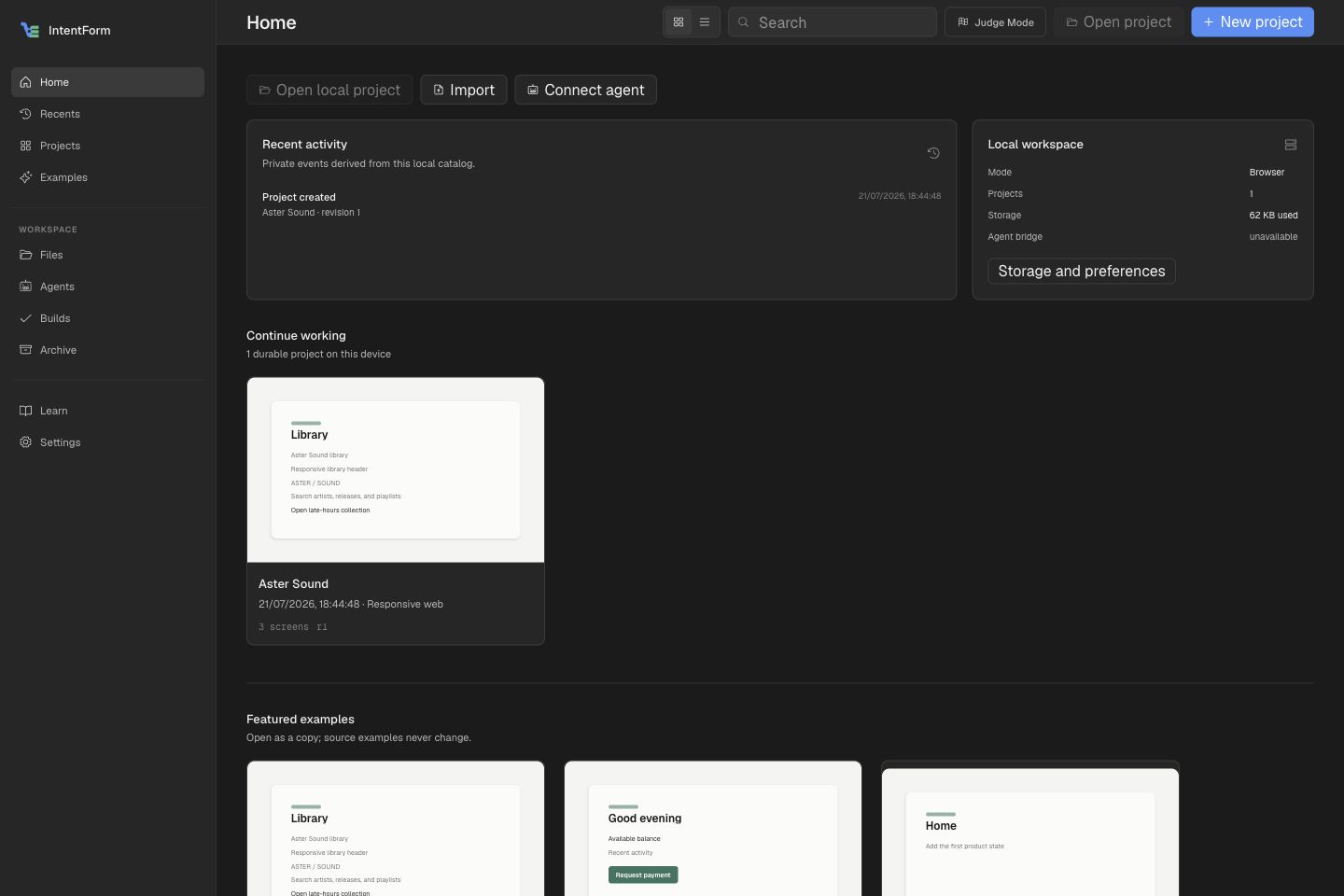
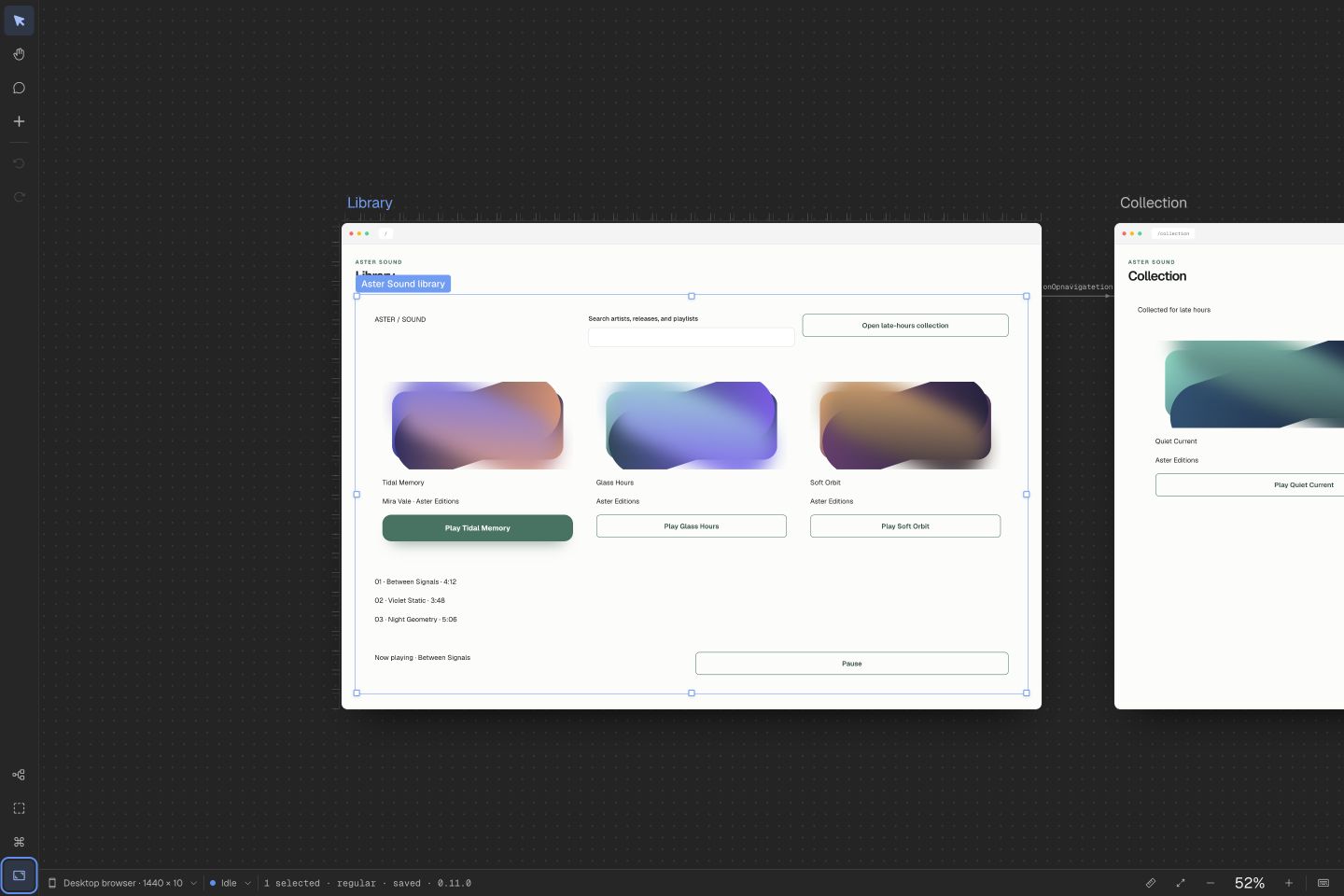
These captures come from the public production build at a 1440 × 960 viewport. They are unretouched 3:2 product evidence prepared for the Devpost gallery; each frame is also kept in the repository so judges can inspect the exact source revision behind it.
| Semantic editing | Responsive intent |
|---|---|
 |  |
| Deterministic React output | Evidence-bound verification |
 |  |
| Exact semantic evidence | Local-first project launcher |
 |  |
| Aster Sound workspace | Focused product showcase |
 |  |
Quick start
Judge setup: no credentials required
The fastest test is the hosted Judge Mode. It needs no account, installation, API key, credits, or model call. The four-step replay is deterministic, leaves durable browser projects untouched, and includes a safe repair preview.
For a fresh local checkout, no .env file is required and judges should not supply a personal OpenAI key:
pnpm install --frozen-lockfile
pnpm dev
Open http://127.0.0.1:3000, then choose Judge Mode or Examples → Aster Sound. Without OPENAI_API_KEY, brief interpretation and repair planning use the built-in reproducible replay paths; Design, Code, Verify, compilers, history, rollback, and the local MCP workflow remain available. OPENAI_API_KEY is an optional server-side deployment setting only for bounded live GPT-5.6 interpretation and repair judgment—never a browser field or a judge requirement.
Requirements:
- Node.js 22 or newer
- pnpm 10.28.0
- Chromium for browser smoke tests
- Xcode command-line tools for SwiftUI and macOS verification
pnpm install --frozen-lockfile
pnpm dev
Open http://127.0.0.1:3000, create a project or copy an example, then enter Studio. Core editing, compilation, deterministic replay, and local agent workflows require no account, hosted service, model call, or paid MCP allowance.
Supported and verified paths:
- Browser Studio: current Chromium on macOS, Linux, and Windows; the hosted Judge Mode above is the fastest test path and needs no account.
- Desktop Studio: the packaged Electron app is build-, signature-, sandbox-, and launch-verified on macOS arm64. The packager targets the current host platform, but Windows and Linux desktop bundles are not yet claimed as release-verified.
- Generated targets: React and responsive Web run in current browsers; Expo exports are checked for iOS and Android; SwiftUI build and Simulator render evidence require macOS with Xcode.
To build the desktop package for the current host after installing dependencies:
pnpm package:desktop
The bundle is written under output/desktop/. For agent installation and a safe read-only connection test, follow packages/mcp-server/README.md.
Focused checks:
pnpm typecheck
pnpm test
pnpm benchmark:large-doc
pnpm build
pnpm smoke:studio
pnpm verify:web-preview
pnpm verify:expo-preview
pnpm verify:swiftui
pnpm verify:swiftui-render
pnpm verify:desktop
The complete portable gate is pnpm verify; native and desktop gates run separately where their platform toolchains are available.
The project format
An .intentform project is canonical JSON validated by the versioned semantic schema. It includes:
- product intent and principles;
- tokens, modes, aliases, and deprecations;
- assets with explicit export and license policy;
- component definitions, variants, slots, instances, and overrides;
- screens, recursive semantic nodes, layout relations, states, contracts, fixtures, and flows;
- platform, breakpoint, device, and preview profiles;
- optional ecosystem, history, review, and collaboration metadata.
Serialized size, graph depth, child count, stable IDs, expressions, components, assets, frames, breakpoints, and patch operations are bounded and fail closed. Migrations are explicit and fixture-backed. Stable serialization produces canonical fingerprints used by compilers, evidence, history, and agent transactions.
Agent-native workflow
IntentForm does not give agents a privileged path around the editor. Studio and MCP use the same graph validation, project revisions, semantic diff, compilation, and verification operations.
Print an MCP configuration plan without modifying a client:
pnpm mcp:install --client codex --print
pnpm mcp:install --client claude --print
pnpm mcp:install --client opencode --print
pnpm mcp:install --client pi --print
Use --project /absolute/path/to/project when necessary. Add --apply only after reviewing the plan. Existing client configuration is not replaced without confirmation and a timestamped backup.
New connections are read-only. Semantic writes require the explicit INTENTFORM_MCP_PERMISSION=write environment setting. Tools cover project inspection, graph search, typed patches, components, tokens, assets, branches, history, compile, verify, preview, accessibility, packages, review, checkpoint, diff, revert, and transactions. Successful operations report project, file, tab, page, device, visual state, selection, affected node paths, and fingerprints.
Compilation and verification
IntentForm separates these states:
- Graph accepted by the schema.
- Target source generated deterministically.
- Generated project built successfully.
- Runtime or native frame inspected against exact fingerprints.
- Evidence verdict produced for the active target and profile.
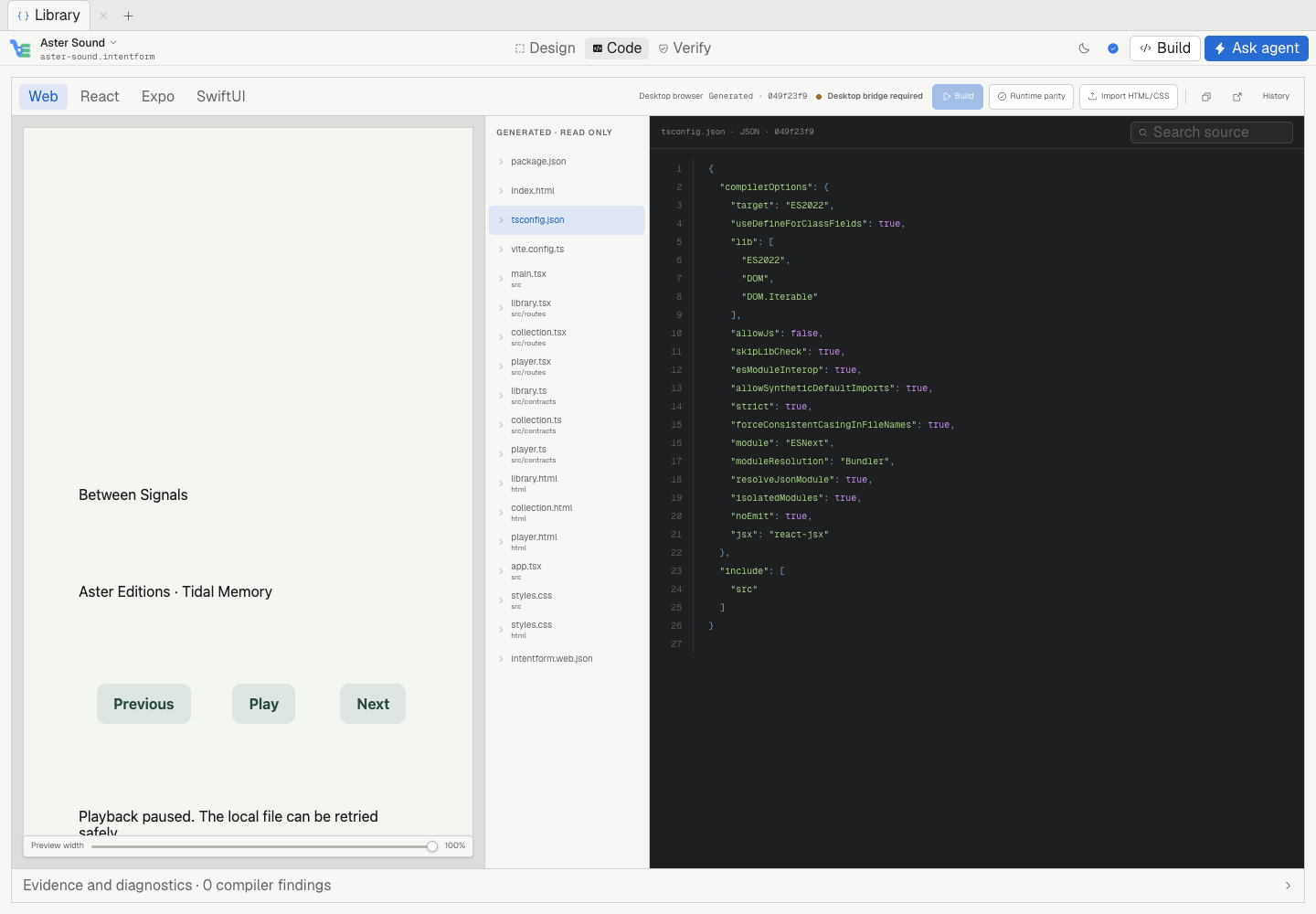
The Studio Code workspace provides a virtualized, syntax-aware source viewer with search, exact node links, copy context, and source-to-canvas navigation. Verify groups semantic, responsive, accessibility, browser, Expo, SwiftUI, and desktop evidence without pretending that one target proves another.
The Runtime Parity Inspector answers "did the real rendered app preserve the semantic design intent?" with measurements instead of assumptions. A sandboxed probe renders the compiled web document at every declared frame and measures each stable node in the live DOM; existence, document order, accessible names and roles, WCAG 2.2 target sizes, horizontal overflow, and compact reachability of persistently placed actions are compared against the graph. Every finding links to the exact node on the canvas, reports are fingerprint-bound and flag themselves stale when the graph changes, and measured geometry is presented as evidence rather than judged — canvas-to-runtime pixel fidelity remains explicitly ongoing work, and the inspector never claims parity for targets it has not measured.
CI runs typecheck, the complete test suite, the 10,000-node benchmark, production builds, Web runtime smoke, Expo exports for iOS and Android, the full Studio browser matrix, checked-in preview drift checks, SwiftUI native build/render evidence, and the hardened macOS desktop package. GitHub Actions are pinned to immutable commits.
The large-document gate measures serialization, open/index/edit/diff/layout/codegen work, pan and zoom queries, bounded cache retention, and a deterministic simulated 60-minute session. Browser smoke also covers interrupted catalog recovery, multi-window conflicts, reload restoration, reduced motion, RTL, forced colors, 200% text, compact and tablet layouts, and request races.
Architecture
apps/
  studio-web/          launcher, editor, isolated previews, local APIs
  studio-desktop/      hardened Electron shell and local services
  react-preview/       generated React evidence harness
  web-preview/         generated responsive DOM/CSS harness
  expo-preview/        generated Expo Router export harness
packages/
  semantic-schema/     canonical graph, migrations, patches, diffs
  layout-engine/       deterministic neutral layout relations
  compiler-*/          React, Web, Expo, and SwiftUI backends
  device-registry/     logical and checksummed precision profiles
  mcp-server/          scoped resources, tools, transactions, transports
  verifier/            semantic and target evidence rules
scripts/               smoke, benchmark, native render, sync, installer gates
IntentForm owns interface structure, tokens, navigation intent, visual state, typed data and event contracts, accessibility, compilation, and verification. It does not own backend behavior, authentication, payments, deployment, or arbitrary application logic.
Compilers remain deterministic: the same graph and compiler version produce byte-identical files. Restricted expressions cannot contain arbitrary JavaScript. Platform backends lower shared intent to native primitives and disclose unsupported relations rather than silently inventing them.
Security and local-first boundaries
- Project and revision state stays local by default.
- Browser projects use IndexedDB, atomic revisions, project-scoped locks, recovery checkpoints, and explicit conflict errors.
- HTTP MCP binds to loopback and requires a private token.
- New agent clients receive read-only tools unless write access is explicitly granted.
- Graph patches are bounded, validated, fingerprint-checked, atomic, and reversible.
- Generated previews are isolated; imported HTML/CSS runs in a sandboxed browser document.
- Asset, package, bezel, plugin, review, and collaboration inputs are path-, checksum-, signature-, and size-checked.
- Logs exclude authored content, credentials, tokens, generated output, and machine-specific paths.
- The semantic MCP surface exposes no arbitrary shell, filesystem, or network operation.
- Production responses enforce content security, framing, permission, referrer, and content-type policies.
- The desktop package includes the project Apache license and NOTICE beside Electron/Chromium legal material.
Optional live-model operations are server-side, bounded, schema-validated, cancelled on deadline, and redacted to request metadata. Deterministic replay remains available without credentials. Public deployments should remain replay-first until quotas are durable across instances.
Report security issues privately through GitHub Security Advisories. Do not open a public issue for credential exposure, code execution, quota bypass, or supply-chain findings. IntentForm is pre-release software and should not process production financial or personal data.
Deployment
The repository deploys from the monorepo root. vercel.json uses the frozen lockfile and the same production build used locally.
vercel deploy
vercel deploy --prod
Run the browser matrix against a deployed revision with:
STUDIO_ORIGIN=https://your-deployment.example pnpm smoke:studio
A deployment is not considered public merely because its build is ready; verify from a clean browser that team SSO or deployment protection does not intercept the product. Keep OPENAI_API_KEY unset for the replay-first public baseline unless a durable shared quota and provider spend limit are configured.
Honest boundaries and roadmap
IntentForm is not a Figma clone, a screenshot-to-code service, or a promise of pixel-identical output across platforms. Native UI has platform-specific navigation, accessibility, text scaling, keyboard, safe-area, and control behavior. The product preserves shared intent while allowing explicit platform expressions.
Current high-value work still includes:
- directory-backed catalog sync and richer filesystem workflows;
- multi-range rich-text authoring, deeper bidirectional layout controls, and variable-font axis editing;
- destructive crop, vector-pen, and SVG geometry workflows beyond the current non-destructive image framing and SVG paint controls;
- broader CSS compatibility and editable HTML/CSS round-trip coverage;
- code-component registration and library update review;
- a deterministic Compose backend;
- multi-user presence and hosted verification workers;
- continuing canvas-to-output layout fidelity work across font metrics and platform-native measurement.
OpenAI Build Week
IntentForm was developed for the 2026 OpenAI Build Week Developer Tools track. The work is intentionally split between probabilistic judgment and deterministic product infrastructure:
- Codex accelerated implementation, repository-wide audits, focused refactors, test authoring, browser/native verification, failure diagnosis, and release review.
- GPT-5.6 is used only where ambiguity is useful: interpreting a brief or proposing a constrained repair. Its output must satisfy the typed schema and graph invariants before it can become a reviewable transaction.
- Deterministic code owns migrations, fingerprints, diffs, compilers, evidence binding, history, and rollback. GPT-5.6 does not emit the production source files.
- Human decisions retained authority over product scope, interaction and visual direction, architecture boundaries, acceptance criteria, transaction approval, and every external publication step.
IntentForm had a semantic-graph and compiler foundation before the submission period. The dated public Git history distinguishes that foundation from the material Build Week extension: the full Design/Code/Verify product experience, durable local project catalog and recovery, responsive and native proof paths, Judge Mode, Aster Sound showcase, MCP transaction review and stale-write protection, Runtime Parity Inspector, desktop packaging, accessibility and viewport hardening, and the expanded deterministic test/evidence matrix were implemented or substantially extended during the event.
The public demo video is not published yet; it will be linked here after the owner records and approves the final sub-three-minute walkthrough. No Devpost submission or release is performed by repository automation.
The recording-ready submission video run of show maps each claim to the exact product state that should be visible, with timing, voiceover, capture checks, and the required Codex/GPT-5.6 explanation.
Contributing
Keep changes narrow, deterministic, reversible, and test-backed.
- Create a focused branch and use a conventional commit subject.
- Add schema changes through explicit migrations and fixture coverage.
- Never edit generated output as the canonical source.
- Run targeted tests first, then the applicable release gates.
- Explain the preserved intent, affected compiler targets, verification, and honest limitations in the pull request.
- Never commit secrets, machine-specific paths, local output, private notes, DerivedData, or simulated evidence presented as real.
Changing UI labels, roles, or test IDs requires updating the production smoke matrix in the same change. Compiler output must not depend on timestamps, randomness, or ambient environment state.
License
IntentForm is licensed under Apache-2.0. See NOTICE for attribution details.
Analysis
View
Metric
- 80

Figures cover GitHub contributors during the hackathon window. A co-authored commit counts in full for each author, so per-member totals add up to more than the whole-team figures.
Technology
- CSSIn code
- HTMLIn code
- Next.jsIn code
- OpenAIIn code
- ReactIn code
- SwiftIn code
- Tailwind CSSIn code
- TypeScriptIn code
- VercelClaimed
8 of 9 appear in the indexed code. 1 claimed on Devpost could not be matched to code, which may simply mean the tool leaves no trace in the repository.
AI coding agents
No AI coding agent signals were found in this repository.
Detected from committed agent config files and commit authorship. Absence of a signal is not proof an agent was unused.
Codebase size
Source size
2.9 MB
Source files
258
Counts recognized source files only; vendored directories, binaries and lockfiles are excluded, so this is smaller than the repository on disk.
Repository
metaforismo/IntentForm
362 files · 4.6 MB · @ 22dfc1a
Structure
Interface
68 files · 19%Screens, components and styles rendered to the user.
API & routing
10 files · 3%Request entry points: routes, handlers and controllers.
Application logic
91 files · 25%Domain rules, services and shared utilities.
+24 moreBackground jobs
1 file · 0%Work run outside a request: tasks, workers and schedules.
Supporting
Layers are inferred from where files sit in the tree, not from reading the code. A project that names its directories unconventionally will read oddly here — open the file browser to check anything the diagram implies.
Languages
- TypeScript87%
- YAML11%
- Markdown1%
- CSS1%
- HTML0%
- Swift0%
Share of indexed source by file size. Binary and vendored files are excluded.
Dependencies
apps/studio-web/package.json
npm · 29- @intentform/compiler-expo
- @intentform/compiler-react
- @intentform/compiler-swiftui
- @intentform/compiler-web
- @intentform/desktop-bridge
- @intentform/device-bezels
- @intentform/device-registry
- @intentform/graph-runtime
- @intentform/intent-interpreter
- @intentform/layout-engine
- @intentform/mcp-server
- @intentform/preview-daemon
- @intentform/proof-report
- @intentform/repair-planner
- @intentform/semantic-schema
- @intentform/token-assets
- @intentform/verifier
- @phosphor-icons/react
- +11 more
packages/mcp-server/package.json
npm · 18- @intentform/compiler-expo
- @intentform/compiler-react
- @intentform/compiler-swiftui
- @intentform/compiler-web
- @intentform/device-bezels
- @intentform/device-registry
- @intentform/ecosystem
- @intentform/preview-daemon
- @intentform/proof-report
- @intentform/semantic-schema
- @intentform/token-assets
- @intentform/verifier
- @intentform/web-verifier
- @modelcontextprotocol/sdk
- zod
- +3 more
apps/expo-preview/package.json
npm · 13- expo
- expo-dev-client
- expo-image
- expo-linking
- expo-router
- expo-status-bar
- react
- react-dom
- react-native
- react-native-safe-area-context
- react-native-screens
- +2 more
apps/studio-desktop/package.json
npm · 10- @intentform/desktop-bridge
- @intentform/mcp-server
- +8 more
packages/preview-daemon/package.json
npm · 10- @intentform/compiler-expo
- @intentform/compiler-react
- @intentform/compiler-swiftui
- @intentform/compiler-web
- @intentform/device-registry
- @intentform/semantic-schema
- zod
- +3 more
package.json
npm · 88 development-only dependencies.
packages/ecosystem/package.json
npm · 7- @intentform/preview-daemon
- @intentform/semantic-schema
- zod
- +4 more
packages/collaboration-relay/package.json
npm · 6- @intentform/ecosystem
- @intentform/semantic-schema
- zod
- +3 more
packages/proof-report/package.json
npm · 6- @intentform/compiler-react
- @intentform/compiler-swiftui
- @intentform/device-registry
- @intentform/repair-planner
- @intentform/semantic-schema
- @intentform/verifier
apps/react-preview/package.json
npm · 5- react
- react-dom
- +3 more
apps/web-preview/package.json
npm · 5- react
- react-dom
- +3 more
packages/desktop-bridge/package.json
npm · 4- zod
- +3 more
packages/repair-planner/package.json
npm · 4- @intentform/semantic-schema
- @intentform/verifier
- openai
- zod
packages/web-verifier/package.json
npm · 4- @intentform/compiler-web
- @intentform/layout-engine
- @intentform/semantic-schema
- +1 more
packages/compiler-core/package.json
npm · 3- @intentform/device-registry
- @intentform/layout-engine
- @intentform/semantic-schema
packages/compiler-expo/package.json
npm · 3- @intentform/compiler-core
- @intentform/semantic-schema
- +1 more
packages/compiler-web/package.json
npm · 3- @intentform/compiler-core
- @intentform/semantic-schema
- +1 more
packages/device-bezels/package.json
npm · 3- @intentform/device-registry
- zod
- +1 more
packages/intent-interpreter/package.json
npm · 3- @intentform/semantic-schema
- openai
- zod
packages/token-assets/package.json
npm · 3- @intentform/semantic-schema
- +2 more
packages/compiler-react/package.json
npm · 2- @intentform/compiler-core
- @intentform/semantic-schema
packages/compiler-swiftui/package.json
npm · 2- @intentform/compiler-core
- @intentform/semantic-schema
packages/graph-runtime/package.json
npm · 2- @intentform/semantic-schema
- +1 more
packages/semantic-schema/package.json
npm · 2- @intentform/device-registry
- zod
packages/verifier/package.json
npm · 2- @intentform/accessibility-verifier
- @intentform/semantic-schema
packages/accessibility-verifier/package.json
npm · 1- @intentform/semantic-schema
packages/device-registry/package.json
npm · 1- zod
packages/layout-engine/package.json
npm · 1- @intentform/semantic-schema
Declared in the repository’s manifests at the indexed commit. A declared package is not proof it is used, and runtime dependencies are listed first.
This project’s features have not been analysed yet.
Export this project's context (description, README, evidence, key source files) to chat with an AI agent elsewhere.