Project Info
Inspiration
AI coding agents can produce impressive work, but the final update often compresses a messy run into confident prose. The expensive part is no longer generating the change—it is finding out which claims are supported, stale, contradicted, or still need a person. The original prompt was inspired by Theo Browne's “I don't have time to build these things, will you?”, which called for a Slack alternative that works for agents. Halba is an independent interpretation: not another agent chat surface, but the proof layer after the run. There is no affiliation or endorsement.
What it does
Halba turns risky completion claims across local workspaces into one Trust Inbox. Deterministic evidence policy ranks contradictions, unsupported or stale proof, changed evidence, expired decisions, degraded imports, failed guards, and dependency impact. Every item says why it matters now and routes to the exact claim, run, or import receipt. Model prose has zero ranking or approval authority. The queue opens into Proof Mode, where one bounded evidence identity stays visible from claim to source to guard to human decision. A public-safe Codex run shows what the agent inspected, changed, checked, and claimed before the material claims enter that loop. Proof Mode imports the bounded agent report, source files, and machine receipts. GPT-5.6 extracts atomic claims and precise citations. Halba validates every source reference, applies deterministic guards, and assigns one of five verdicts: supported, unsupported, stale, contradicted, or uncertain. The user sees: what changed; what is actually verified; what is missing or stale; what conflicts with deterministic evidence; which claims require human review. Every claim opens to its exact evidence boundary: source-backed claims show the cited lines and content hash, while missing evidence is exposed as an explicit missing-source state. Proof Mode also preserves the model's reasoning boundary and deterministic guard results. A human can approve, reject, resolve, or request more proof with a local audit note. Closed gates reduce channel attention; requesting proof intentionally leaves the gate open.
How we built it
Halba is a dependency-free Node.js application with a static browser frontend. Proof bundles are local JSON plus source files. The server rejects absolute paths, traversal, undeclared files, symlinks, oversized inputs, and invalid line ranges. The workspace contract validates safe ids, channel/agent/thread references, timestamps, typed event names, proof-bundle linkage, and a 64 KB input ceiling. Bounded Codex-session, CI-manifest, and release-manifest adapters normalize into the same local contract. They do not store raw transcripts or arbitrary command output, and they cannot create lineage or approval authority. Codex accelerated the Build Week delta end to end: baseline and privacy auditing, Proof Mode implementation, deterministic guards, the eval corpus, rendered frontend iteration, the Remotion film, Docker verification, and public release automation. The most important decisions were to keep evidence local, separate inference from proof authority, label recorded versus live execution, and reserve unresolved decisions for a human. The public demo includes a safe version of the Codex-authored report, diff, and receipts it was built to inspect. The live inference path uses the OpenAI Responses API with gpt-5.6-sol, max reasoning, strict Structured Outputs, and store: false. Model output is never authoritative by itself. The adjudicator checks exact quotes and runs deterministic receipt, freshness, JSON-field, and required-citation guards before producing a verdict. The public Pages demo uses synthetic evidence and a clearly labeled structured-inference fixture so judges can reproduce the full workflow without providing credentials. It is not presented as evidence of a live GPT request. The Node and Docker paths retain the optional live integration, which fails closed when it is not configured or returns an invalid model response. Challenges The hardest design problem was separating inference from proof. It is tempting to let a strong model act as the judge. Halba instead treats model output as untrusted structured input and preserves deterministic authority where the source can answer directly. Public release preparation was also a product problem. The pre-existing local app contained private adapters and data. We created a strict allowlist, a secret/path audit, and a clean-room packaging check that rebuilds the release tree and reruns checks, smoke tests, and evals from that tree. Accomplishments One legible end-to-end workflow from agent report to human decision. One ranked cross-workspace Trust Inbox for changed evidence, failed guards, expired decisions, degraded imports, and downstream risk. Exact-source grounding instead of opaque confidence scores. Deterministic guards that can override model overconfidence. A regression corpus spanning every verdict, malformed output, prompt-like evidence, stale boundaries, false positives, and failed receipts. A responsive desktop/mobile review surface built for a short live demo. A Slack-style agent workspace with proof-driven attention and typed Codex run events. Three bounded run adapters—Codex session metadata, structured CI receipts, and release packets—plus one validated workspace contract. A downloadable review record that preserves exact source hashes, guard outcomes, and human decisions. A dependency-free product runtime inside a reproducible, privacy-audited public release. A current captioned 72-second Trust Operations film whose Remotion source, narration, captions, and original sound bed are checked in; it explicitly explains how Codex accelerated the build and how GPT-5.6 is used inside Halba.
What we learned
The useful boundary is not “AI versus rules.” GPT-5.6 is excellent at turning an unstructured completion report into testable claims. Rules are excellent at answering narrow questions about receipts, dates, and exact source text. The trustworthy product comes from showing where each one stops.
What's next
Measured operator studies for comprehension, prioritization quality, and weekly-review usefulness. Additional deterministic guard classes where real imported evidence demonstrates a repeated need. Identity-aware signatures only after the authorship and trust model is explicitly defined; current hash chains prove integrity, not identity. More live-model eval runs with published latency, token usage, failure distributions, and no replay-derived quality claims. Built with OpenAI Responses API, GPT-5.6 Sol, Codex, Node.js, HTML, CSS, JavaScript, local JSON, SQLite, Docker, GitHub Pages, isolated Chromium/CDP browser verification, and Remotion for the submission film. Contribution I designed and built Halba’s local-first Trust Operations system and Proof Mode: the bounded run adapters, evidence policy, exact-source adjudication, deterministic guards, evals, responsive UI, privacy hardening, packaging, and deployment—with Codex as my implementation partner.
Halba
Halba is a local-first trust operations control plane for AI-assisted work.
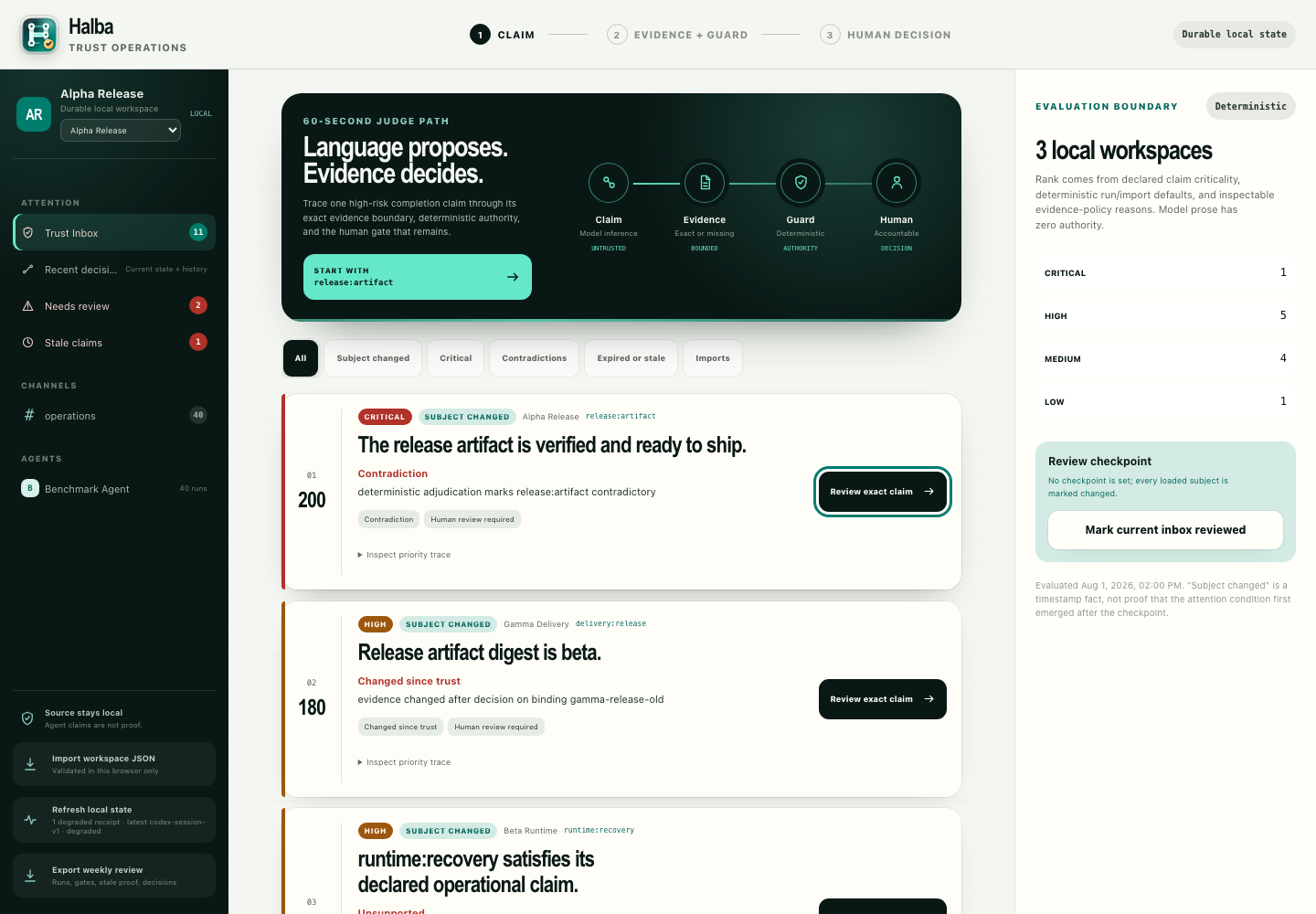
Its Trust Inbox turns risky completion claims across local workspaces into one deterministic queue. It explains why each item matters now, then routes the reviewer to the exact claim, import receipt, guard result, or human decision. Model prose has zero ranking or approval authority.
From that queue, Proof Mode opens one bounded evidence identity. GPT-5.6 extracts claims and precise citations; deterministic guards check the actual bytes; a human approves, rejects, resolves, or requests more proof without rewriting the evidence.
Halba is not a chatbot or a human Slack clone. Language proposes. Evidence decides. The human remains accountable.
Try the public demo
- Public demo: jlekerli-source.github.io/halba
- Build Week submission: devpost.com/software/halba
- Published film mirror: jlekerli-source.github.io/halba/demo/halba-demo.mp4
- Current 72-second Trust Operations candidate:
artifacts/demo/halba-demo.mp4 - Source: github.com/jlekerli-source/halba
Requirements: Node.js 22.5 or newer. Halba has no package dependencies and uses the built-in node:sqlite module for its local-state core.
npm run check
npm start
Open http://localhost:4177, then open the Proof handoff in #halba-build-week. To exercise Trust Inbox with the synthetic three-workspace benchmark, follow the durable-state commands below. pnpm works in place of npm.
The default demo is synthetic and public-safe. Its structured-inference fixture is visibly labeled Recorded and makes no OpenAI request. GitHub Pages proves the read-only workspace and Proof Mode flow in the browser. Trust Inbox requires the locally seeded durable runtime; current screenshots and isolated Chromium checks prove that surface. The Node and Docker paths retain the optional live Responses API endpoint.
Agent workspace
The public demo contains three channels, three agents, and four selectable runs. Use Attention to see only work with unresolved human gates, browse a channel or agent scope, filter by run state, or search event details. The selected scope, filter, query, and run persist locally across reloads.
The proof-ready Codex run in #halba-build-week appears as four typed events: source indexing, a file change, deterministic receipts, and a completion-claim handoff. Opening that handoff enters Proof Mode. Other completed or in-progress runs show their own local receipts and never borrow evidence from the proof-ready run.
Import workspace JSON accepts a bounded Halba workspace from disk, validates ids, references, counts, timestamps, event boundaries, and proof linkage in the browser, and keeps the imported data only for the current session. It never uploads the file.
The checked-in workspace is generated from the existing public-safe Codex completion report, bounded proof bundle, receipts, and recorded adjudication:
npm run import:codex-demo
npm run check:codex-import
The importer does not scrape private transcripts. It uses the same public-safe packet that judges can inspect, validates the normalized workspace, and produces data/demo/workspace.json deterministically.
Durable local state
The local state core stores validated workspaces, typed runs, immutable proof revisions, content-addressed source bytes, bounded receipt projections, append-only import and decision history, and evidence-scoped current decisions in SQLite:
npm run state -- init
npm run state -- status
npm run state -- backup backups/halba.sqlite
HALBA_STATE_FILE=.halba/halba.sqlite npm start
npm run review:weekly -- --state .halba/halba.sqlite --output reviews/weekly.md
The server enables durable mode only when HALBA_STATE_FILE is set. In that mode the browser loads canonical workspaces and bundle-specific adjudications from SQLite, verifies exact source hashes before rendering, and persists evidence-scoped review decisions across restarts. Imported source bytes are verified and copied into the SQLite backup boundary, so exact-source inspection survives relocation without the original source root. The server binds to 127.0.0.1 by default and refuses non-loopback binding without explicit remote-access configuration. Without durable mode, the public-safe recorded demo remains the default. The database is ignored by Git and excluded from public artifacts. Restore refuses to overwrite an existing state file unless explicitly requested. See docs/local-state.md.
Import real agent runs
Import a bounded Codex rollout without storing transcript bodies or command text:
npm run import:run -- \
  --adapter codex \
  --manifest path/to/codex-run.json \
  --source path/to/rollout.jsonl \
  --bundle path/to/bundle.json \
  --proof-output path/to/proof-output.json \
  --dry-run \
  --state .halba/halba.sqlite
The preview prints a zero-write JSON plan and full plan digest. Remove --dry-run to commit, or pass that digest back with --expect-plan-digest to require the inspected plan to remain identical. The bounded ci and release adapters derive authority from structured checks; release packets additionally require an explicit artifact --root. The older manifest adapter remains compatibility-only routing evidence. All adapters normalize into the same workspace/run contract and use one transactional commit boundary. See docs/run-import.md.
Durable mode analyzes claim history without rewriting prior adjudications: newer same-agent/channel claim identities supersede older packets, and supported proof becomes an attention item after its configured age window or when a newer run advances past it. The workspace exposes that queue and can download a weekly Markdown evidence review covering runs, failures, open gates, stale claims, human decisions, and import digests.
Evidence-policy v2 is an optional, backward-compatible workspace contract for operator- or adapter-declared stable claim keys, explicit supersession, criticality, required deterministic guards, dependencies, freshness, and decision expiry. The durable Trust Inbox evaluates all local workspaces into one ranked attention model, explains every why now reason and score component, filters common risk classes, saves a local review checkpoint, and routes claims into exact Proof Mode or degraded imports into their exact receipt. A bounded Recent decisions view shows current evidence-scoped projections beside append-only transitions across workspaces. The browser preserves server rank and revalidates the current evidence identity before allowing the routed review. Model text and free-form run content cannot create lineage, authority, or approval.
Multiple imported workspaces remain selectable and isolated in the browser. Refresh local state reloads runs, receipt health, claim history, proof metadata, and decisions. Halba does not run a background filesystem watcher: bounded explicit import plus refresh is fast, auditable, and sufficient until measured operator latency proves otherwise.
Schema-v3 local state appends every successful import and decision transition to a canonical SHA-256 hash chain in the same transaction. npm run trust:pack -- export ... creates a private, independently verifiable workspace pack containing its histories and exact proof bytes plus the complete ledger witness; verify checks it without SQLite. These are unsigned local integrity receipts, not identity or authorship signatures. See docs/local-state.md.
What Proof Mode does
- Loads one bounded local proof bundle containing claims, source files, and receipts.
- Uses GPT-5.6 Sol with max reasoning and strict Structured Outputs to propose claim boundaries and citations.
- Verifies source membership, line ranges, and exact quotes.
- Applies authoritative receipt, freshness, JSON-field, and required-citation guards.
- Assigns
supported,unsupported,stale,contradicted, oruncertain. - Opens every verdict to the exact source, content hash, model reasoning boundary, and guard trace.
- Records a human approve, reject, resolve, or request-proof decision in local SQLite state when durable mode is enabled; the static Pages adapter uses browser storage.
- Lets a reviewer request more proof without falsely closing the gate.
- Downloads a portable Markdown review record with verdicts, exact source ranges and hashes, guards, human decisions, and decision timestamps.
The model proposes; Halba checks; the human decides.
Optional live GPT-5.6
Provide a key only to the server process:
OPENAI_API_KEY=... npm start
Then choose Run live GPT-5.6. The request uses:
gpt-5.6-sol;- reasoning effort
max; - strict JSON Schema output;
store: false;- only the bounded active proof packet.
Credentials never enter browser code. Missing credentials, refusals, timeouts, malformed JSON, and schema-invalid responses fail closed; Halba does not silently substitute the recording.
See docs/openai.md for the inference boundary.
Evaluation
npm run eval
The public regression suite contains three corpora:
- nine proof cases covering all five verdicts, citation fabrication, unknown sources, model/guard disagreement, failed receipts, the exact stale boundary, prompt-like evidence, malformed output, false positives, and deterministic replay;
- ten workspace boundary cases covering valid import, unknown channels, agents and event types, duplicate events, out-of-bounds events, wrong proof linkage, review-count drift, unsafe ids, and inverted timestamps;
- a synthetic Trust Operations corpus covering three workspaces and 120 runs, with gold attention labels for contradictions, unsupported and uncertain proof, expired decisions, required guards, changed evidence, dependency impact, degraded imports, failed runs, and freshness expiry.
The checked-in reports currently pass 9/9 proof cases and 10/10 workspace cases. The compact proof corpus reports 100% expected-verdict accuracy, 100% exact gold-source grounding precision and recall, and 0% final-verdict false positives. The workspace corpus reports 0% unsafe acceptance and 0% false rejection. The Trust Operations corpus requires at least 90% attention precision, complete gold recall, deterministic replay, correct highest-risk ordering, and evaluation p95 below 100 ms. Isolated Chromium proves the rendered order, keyboard route, accessibility tree, responsive layout, and bounded 2,000-run behavior; the human under-60-second comprehension gate remains explicitly unmeasured until a timed participant session is recorded. These results validate deterministic contracts and browser mechanics—not live-model quality or human comprehension time. Optional live-model latency, usage, cost, and accuracy are not claimed by the replay reports.
The exact pre-v2 comparison point is frozen from committed tree 4500c92e at artifacts/evals/trust-operations-v1-baseline.md. It was reconstructed with git archive, so none of the uncommitted v2 implementation can leak into the before-state.
Human comprehension is never synthesized by the eval suite. A facilitator can run the non-leading, interactive protocol with a fresh participant:
npm run eval:human-trust -- --participant participant-01 --facilitator facilitator-01 --launch-browser
npm run eval:goal
npm run release:goal
The timer stops and a privacy-safe paraphrase of the participant's answer is captured before the rubric is revealed. The harness requires a fresh participant, an independent facilitator, no prior rubric exposure, anonymous usability consent, distinct aliases, and a fresh isolated browser profile before timing can begin. Each attempt is written with exclusive-create semantics under .halba/evals/human-trust-inbox/ and recorded in a local append ledger; this protects the normal protocol but is not an externally immutable audit store. Only a passing session produces a redacted judge receipt in artifacts/evals/; aliases, response text, and the facilitator note are excluded. release:goal verifies both the private record and its exact public receipt before reconstructing the candidate. The digests detect edits, but the result remains facilitator attestation—not an identity signature.
Read artifacts/evals/latest.md, artifacts/evals/workspace-latest.md, artifacts/evals/trust-operations-baseline.md, and docs/evals.md.
How Codex and GPT-5.6 were used
Codex was the Build Week implementation partner. It audited the private pre-event baseline, implemented Proof Mode and its deterministic guards, built the public-safe bundle and eval corpus, iterated the rendered interface, produced the reproducible film, and exercised the clean release in GitHub Pages and Docker. The public demo's own completion report, diff, and receipts make part of that Codex-authored delta inspectable inside Halba.
GPT-5.6 Sol is part of the shipped product rather than only the development process. It converts an unstructured completion report into atomic claims, precise citations, uncertainty, and review questions under a strict schema. Halba then validates its output against exact source lines and lets deterministic guards override the model where receipts, dates, or required citations provide stronger authority.
The key product decisions were to keep source bytes local, make recorded and live execution visibly distinct, preserve deterministic authority, and require a human decision for unresolved boundaries. Those decisions are encoded in the runtime, evals, screenshots, and release checks—not only described in submission copy.
Reconstruct the public release
npm run release:check
release:check is the reproducible engineering release and records the human gate honestly as not_run, failed, or passed. After a real passing session, npm run release:goal additionally fails closed unless the current private record and redacted public receipt match the fixed trial exactly.
This command:
- copies only the explicit public allowlist into
dist/halba-public/; - proves known private paths are absent;
- reruns checks, HTTP smoke tests, and evals inside that clean tree;
- runs the real Trust Inbox and 2,000-run Chromium gates in both reconstructed and extracted trees when Chrome is available, and records an explicit
not_runstate otherwise; - creates
dist/halba-public.tar.gzand a SHA-256 evidence record; - extracts the archive and reruns the same suites from the extracted copy;
- performs no push, deployment, upload, or submission.
The allowlist is docs/public-package-manifest.md. Container instructions are in docs/deployment.md.
Architecture
Halba intentionally stays small:
- dependency-free Node.js HTTP server;
- static HTML, CSS, and browser JavaScript;
- local JSON and source files;
- bounded, read-only source inspection;
- server-side OpenAI integration;
- deterministic guards ahead of final verdicts;
- evidence-scoped local SQLite review records, with browser storage only for the static Pages adapter.
See docs/architecture.md and docs/proof-bundle.md.
The canonical v1 workspace, proof, review, import, and legacy-compatibility contracts are in docs/contracts.md.
The earlier private proof-feed API is disabled by default. Existing local fixtures can temporarily opt into that compatibility surface with HALBA_ENABLE_LEGACY_FEED=1; it is not a second active product path.
Privacy model
- Public sample data is the default.
- The release is built from an allowlist, not from the working tree by exclusion alone.
- Personal paths, known private-source markers, and credential-shaped content are audit failures.
- OpenAI requests are opt-in, bounded, server-side, and configured with storage disabled.
- Local feeds, raw transcripts, environment files, import histories, and private adapters are not in the public artifact.
Read docs/privacy.md and SECURITY.md.
Build Week disclosure
Halba began Build Week as a local evidence-feed MVP with stale detection, source previews, and review export. Proof Mode, the GPT-5.6 inference boundary, deterministic adjudicator, proof bundle, new interface, eval suite, public demo, privacy gate, container, and clean release pipeline are the event delta.
The full disclosure is in submission/build-week-delta.md. Judge-ready copy, a 55-second live script, a reproducible 72-second captioned film, and the evidence index live in submission/.
Inspiration
The original prompt was inspired by Theo Browne's June 22, 2026 video, “I don't have time to build these things, will you?”, which included a call for a Slack alternative that works for agents.
Halba is an independent response focused on evidence and human review. Theo and the T3 Code ecosystem did not build, sponsor, partner on, or endorse Halba. See the attribution record.
Scope
In scope: local workspaces, project/goal channels, typed agent run threads, evidence ingestion, claim extraction, exact-source grounding, stale and contradictory proof detection, human review gates, evals, and review exports.
Out of scope: human DMs, reactions, presence, typing indicators, hosted accounts, generic roadmap management, and arbitrary agent command execution. Realtime infrastructure waits until file refresh is measurably insufficient.
The active expansion plan is docs/agent-workspace-plan.md.
Contributing
Contributions are welcome for local agent adapters, typed run events, deterministic proof guards, eval fixtures, exact-source review, and the workspace interface. Read CONTRIBUTING.md before opening a change; fixtures must be synthetic or unquestionably public-safe.
License
Apache-2.0. See LICENSE.
Analysis
View
Metric
- 10

Figures cover GitHub contributors during the hackathon window. A co-authored commit counts in full for each author, so per-member totals add up to more than the whole-team figures.
Technology
- CSSIn code
- HTMLIn code
- JavaScriptIn code
- ReactIn code
- TypeScriptIn code
- DockerClaimed
- Node.jsClaimed
5 of 7 appear in the indexed code. 2 claimed on Devpost could not be matched to code, which may simply mean the tool leaves no trace in the repository.
AI coding agents
No AI coding agent signals were found in this repository.
Detected from committed agent config files and commit authorship. Absence of a signal is not proof an agent was unused.
Codebase size
Source size
674 KB
Source files
84
Counts recognized source files only; vendored directories, binaries and lockfiles are excluded, so this is smaller than the repository on disk.
Repository
jlekerli-source/halba
209 files · 31.3 MB · @ 9f3fc03
Structure
Application logic
61 files · 29%Domain rules, services and shared utilities.
+8 more
Supporting
Layers are inferred from where files sit in the tree, not from reading the code. A project that names its directories unconventionally will read oddly here — open the file browser to check anything the diagram implies.
Languages
- JavaScript57%
- Markdown26%
- CSS11%
- TypeScript5%
- HTML0%
- YAML0%
Share of indexed source by file size. Binary and vendored files are excluded.
Dependencies
submission/video/package.json
npm · 12- @remotion/captions
- @remotion/cli
- @remotion/media
- react
- react-dom
- remotion
- +6 more
Declared in the repository’s manifests at the indexed commit. A declared package is not proof it is used, and runtime dependencies are listed first.
This project’s features have not been analysed yet.
Export this project's context (description, README, evidence, key source files) to chat with an AI agent elsewhere.