Project Info
Evidence → deterministic impact → recovery proposal → human approval → reversible history. Live application: https://inordo.vercel.app Demo video: https://youtu.be/eDPB6wtkFrM Source code: https://github.com/Chi944/InOrdo Track: Work & Productivity
Inspiration
A project update rarely changes only one record. If a summit venue moves by two weeks, the event date is obvious—but speaker confirmations, catering, programme deadlines, travel, accessibility arrangements, signage, and briefing materials may all become stale. Small teams often reconstruct that chain manually, under time pressure, with the source fact, inferred impact, and resulting edits scattered across different tools. We built InOrdo to make that chain of reaction visible and controllable.
What it does
InOrdo turns an unstructured project update into a reviewable workflow: Preserve the evidence. A typed or pasted update is stored as the source of truth. Draft a candidate change. GPT-5.6 extracts a bounded structured interpretation while keeping source fact and model inference visibly separate. Calculate downstream impact. Pure TypeScript traverses explicit project dependencies deterministically, returning direct and indirect effects with readable paths. Draft recovery actions. GPT-5.6 receives the validated change and deterministic paths, then proposes a bounded set of recovery actions. Require human approval. Every proposal remains inert until an authorized person selects specific allowlisted actions. Preserve history and undo safely. Applied changes record before/after state and actor attribution. Supported operations can be reversed through a linked compensating operation rather than erasing history. The submitted synthetic scenario is the Regional Climate Action Summit 2026: 24 active project records and 26 explicit dependencies. A venue update moves the summit from 12 September to 26 September 2026, allowing the reviewer to inspect its direct and multi-hop consequences. What makes InOrdo different InOrdo is not trying to replace broad work-management platforms. Instead, it focuses on a narrower trust boundary that begins when new evidence invalidates part of an existing plan: Evidence → structured change → deterministic reach → inert proposal → human approval → reversible history The model interprets and drafts, but it never decides graph reach, authorizes itself, or directly mutates project data. This combination of preserved evidence, explainable dependency paths, selective approval, and compensating undo is the core product idea.
How we built it
InOrdo is a Next.js 16 App Router application using React 19, TypeScript, Tailwind CSS, Supabase Postgres and Auth, and the OpenAI Responses API. The GPT-5.6 boundary is server-only. It has no tools or write authority. Strict schemas and application post-validation check identifiers, fields, values, dates, evidence spans, confidence, impact coverage, and allowlisted action types before model output can enter the review workflow. Dependency reach is deliberately not delegated to the model. A pure TypeScript traversal handles cycles, duplicate edges, depth limits, deterministic ordering, and stable shortest paths over one project’s active records. Supabase row-level security and server-side authorization enforce workspace and role boundaries. Before applying selected actions, the server rechecks proposal ownership, current item versions, action eligibility, human input, and idempotency. Supported undo operations recheck recorded after-state before creating a compensating transaction. Codex accelerated concrete work packages across the repository foundation, schema and RLS design, deterministic graph engine, strict model contracts, approval and undo services, accessible interface, automated tests, security review, and release evidence. Deston and Andres retained responsibility for product direction, design decisions, credentials, provider spending, approvals, and release authority.
Challenges we ran into
Making AI useful without giving it authority The model needed enough context to interpret an update and draft useful actions, but not enough authority to traverse the graph, approve work, or mutate data. We enforced that separation in server and database contracts rather than relying on interface copy. Keeping graph results reproducible Cycles, fan-out, duplicate edges, archived records, and multiple possible routes can make impact analysis ambiguous. We implemented bounded deterministic traversal with stable ordering and a best-depth policy so the same graph produces the same explainable paths. Making undo honest A button labeled “undo” is not sufficient. Safe reversal requires recorded before/after state, version checks, and a linked compensating operation. If state has become stale or the action is unsupported, InOrdo fails closed. Recording a real demo without exposing unlimited API usage We authorized exactly one purpose-specific Production GPT-5.6 run. After capturing and verifying the saved result, the recording key was revoked and Production returned to disabled analysis mode. Judges can inspect the genuine persisted result without being able to initiate paid requests. Accomplishments that we are proud of A coherent evidence-to-recovery workflow rather than an isolated AI feature. One verified Production GPT-5.6 journey from preserved evidence through direct and indirect impact, recovery proposal, explicit approval, apply, linked history, and compensating undo. A deterministic dependency engine with readable paths and coverage for chains, fan-out, fan-in, cycles, duplicates, archived items, maximum depth, ordering, and shortest-path behavior. Server-enforced human approval and role boundaries; model output never directly mutates data. A synthetic workspace containing six project-record types, 24 active records, and 26 explicit dependencies. 514 passing unit and component tests across 64 files, two guarded Playwright Chromium journeys, a successful production build, and zero audited production dependency vulnerabilities. A responsive, keyboard-accessible judging experience with an intentionally read-only viewer account.
What we learned
Structured output is only the beginning of a safe model boundary. Canonical-state validation, evidence checks, authorization, and deterministic application logic still matter. Explainability becomes much stronger when graph paths—not generated prose—are authoritative for dependency reach. “Human in the loop” must be a real server-side state transition. A checkbox alone does not provide control. Finally, honest limitations improve a demo. Disabled controls and explicit read-only states are better than implying that unfinished or unavailable capabilities work.
What's next
Add proposal correction and rejection workflows. Expand ordinary workspace creation, invitations, and project switching. Add authenticated end-to-end coverage and stronger operational monitoring. Introduce reviewed text/Markdown and CSV ingestion before considering broader connectors. Explore email, Slack, Teams, Google Drive, voice, and URL ingestion only after the standalone evidence-and-approval workflow remains reliable. Extend reversible operation support while preserving the same fail-closed contracts. Testing the submitted build Judges receive a dedicated read-only account through Devpost’s private testing instructions. They can navigate the synthetic workspace, inspect records and dependencies, open saved evidence, follow deterministic impact paths, review the persisted GPT-5.6 proposal, and inspect apply/undo history. New paid analysis and all project mutations are disabled for the judge account. The visible model result is the genuine saved Production result shown in the demo video. Current limitations are intentional and visible: only the synthetic summit workspace is provisioned; ordinary-project creation is an informational preview; and file, CSV, URL, voice, email, Slack, Teams, and Google Drive imports are not implemented.
InOrdo
Turn an unstructured project update into evidence-backed impacts and recovery actions—without giving the model permission to change the plan.


Open the application · Read the architecture · Follow the demo · Review release evidence
OpenAI Build Week · Work & Productivity · Built for small teams
InOrdo gives a team one reviewable path from new evidence to a safe project response. It preserves the source, uses a bounded server-side model route for interpretation and drafting, computes dependency reach in deterministic TypeScript, and requires an authorized person to approve each internal action. Applied operations are attributable and reversible only when the recorded contract says they are.
[!IMPORTANT] The canonical deployment is inordo.vercel.app. It serves the release built by direct Vercel CLI deployment from a clean worktree at reviewed
maincommit4f54cc1eec37d49aa6b1da6e0dafbc6f7d738d03. Post-recording Production deploymentdpl_BW4kvr2zMUNkwv46XEeMMFRJeisJisREADYat immutable inordo-caheq8v2h-chi944s-projects.vercel.app. Vercel Authentication remains enabled for Preview deployments only.Production is deliberately back in
ANALYSIS_MODE=disabled;/api/healthisreadywith analysis disabled. Exactly one bounded GPT-5.6 Production run succeeded, and its genuine saved evidence, direct and indirect impact paths, recovery proposal, selected internal date action, explicit human response, successful apply, linked history, and compensating undo remain viewable. Before that run, an older duplicate active InOrdo provider key was discovered and revoked. After the playable capture, the fresh recording key was revoked, zero active InOrdo keys remained, the VercelOPENAI_API_KEYwas removed, and local.env.recording.localwas deleted. New paid analysis is disabled.
Product interface
These captures show the implemented product interface from an optimized build. They are not a live-provider response or proof of an authenticated production session.
| Landing and change trace | Responsibility-separated workflow |
|---|---|
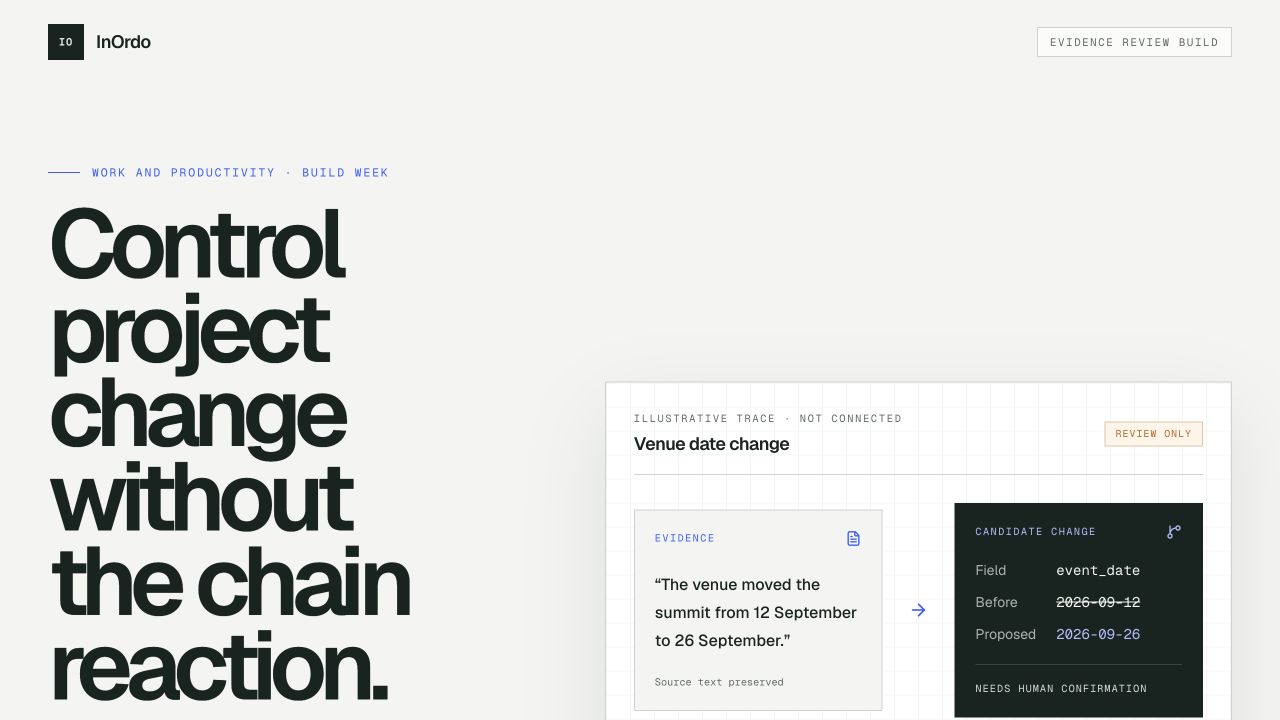 | 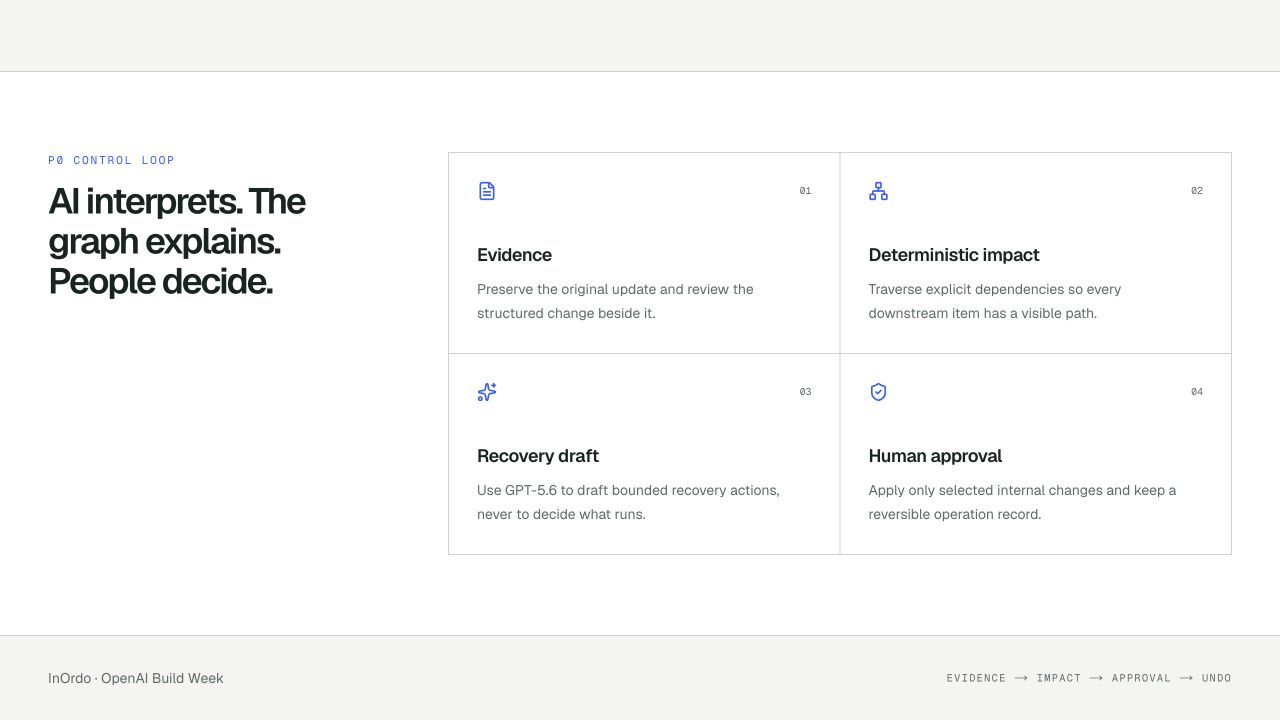 |
The completed external demo video uses genuine Production footage. These two checked-in images remain illustrative optimized-build captures and are not themselves proof of a live GPT-5.6 response; synthetic or intercepted test data must never be presented as one.
Contents
- Why InOrdo
- Where InOrdo fits
- How it works
- What is implemented
- Quick start
- Configuration
- Local development versus Vercel
- Architecture and safety contracts
- Testing and release
- Demo scenario
- Limitations and non-goals
- Documentation
- Contributing
- Submission handoff
- License
Why InOrdo
A venue change, shifted deadline, or revised decision rarely affects one record. It can invalidate tasks, milestones, risks, and shared artifacts several steps downstream. Small teams often reconstruct that chain manually, under time pressure, with the source fact, inferred impact, and resulting edits scattered across different tools.
InOrdo keeps those responsibilities visible and separate:
evidence → impact → proposal → approval → history and undo
- Preserve the raw update before interpreting it.
- Distinguish source fact from model inference.
- Derive downstream reach from explicit, inspectable dependencies.
- Show a full path for every direct or indirect impact.
- Keep drafted actions inert until selective human approval.
- Apply allowed internal changes atomically and record who did what.
- Undo only when the entire operation is supported and still safe to reverse.
Where InOrdo fits
InOrdo is not intended to replace a general-purpose work-management suite. The comparison below reflects each vendor's own published product emphasis; it does not claim that another product lacks adjacent capabilities.
| Product | Current first-party emphasis |
|---|---|
| Asana | Organization-wide project and work management, goals, reporting, resources, workflows, automation, and human-agent collaboration. |
| Jira | Planning, tracking, dependency management, collaboration, reporting, customizable workflows, integrations, automation, and AI assistance. |
| Linear | Product-development planning and execution for teams and agents, including intake, projects, issues, and updates; its documentation also describes explicit project dependency views. |
| monday work management | Board-based project and operational work management with views, dashboards, automations, integrations, and embedded AI workflows. |
InOrdo's Build Week P0 explores a narrower control loop: preserve an unstructured update as inspectable evidence, validate a structured candidate change, compute downstream reach with deterministic code, let the model draft inert recovery options, and require an authorized human to select allowlisted operations. Applied field updates retain actor-attributed history and support compensating undo only when the recorded contract remains safe.
The distinction is therefore an explicit evidence → deterministic impact → proposal → human approval → reversible history trust boundary—not a larger feature list or a claim of exclusive capability. InOrdo currently lacks the connector ecosystem, ordinary-workspace provisioning, and platform breadth of the products above.
How it works
flowchart LR
    E["Unstructured update"] --> S["Immutable evidence"]
    S --> X["Bounded model extraction"]
    X --> V["Strict schema and evidence validation"]
    V --> G["Deterministic graph traversal"]
    G --> D["Bounded recovery draft"]
    D --> H["Human selective approval"]
    H --> O["Atomic allowlisted operation"]
    O --> A["Actor-attributed history"]
    A --> U["Compensating undo when safe"]

    classDef model fill:#fff7ed,stroke:#c2410c,color:#431407;
    classDef deterministic fill:#eff6ff,stroke:#1d4ed8,color:#172554;
    classDef human fill:#f0fdf4,stroke:#15803d,color:#052e16;
    class X,D model;
    class S,V,G,O,A,U deterministic;
    class H human;
The reviewed provider policy supports an exceptional one-use GPT-5.6 recording route, a separately capped Vercel AI Gateway route using the open-weight GPT-OSS model, or a disabled state. A model has no tools, never traverses the graph, never authorizes a user, and never mutates data. Application and database code own canonical state, authorization, reachability, approval, idempotency, transactions, audit history, undo, and reset.
What is implemented
The P0 repository includes:
- a public landing page, email/password sign-in, and a protected workspace under
/app; - native tasks, milestones, decisions, events, risks, and artifacts;
- item, decision, risk, and dependency views, including item detail and editing;
- explicit directed dependencies and deterministic direct/downstream impact paths;
- immutable source intake and a mode-aware, server-only two-stage model boundary;
- persisted proposals with one to eight independently reviewable recovery actions;
- allowlisted, selectively approved internal operations with ordered history;
- compensating undo for eligible whole field-update operations;
- a generation-fenced reset for one named synthetic demo project; and
- unit, component, guarded browser, migration, RLS, and rollback-wrapped SQL verification paths.
This is a Build Week P0, not a production-readiness claim. Live-service and staged-release gaps are listed under Release status and Limitations and non-goals.
Access, input, and provider scope
- Available evidence input: typed or pasted project updates, manual notes, meeting minutes, and meeting summaries within the existing text limit.
- Not implemented: file upload, CSV import, URL fetching, voice, email, Slack, Teams, Google Drive, and other connectors. The interface exposes no fake upload or connector control.
- Project scope: the synthetic summit workspace is available. Ordinary project creation, invitations, switching, and provisioning are not implemented;
/app/projects/ordinaryis an informational preview only. - Judge scope: the dedicated judge account is
viewerand read-only. It may navigate and inspect saved synthetic records, evidence, paths, proposals, and history, but cannot analyze or mutate data. - Fallback scope: the optional fallback is open-weight GPT-OSS through a dedicated, capped Vercel AI Gateway. A quota can be exhausted and Gateway service is not guaranteed to remain free forever.
- Billing boundary: a user's ChatGPT subscription cannot authenticate or fund API calls made by this external application. Provider credentials and billing remain deployment/operator responsibilities.
Quick start
Prerequisites
- Node.js 22.x and npm.
- A Supabase project, or Docker Desktop/a compatible container runtime for local Supabase.
- An operator-created Supabase Auth user mapped to the synthetic workspace for protected-route testing.
- A dedicated provider credential only for an approved live-analysis mode: an exact one-use OpenAI recording grant or a separately capped Gateway fallback. Analysis may remain disabled.
Install and run
git clone https://github.com/Chi944/InOrdo.git
cd InOrdo
npm ci
cp .env.example .env.local
npm run dev
On Windows PowerShell, use Copy-Item .env.example .env.local instead of cp. Configure the names described below, restart the development server after changing them, then open http://localhost:3000.
The public landing page can render without private credentials. Protected data requires valid Supabase configuration and a provisioned account. Analysis is disabled unless the strict server policy selects an authorized provider route; the presence of a credential alone is not authorization. Keep .env.local ignored, and never paste its values into commands, issues, screenshots, logs, or commits.
For the complete Windows/macOS setup, least-privilege frontend setup, health checks, and authenticated review steps, use docs/local-run-and-test.md. Do not casually push a hosted database from the quick-start flow; hosted migrations use the exact approval gates in the deployment runbook.
Configuration
Configuration names belong in local .env.local and the appropriate Vercel environment only when that capability is needed. Values never belong in this README.
| Variable | Exposure | Purpose and rules |
|---|---|---|
NEXT_PUBLIC_SUPABASE_URL | Browser-safe | Supabase project URL. Vercel embeds NEXT_PUBLIC_* values into the client build. |
NEXT_PUBLIC_SUPABASE_ANON_KEY | Browser-safe | Anonymous key used with the signed-in session and RLS; it is not a service-role credential. |
SUPABASE_SERVICE_ROLE_KEY | Server only | Narrow privileged persistence after request-scoped user authorization. Never import it into a Client Component. |
OPENAI_API_KEY | Recording only, server only | Enables only an approved exact recording grant. Remove it immediately after the recording attempt. |
OPENAI_MODEL | Recording only, server only | Must be exactly gpt-5.6-luna; recording never falls back. |
DEMO_PROJECT_SLUG | Server only | Selects the exact checked-in synthetic project for workspace lookup and protected reset. |
DEMO_RESET_SECRET | Server only | Server-held reset guard; it is never supplied by browser code. |
ANALYSIS_MODE | Server only | Exactly disabled, recording, or auto. Absent or invalid values fail closed to disabled. |
AI_GATEWAY_API_KEY | Auto only, server only | Dedicated Gateway key with a nonrenewing hard quota and automatic top-up disabled. |
AI_GATEWAY_MODEL | Auto only, server only | Must be exactly openai/gpt-oss-20b. |
Only the two NEXT_PUBLIC_ variables may enter the browser bundle. Every other configuration name remains server-side. The application validates names and readiness without printing values, and it constructs no provider client until authorization plus the database claim select an exact route.
Local development versus Vercel
The same Next.js code runs in both places, but the runtime and configuration lifecycle differ.
| Concern | Local | Vercel |
|---|---|---|
| Code lifecycle | npm run dev provides hot reload on your machine. | Each deployment is an immutable cloud build. Production changes only after a new deploy/alias assignment. |
| Environment | Next.js reads ignored .env.local; restart after changing a variable. | Variables are scoped to Production, Preview, or Development. A change affects only a new deployment. |
| Public values | NEXT_PUBLIC_* values are compiled when the local process builds/starts. | NEXT_PUBLIC_* values are inlined at build time and frozen into that artifact. |
| Data services | Use the local Docker stack or an explicitly configured hosted Supabase project. | Server functions reach the configured hosted Supabase project over the network. |
| Reachability | Normally machine-only at localhost:3000. | Publicly available at inordo.vercel.app; Preview deployments remain behind Vercel Authentication. |
| Auth | Local callback URLs must be allowed in Supabase Auth. | The canonical domain and approved Preview wildcard must be configured as Auth redirects. |
| Runtime behavior | Long-lived developer process with local logs and resources. | Platform-managed functions, build artifacts, cold starts, request/body/time limits, and provider/network failure modes. |
| Verification | Best for fast unit, UI, and local database iteration. | Required for domain, cookie, redirect, environment-scope, hosted RLS/RPC, and production smoke evidence. |
The Vercel project uses Node.js 22.x and is deployed manually; it is not connected to automatic Git deployments. See docs/deployment-runbook.md before changing Production configuration or deploying.
Architecture and safety contracts
Technology
| Layer | Technology |
|---|---|
| Web | Next.js 16 App Router, React 19, TypeScript, React Server Components |
| Interface | Tailwind CSS 4, Lucide icons |
| Data and identity | Supabase Postgres, Auth, RLS, Supabase JS/SSR |
| Model boundary | One-use GPT-5.6 recording or capped Vercel AI Gateway GPT-OSS, OpenAI SDK-compatible server adapters |
| Validation | Zod plus canonical-state postvalidation |
| Quality | Vitest, Testing Library, Playwright, ESLint, TypeScript, SQL assertion suites |
| Toolchain | Node.js 22, npm |
flowchart TD
    B["Browser"] --> N["Next.js App Router"]
    N --> U["Request-scoped Supabase client"]
    U --> P["Supabase Auth + Postgres + RLS"]
    N --> R["Server-only analysis and operation routes"]
    R --> C["Authorization + canonical-state checks"]
    C --> M["OpenAI adapter"]
    C --> T["Pure TypeScript traversal"]
    C --> Q["Constrained Supabase RPCs"]
    Q --> P
    M -. "Structured drafts only" .-> C
Browser code receives only the public Supabase URL and anonymous key. Normal product reads use a request-scoped user client under RLS; the service-role client is not a general read path. OpenAI calls and privileged persistence live in server-only modules. RLS and database constraints remain the source of truth; hiding a control in the UI is never treated as authorization.
Analysis boundary
The server performs two bounded logical model calls:
- Extraction returns either no candidate or one structured candidate change from the source and a bounded canonical snapshot.
- Recovery drafting receives the validated change plus application-computed impact paths and returns one to eight inert recovery actions and annotations.
Both calls use strict Zod-backed structured output, canonical-state postvalidation, evidence-span checks, no tools, store: false, a 30-second timeout per call, and no automatic retries. IDs, fields, values, versions, dates, owners, and impact coverage are checked before derived data can persist. OpenAI is never called from a Client Component.
recording mode routes only an exact owner-issued, one-use actor/project/source grant to gpt-5.6-luna. auto mode routes only to openai/gpt-oss-20b through a dedicated capped Gateway key and never consumes the OpenAI recording key. disabled, invalid configuration, viewer access, exhausted quota, duplicates, and unauthorized requests create no provider call. A provider failure may preserve immutable evidence plus a failed claim, but it creates no proposal or project mutation.
An analysis claim has a fixed, nonrenewable three-minute lease. An active exact duplicate returns 202 with Retry-After; replay after expiry terminalizes the same claim instead of spending on a second model attempt. Idempotent completion accepts one owner of the claim, and late provider results plus their derived writes are rejected atomically.
Deterministic dependency graph
Dependency direction follows the database contract:
from_item_idis the dependent item;to_item_idis its upstream prerequisite or context; and- when an upstream item changes, traversal follows reverse adjacency to find what it affects.
Pure TypeScript breadth-first traversal considers active records only, terminates cycles and self-loops defensively, deduplicates edges and affected records, and returns stable direct/indirect paths. A best-depth map preserves the deterministic shortest/best path. Default maximum depth is 5 and the validated maximum is 20. The graph function makes no network or model call.
Approval, history, and undo
- A proposal is not permission. Only an authorized owner/admin can select specific action IDs and confirm the operation.
- Only an eligible, fully linked proposal can move from
drafttoreadyon the server. That transition approves nothing: actions remain pending, and the UI fails closed in every other state. - The mutation vocabulary is allowlisted: field update, constrained task creation, constrained risk creation, and confirmation activity.
- Authorization, proposal readiness, action state, expected item versions, human responses, payload bounds, and idempotency are rechecked server-side.
- Set-level validation rejects duplicate target-field updates and incompatible same-item dates; create-item audit receipts are rebuilt from the committed row rather than caller or model JSON.
- Selected actions, record changes, proposal transitions, and ordered before/after audit entries commit in one transaction or none do.
- History is actor-attributed and append-only.
- Undo is available only for an entire operation made solely of reversible field updates, and only while current state still matches every recorded after-state.
- Undo creates a linked compensating operation. It never edits or erases the original history.
Demo reset
Reset is restricted to an owner/admin, the exact configured synthetic project, and a server-held guard. It restores the checked-in baseline of 24 active records and 26 edges, retires nonbaseline records, advances the project workflow generation to fence stale requests, and preserves prior evidence and operation history as archived history. It is not a general workspace-delete endpoint.
Native record mutation rollout
Native create/update item and create/remove dependency writes use four authorized, generation-fenced, idempotent RPCs. Migration 20260719140000_guard_project_record_mutations was the expand phase: it added the private receipt ledger and RPCs while temporarily retaining legacy contributor DML. After the exact RPC artifact passed hosted create, update, dependency-add, dependency-remove, replay, and reset smoke tests, reviewed PR #17 merged and the separately approved 20260720190000 contract migration was applied by itself.
The linked ledger now has exact parity through 20260721100000_add_analysis_access_policy.sql. That exact migration was applied only after a sanitized linked-target match, a second dry run, and the owner's exact approval; its SHA-256 is 0F4125F0897FE96A942889EF57C8A4CC186F730539597149EB98CABEA4939B1F. Post-apply parity and linked database lint passed with no pending migration. The earlier contract verifier proves legacy table and column write grants/policies are absent, member reads remain, direct DML is denied, all four RPCs succeed, exact retry deduplicates, and true nonmembers are rejected. Because the migrations are forward-only, a pre-RPC deployment is no longer a valid rollback target. The authoritative containment and forward-recovery rules are in the deployment runbook and rollback plan.
Repository map
.
├── src/
│   ├── app/                     # Landing, login, protected workspace, API routes
│   ├── features/
│   │   ├── analysis/            # Intake, model adapter, validation, orchestration
│   │   ├── impact/              # Pure deterministic graph traversal
│   │   ├── operations/          # Apply, history, undo, reset
│   │   └── project-records/     # Typed item/dependency operations
│   ├── lib/                     # Auth, environment, repositories, Supabase clients
│   └── types/                   # Generated database types
├── supabase/
│   ├── migrations/              # Forward-only schema and contract migrations
│   ├── tests/                   # Rollback-wrapped SQL assertions
│   └── seed.sql                 # Credential-free fictional summit fixture
├── docs/                        # Product, architecture, QA, release, submission
└── .github/                     # CI and contribution templates
Testing and release
Commands
| Command | Purpose |
|---|---|
npm run dev | Start the local development server. |
npm run lint | Run ESLint. |
npm run typecheck | Check TypeScript without emitting files. |
npm run test | Run Vitest in watch mode. |
npm run test:run | Run unit and component tests once. |
npm run test:e2e | Run the guarded Chromium journey; provider/database seams are intercepted, so this is not live-service evidence. |
npm run build | Create the optimized production build. |
npm run start | Serve the optimized build. |
git diff --check | Detect whitespace errors in the patch. |
Before committing, run:
npm run lint
npm run typecheck
npm run test:run
npm run build
git diff --check
Local Supabase verification starts with npx --no-install supabase start and may use npx --no-install supabase db reset to replay migrations and supabase/seed.sql. db reset is destructive: run it only against the local or an explicitly disposable demo database. Linked hosted migrations, rollback-wrapped SQL suites, security checks, and release approval are documented separately; do not infer them from an application build.
Release status
| Area | Current evidence | Still required |
|---|---|---|
| Application | The exact release SHA passed under Node 22.23.1/npm 10.9.8: lint, typecheck, 514 tests across 64 Vitest files, two Chromium journeys, the Next.js 16.2.10 production build, a zero-vulnerability production audit, and whitespace checks. | Keep future changes behind their own review and gates. |
| Database | Hosted migrations have exact parity through 20260721100000; the policy migration checksum, second dry run, exact approval, post-apply parity, empty pending set, and linked database lint are recorded. | Preserve parity and use a new reviewed forward migration for any correction. |
| Provider safety | The recording deployment was READY with analysis recording_configured. One exact 14-minute grant authorized one successful GPT-5.6 Production run. Canonical-source and fresh-duplicate gates passed; post-capture verification found one claimed, consistent, expiry-valid grant. The older duplicate provider key and fresh recording key were revoked, zero active InOrdo keys remained, the Vercel key was removed, and Production returned to disabled mode. | Keep new paid analysis disabled; any future attempt requires an entirely new approved key/grant lifecycle. |
| Browser and media | Exactly one owner, one admin recording operator, and one viewer judge were verified as three distinct real Auth identities. The sanitized operator journey captured genuine saved evidence, deterministic direct/indirect impact, recovery proposal, explicit human approval, apply, linked history, and compensating undo. Fresh isolated viewer QA covered signed-out redirect, login/session refresh, five routes at 375/768/1440, keyboard focus, reduced motion, no overflow, and disabled/absent mutation controls. The public 2:44 YouTube upload resolves without sign-in with the reviewed title and audio formats. | Keep broader automated-only announcement coverage labeled as such. |
| Deployment and submission | Post-recording Production dpl_BW4kvr2zMUNkwv46XEeMMFRJeisJ is READY at public inordo.vercel.app, with health ready and analysis disabled. The public YouTube URL and primary Codex feedback reference are recorded in Devpost. | Record the final repository SHA in Devpost, obtain explicit rules acceptance, and submit before the deadline. |
Vercel deployment is manual—there is no Git-connected automatic deploy. Production must use Node.js 22.x, a clean reviewed main equal to origin/main, correctly scoped environment names, and the canonical alias. Environment changes require redeployment. Supabase Auth allows the canonical production origin, documented local redirects, and the approved account-scoped Preview wildcard. Deston confirmed on July 20, 2026 that the current Vercel Hobby terms permit this hackathon demo; that project-owner confirmation is recorded as operational evidence, not legal advice.
Never treat db push --dry-run as mutation authorization, never deploy a feature branch as Production, never expose a server secret to Preview/client code, and never describe a build/test seam as live provider or RLS evidence. Use:
- QA checklist for exact completed and pending evidence;
- release evidence for commit/deployment identity;
- deployment runbook for environment, migration, deploy, smoke, and rollback commands;
- security review for the threat checklist; and
- rollback plan for forward-only database and application containment.
Demo scenario
The fixture is the fictional Civic Futures Lab — Regional Climate Action Summit 2026: eight fictional team members, 24 active project records, and 26 explicit dependencies. No customer data or credential is included.
The demo source moves the summit from 12 September 2026 to 26 September 2026 because the venue is unavailable. The intended review path is:
- sign in with an operator-provisioned email/password account and open
/app; - paste the exact venue update and preserve it as evidence;
- compare the source with the structured candidate change;
- inspect deterministic direct and indirect paths, including event → speaker confirmation → programme lock → briefing pack;
- review one to eight recovery actions and leave any cost-sensitive travel decision unselected;
- confirm only the chosen actions, then inspect actor-attributed history; and
- undo an eligible whole field-update operation or run the protected named-demo reset.
The protected workspace also exposes /app/projects, /app/items, item detail, /app/decisions, /app/risks, and /app/dependencies. Follow the exact source, expected path, presenter notes, and stop conditions in docs/demo-scenario.md. Ordinary-project provisioning is not implemented; its route is informational. Account provisioning stays out of source control and is described in docs/demo-user-setup.md.
Limitations and non-goals
| Limitation | Practical effect |
|---|---|
| New live analysis is deliberately disabled. | The verified saved GPT-5.6 result remains reviewable, but no usable InOrdo recording key or Production Gateway key is configured, so the deployed application cannot spend provider credit. A new result would require a new one-use recording gate. |
| GPT-OSS fallback has a real cost boundary. | The route supports a dedicated capped Vercel AI Gateway key, but no Production Gateway key is currently configured; future quota may be exhausted and service is not guaranteed to remain free forever. |
| Ordinary workspaces are informational only. | Project creation, invitations, switching, and provisioning are not implemented in this Build Week release. |
| Judge access is intentionally read-only. | The viewer may inspect the synthetic workspace but cannot analyze, create, edit, apply, undo, reset, remove, or delete. |
| Evidence input is text-only. | Typed/pasted updates, manual notes, meeting minutes, and summaries are available; files, CSV, URLs, voice, email, and connectors are not. |
| Some accessibility evidence is layered. | Real Production passed the fresh isolated responsive, landmark/heading, keyboard-focus, reduced-motion, redirect/session, and viewer-control checks. Status announcements, dialog focus return, and non-color semantics remain supported by automated component/Playwright evidence rather than a second live provider run. |
| Supabase leaked-password screening is unavailable on the current Free plan. | Keep the synthetic demo password unique, generated, out of source control, and rotate it if exposure is suspected. |
| Undo is intentionally narrow. | Only an entirely reversible field-update operation with matching current after-state can be compensated. |
Analysis finalization takes whole-table SHARE locks on item/dependency tables. | Other-project writes may wait; P0 is bounded to a low-volume synthetic demo pending project-scoped coordination. |
| Dependency management loads at most 500 edges without a truncation indicator. | The 26-edge fixture is complete; larger projects must not treat the screen as a complete inventory. |
| Preview protection and operator-held credentials constrain authenticated QA. | Public Production access is available, while login credentials and provider spend remain explicit human responsibilities. |
Outside P0:
- external connectors and synchronization engines;
- embeddings, vector search, RAG, or semantic search infrastructure;
- autonomous model-driven mutation;
- enterprise administration and production-scale observability;
- native mobile applications; and
- alternate backends, graph databases, or workflow orchestrators.
The current priorities and scale follow-ups live in docs/backlog.md.
Documentation
| Document | Use it for |
|---|---|
| Product brief | Purpose, P0 scope, actors, and acceptance principles. |
| Architecture | Trust boundaries, schemas, graph semantics, model/data contracts, and invariants. |
| Local run and test | Safe environment setup, local/hosted modes, and role-specific verification. |
| Demo user setup | Provisioning separated owner/operator/judge Auth identities without committing credentials. |
| Devpost judge handoff | Read-only test path, mutually exclusive result copy, private credential rules, and account retirement. |
| Demo scenario | Fictional source, expected paths, presenter flow, and stop conditions. |
| Security review | Threat checklist, completed evidence, and remaining live checks. |
| QA checklist | Automated, SQL, browser, accessibility, and production gates. |
| Release evidence | Exact commit/deployment status and evidence matrix. |
| Deployment runbook | Manual Vercel/Supabase release, exact approvals, smoke, and recovery. |
| Rollback plan | Containment, compatible artifacts, forward migrations, and domain compensation. |
| Backlog | P0 closure, roadmap, and scaling debt. |
| Codex log | Public work-package summaries without private transcripts. |
| Submission copy · video script · submission checklist | Final Build Week packaging and human handoff. |
Contributing
Read AGENTS.md before making changes. It defines Deston/Andres ownership, architecture boundaries, secret handling, required checks, branch naming, and the non-negotiable rule that model output never directly mutates data.
Use short-lived deston/, andres/, or codex/ branches as appropriate, keep commits focused and conventional, preserve unrelated work, and never force-push a shared branch. Pull requests should state user-visible behavior, trust-boundary changes, tests run, and remaining human gates.
How Codex accelerated the build
Codex supported scoped implementation and review across the repository foundation, schema/RLS, deterministic graph engine, strict GPT contracts, operation/undo/reset boundaries, accessibility-focused UI, automated checks, and release documentation. Human owners retained product decisions, credentials, approvals, provider spend, and deployment authority. Public work-package summaries are in docs/codex-log.md; no private transcript is committed.
Submission handoff
| Item | Public value or required action |
|---|---|
| Track | OpenAI Build Week — Work & Productivity |
| Repository | github.com/Chi944/InOrdo |
| Production application | inordo.vercel.app — public post-recording deployment dpl_BW4kvr2zMUNkwv46XEeMMFRJeisJ, released from clean reviewed SHA 4f54cc1eec37d49aa6b1da6e0dafbc6f7d738d03; saved verified GPT-5.6 evidence is viewable, new analysis is disabled, and Preview deployments remain protected |
| Demo access | The judge-only viewer credential and instructions are saved privately in Devpost; the repository retains only the non-secret judge handoff. |
| Demo video | InOrdo — Evidence-Backed Project Recovery — public, 2:44, and verified without sign-in |
| Devpost entry | InOrdo on Devpost |
| Team | Deston — Engineering, Data & AI Safety; Andres — Product Design & Experience. Andres is a confirmed Devpost team member. |
| Primary Codex feedback Session ID | 019f70e9-a3ae-7e43-b97a-f62016c32629 — identifier only; no private transcript is published |
| Deadline | July 21, 2026 at 5:00 PM PDT / July 22, 2026 at 8:00 AM SGT, subject to final confirmation against the official schedule |
Before submission, record the final merged repository SHA in Devpost, verify the public links signed out, accept the official rules and Devpost terms, and submit before the deadline. Then lock the repository, deployment, Devpost entry, and video as required. The full owner-by-owner checklist is docs/submission-checklist.md.
License
InOrdo is available under the MIT License, currently attributed to the InOrdo Hackathon Team.
Deston and Andres have confirmed authorization and consent for the supplied photos and likenesses used in the video and thumbnail, and approved the temporary MIT attribution InOrdo Hackathon Team for this submission.
Analysis
View
Metric
- 88
- 1


Figures cover GitHub contributors during the hackathon window. A co-authored commit counts in full for each author, so per-member totals add up to more than the whole-team figures.
Technology
- CSSIn code
- Next.jsIn code
- OpenAIIn code
- ReactIn code
- SQLIn code
- SupabaseIn code
- Tailwind CSSIn code
- TypeScriptIn code
- PostgreSQLClaimed
- VercelClaimed
8 of 10 appear in the indexed code. 2 claimed on Devpost could not be matched to code, which may simply mean the tool leaves no trace in the repository.
AI coding agents
- CodexConfig
Detected from committed agent config files and commit authorship. Absence of a signal is not proof an agent was unused.
Codebase size
Source size
2.1 MB
Source files
233
Counts recognized source files only; vendored directories, binaries and lockfiles are excluded, so this is smaller than the repository on disk.
Repository
Chi944/InOrdo
251 files · 2.6 MB · @ 83ca759
Structure
Interface
41 files · 16%Screens, components and styles rendered to the user.
API & routing
6 files · 2%Request entry points: routes, handlers and controllers.
Application logic
45 files · 18%Domain rules, services and shared utilities.
Data & schema
29 files · 12%Schema definitions, migrations and data access.
Supporting
Layers are inferred from where files sit in the tree, not from reading the code. A project that names its directories unconventionally will read oddly here — open the file browser to check anything the diagram implies.
Languages
- TypeScript42%
- SQL29%
- Markdown29%
- YAML0%
- CSS0%
Share of indexed source by file size. Binary and vendored files are excluded.
Dependencies
package.json
npm · 26- @supabase/ssr
- @supabase/supabase-js
- clsx
- date-fns
- lucide-react
- next
- openai
- react
- react-dom
- tailwind-merge
- zod
- +15 more
Declared in the repository’s manifests at the indexed commit. A declared package is not proof it is used, and runtime dependencies are listed first.
This project’s features have not been analysed yet.
Export this project's context (description, README, evidence, key source files) to chat with an AI agent elsewhere.