Project Info
Inspiration
The moment that triggered BOB Forge was simple: an HTTP health check said the service was alive, but its WebSocket feed had already stopped after close code 1012. A coding agent can propose a convincing fix, but a proposal is not a release. Someone still has to isolate the change, prove what was tested, decide whether those exact bytes may deploy, measure recovery, and preserve a rollback record. I built BOB Forge to explore one question: can an AI repair a real incident without becoming the release authority?
What it does
BOB Forge is a local-first release control plane for a real, intentionally broken reconnect service. The full flow runs on a Windows PC and can be steered from a phone on the same Wi-Fi network: The operator submits the stalled-feed incident. Locally authenticated Codex and GPT-5.6 inspect an isolated per-task Git copy and return a structured diagnosis and bounded repair proposal. BOB Forge validates the proposal, permits only the registered source edit, and applies it outside the model process. Fixed compile and reconnect gates run inside hardened local Docker containers while the original source remains untouched. A human reviews the result on a paired phone. Approval is bound to five integrity digests: the plan, tested artifact, baseline, candidate, and deployment manifest. Only the approved frozen bytes reach the local Docker sandbox. BOB Forge measures recovery, rehearses an exact rollback, and exports a portable evidence pack with a semantic verdict. The demonstrated repair changes one file. The broken client receives two messages and stops; the tested candidate reconnects with bounded exponential backoff and reaches the required message count. Why it is different Most agent demos focus on whether a model can write a patch. BOB Forge focuses on everything that must be true after the patch looks plausible. Codex owns reasoning. Deterministic software owns file scope, patch validation, commands, tests, approval, deployment, health measurement, rollback, and evidence. There is no automatic switch to a paid API provider, and the default demo uses the user's existing local Codex authentication rather than an OpenAI API key. This separation is useful for solo developers and small teams that want agentic speed but do not have a dedicated SRE or release engineering function. It turns “the model says the fix works” into a reviewable chain of observed facts. How I built it The control plane is written in Python and persists tasks, versioned state transitions, events, artifacts, approvals, deployments, and recovery state in SQLite. Durable server-sent events replay after reload. A responsive HTML, CSS, and JavaScript HUD exposes the same authoritative state on desktop and mobile. The local Codex provider consumes structured JSONL. A bounded inspector selects context from an isolated Git copy, and the source plus Git metadata are hashed before and after the model turn. The patch engine enforces selected-file membership, expected hashes, exact replacements, path and size limits, secret checks, and Python AST restrictions. Docker test and deployment commands are fixed by the product, not authored by the model. Approval is versioned and fails closed if any bound digest changes. The exported schema-v2 Evidence Pack can be checked by a standalone verifier without Codex, Docker, an API key, or phone access. How I used Codex and GPT-5.6 During Build Week, Codex was my implementation and review partner for the independent BOB Forge control plane, reconnect fixture, safe patch boundary, Docker gates, phone workflow, failure handling, tests, and submission packaging. It accelerated repository inspection, implementation, debugging, security review, and repeated verification. I made the product and release-authority decisions: one honest vertical slice, local Windows execution, explicit human approval, no source merge or push, and no automatic paid-provider fallback. Inside the product, the local Codex CLI runs GPT-5.6 with ultra reasoning to produce the diagnosis, evidence, bounded plan, selected file, exact edits, requested tests, diff explanation, and risk. GPT-5.6 cannot apply the patch, choose commands, approve a release, or deploy. BOB Forge records the concrete provider, model, reasoning effort, transport, billing mode, and whether any degraded path was used. Challenges and lessons The hardest challenge was not reconnect logic. It was maintaining one trustworthy identity for the candidate across analysis, validation, approval, deployment, rollback, and export. That led to immutable snapshots, digest-bound approvals, fail-closed state transitions, and a portable verifier that recomputes the evidence verdict. I also learned that a truthful local-first product needs to survive reloads and long model turns without faking progress. Durable events, resumable state, explicit readiness, and visible failure states became core product features rather than polish. Build Week disclosure BOB Forge is a separate repository created during Build Week. Its first provenance commit, 52131cd, preserves a visual HUD foundation imported from my pre-existing Hermes OS project. That visual language, animation system, responsive layout foundation, and service-worker foundation are not claimed as new work. The BOB-specific control plane, local Codex boundary, isolated Git workspaces, validation engine, Docker gates, phone approval workflow, deployment and rollback system, evidence format, portable verifier, and product workflow were built during Build Week. The repository contains the detailed boundary and dated commit history. Current scope The submission intentionally proves one deep vertical slice: reconnect-demo, one permitted source file, and a local Docker target. It does not claim arbitrary-repository autonomy or production deployment. The rollback rehearsal restores the exact registered broken baseline to prove reversibility; it is not presented as a previous healthy production release. BOB Forge is built around one principle: an AI-generated patch should not automatically become a release.
BOB Forge
BOB Forge turns an issue into a verified fix.
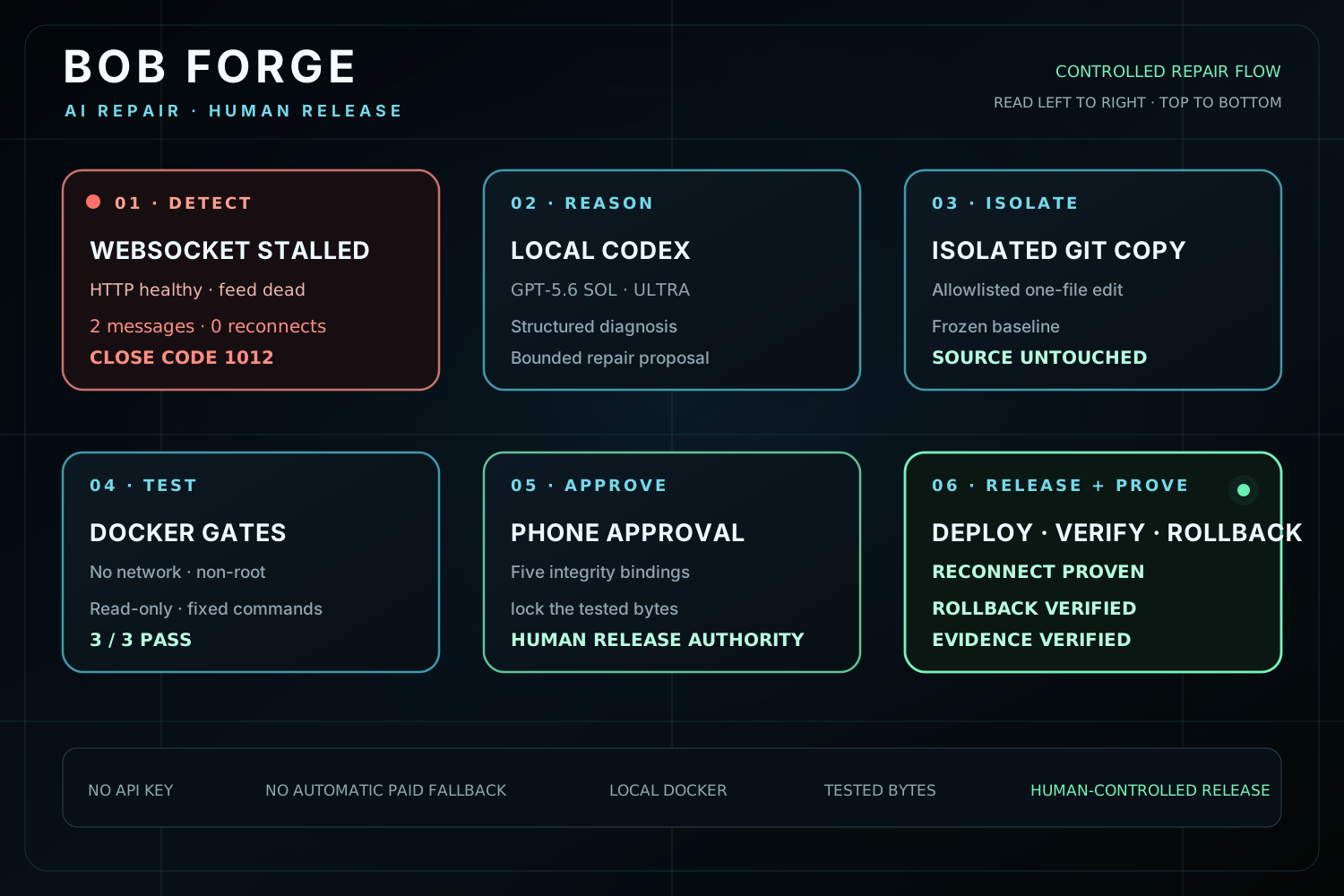
BOB Forge is for solo developers and small teams that do not have dedicated SRE or DevOps staff. It is a local-first Build Week engineering demo that inspects one registered read-only project, asks a structured execution provider for a bounded repair proposal, copies the source into an isolated local Git workspace, validates and tests the change, then waits at one post-test human approval gate. An approved artifact can target only the local Docker sandbox. There is no VPS, hosted control plane, production deployment, source merge, or push path.
Why not just Codex? Codex is the repair intelligence and proposal engine; BOB Forge is the deterministic control plane around isolation, patch validation, testing, human approval, portable evidence, local deployment, health verification, and rollback. The model proposes a repair, while BOB Forge owns what may run and whether the tested release may deploy.
Honest hackathon scope: the current product supports one bundled target,
reconnect-demo. It repairs a real intentionally broken WebSocket reconnect fixture; it is not yet a generic arbitrary-repository agent or a production deployer.
Judge demo path
1. Watch the product
The public demo URL is supplied in the Devpost entry. It shows the real reconnect-demo repair flow, including local Codex/GPT-5.6 analysis, isolated Docker gates, phone approval, measured health, explicit rollback, and the final evidence verdict.
2. Verify the preserved run
The final redacted Evidence Pack can be checked without Docker, a phone, an API key, or access to the developer's Codex login:
.\scripts\verify-evidence.ps1 C:\path\to\bob-forge-evidence-task_id.json
The verifier recomputes the canonical-payload self-consistency digest, stable run digest, and semantic verdict, then exits non-zero on a mismatch. Judge Mode also embeds the final application commit. This portable path is evidence verification, not a simulated model run or a hosted demo; see Judge test path for the trust boundary.
3. Run a complete local repair
From the repository root, run the clean-checkout preflight once. It validates the local ChatGPT Codex login, the project-pinned local Docker engine, tests, linters, reset, and fixture warmup without starting the server:
.\scripts\preflight.ps1
After committing the exact bytes under review, create a real local-Codex/Docker proof with:
.\scripts\run-e2e.ps1
For the timed run, keep the PC and phone on the same trusted Wi-Fi and start:
.\scripts\judge-demo.ps1 -LaunchOnly
Open the newly printed /pair URL on the phone, enter that restart's code, submit the prefilled reconnect-demo incident, inspect the isolated diff and Docker test evidence, approve the exact artifact, show reconnect health, roll back to the measured broken baseline, and tap Export evidence pack. The current export is schema v2: require verdict.status = "VERIFIED" and verdict.verified = true; INCOMPLETE or MISMATCH is evidence of a missing or contradictory proof, not a passing demo. The concise operator flow is in Judge quickstart, and the full cue sheet is in docs/JUDGING.md. If a physical phone is unavailable, use the same HUD on loopback and say so; never weaken the access checks.
Quick start
Requirements: Python 3.12+, PowerShell, Git, an installed Codex CLI signed in through ChatGPT, and a running local Docker Desktop engine for executable validation/deployment. Node.js is optional and is used only for frontend syntax checks. Setup now verifies the project-resolved local Docker endpoint and a real engine response; Docker absence fails before model-authored code can run, with no host or remote-daemon fallback. The default local Codex path uses the user's eligible ChatGPT Codex plan, explicitly pins Build Week runs to gpt-5.6-sol with ultra reasoning, and does not require an OpenAI API key.
Set-Location -LiteralPath '<path-to-cloned-bob-forge-repository>'
.\scripts\setup.ps1
.\scripts\start-demo.ps1
Open http://127.0.0.1:8138, select reconnect-demo, and submit the prefilled reconnect incident. Runtime state is stored under .bob-forge/ and can be removed safely with:
.\scripts\reset-demo.ps1
start-demo.ps1 always runs the BOB Forge control plane as a Windows host process so it can use the local Codex and Docker CLIs. docker-compose.yml now launches only the intentionally broken upstream and broken-demo fixtures; it is not a BOB Forge server or deployment adapter. The root control-plane image was removed. Deployment builds the reviewed demo_service/Dockerfile separately from the content-addressed pre-change baseline and the frozen candidate that already passed Docker tests.
Execution selection is explicit:
local_codexis the default and uses hardened directcodex exec --json --sandbox read-onlywith user config/rules ignored for the task boundary, explicitly passing--model gpt-5.6-solandmodel_reasoning_effort="ultra"; the complete bounded event stream is rejected if it reports command, file-change, web-search, or tool actions;- the pinned beta SDK remains available only through explicit
BOB_FORGE_CODEX_TRANSPORT=sdk_opt_in, because it does not provide an equivalent ignore-user-config/rules boundary; - deterministic fallback is disabled by default; only a prepared non-judge
reconnect-demomay opt in with the exactBOB_FORGE_ALLOW_DETERMINISTIC_FALLBACK=YESsetting; openai_apiis a separate paid opt-in requiringBOB_FORGE_EXECUTION_PROVIDER=openai_api,OPENAI_API_KEY, andBOB_FORGE_CONFIRM_PAID_API=YES.
Judge Mode forces BOB_FORGE_ALLOW_DETERMINISTIC_FALLBACK=NO and fails closed if local Codex is unavailable. There is never an automatic provider switch or paid-API fallback; an API key alone does not activate paid mode. See execution and cost and OpenAI integration.
BOB_FORGE_CODEX_MODEL and BOB_FORGE_CODEX_REASONING_EFFORT can override those local defaults with validated values. /api/system/status reports the actual configured model and effort so the HUD can show what will run rather than inheriting an invisible global Codex setting.
Optional paired phone view
Loopback is always the default. On a trusted same-WiFi network, an explicit exact RFC1918 address enables paired phone access:
.\scripts\start-demo.ps1 -LanAddress 192.168.1.25                 # lan-readonly
.\scripts\start-demo.ps1 -LanAddress 192.168.1.25 -AllowLanControl # lan-control
The script verifies that the address is assigned to this PC on a Windows Private network profile, prints a restart-scoped /pair URL/code, and creates no firewall rule. LAN mode uses plain HTTP: use it only on trusted WiFi. The pairing cookie protects static/API/SSE access; control mode additionally uses exact Origin checks and session-bound CSRF. No HTTPS tunnel or VPS path is implemented or enabled by default.
What is real
- SQLite tasks, versioned transitions, events, commands, artifacts, approvals, deployments, and crash-boundary recovery;
- durable SSE replay through
Last-Event-ID, reload recovery, periodic persistedexecution_provider / workingheartbeats while local Codex is analyzing, and exact same-origin local HTTP enforcement; - bounded repository inspection, a fresh isolated Git baseline per task, provider-mutation detection including
.git, a client-only edit allowlist, AST checks, and real pre-approval tests inside hardened local Docker; - one post-test release approval bound to the current task version, diagnosis/plan evidence, immutable pre-change baseline, tested candidate, and canonical deployment manifest; both frozen source-plus-Git trees are re-hashed before deployment and captured as deterministic Docker tar/stdin bytes;
- local-only Docker build, health proof, and rollback adapters;
- schema-v2 redacted judge evidence with a self-digest and semantic
VERIFIED/INCOMPLETE/MISMATCHverdict over local-Codex execution, integrity, tests, approval, deployment, health, and rollback bindings. - a portable evidence verifier, stable run digest across repeat exports, and Judge-Mode application-commit binding; these prove internal consistency and release provenance but are not claimed as third-party signatures.
The WebGL/Canvas Core, Orbit, animation engine, and timing constants are prior Hermes OS work reused with disclosure. BOB Forge adds the standalone backend, workflow panels, API adapter, and engineering pipeline. See prior work, HUD audit, and UI reuse.
How Codex and GPT-5.6 fit
During Build Week, Codex was the implementation partner for the independent BOB Forge control plane, reconnect fixture, deterministic validation and Docker gates, phone workflow, failure handling, tests, security review, and submission documentation. It accelerated repository inspection, implementation, debugging, and repeated verification. The product scope and release-authority decisions stayed human: one bounded repair scenario, local Windows execution, explicit phone approval, no source merge or push, and no automatic paid-provider fallback. The dated commit history and prior-work disclosure keep that authorship boundary reviewable.
At runtime, BOB Forge invokes the locally authenticated Codex CLI with gpt-5.6-sol and ultra reasoning for a structured diagnosis and repair proposal. GPT-5.6 receives no patch, command, approval, or deployment authority. Proposal turns use the CLI's read-only sandbox, action-bearing results fail closed, and BOB Forge alone validates and applies the bounded proposal, runs fixed Docker gates, binds the tested bytes to human approval, and verifies local deployment and rollback.
Verification ledger — 2026-07-16
- Historical explicit-
sdk_opt_inproof controlled installed Codex 0.144.1 through an existing ChatGPT subscription with no API key. That non-degraded task kept source plus.gitunchanged, passedsandbox_build, containerizedcompile, and containerizeddemo_tests, completed local deployment at 12 messages/6 reconnects, and verified rollback at 2 messages/0 reconnects. - A historical direct-CLI proof also succeeded through
codex exec --json --sandbox workspace-write, returned valid structured JSONL, and reported ChatGPT-subscription billing rather than paid API billing. - The current two-fixture Compose file built and reached readiness:
upstreambecame healthy andbroken-demoreproduced the stalled two-message close-1012baseline. - A real protected LAN HTTP client connected through an assigned private address, paired, obtained its session/CSRF contract, approved the task, and completed local deployment health at 12 messages/5 reconnects. Rollback verified the baseline at 2 messages/0 reconnects.
- The current submission-candidate clean-commit proof passed through
local_codex / codex_cli_jsonl / gpt-5.6-sol / ultrawith the read-only/action-event acceptance gate, ChatGPT-subscription billing,degraded = false, and no automatic paid fallback. The candidate exceeded the required four messages and one reconnect; rollback restored exactly 2 messages/0 reconnects/close1012; nested schema-v2 evidence wasVERIFIED; the proof commit matchedgit rev-parse HEAD; and managed Docker resources were cleaned up. Any later tracked change invalidates this statement untilscripts/run-e2e.ps1is repeated. - The trusted Wi-Fi profile was manually set to Windows
Private, so normal explicit-LAN preflight was eligible. BOB Forge did not elevate, change the OS profile, or create/modify a firewall rule. A physical Android phone paired on that address, drove approval, displayed the healthy local deployment, drove exact rollback, and requested the redacted export. The external submission package preserves the schema-v2VERIFIEDphone export and manual QA record bound to the submitted commit; any later tracked change requires a fresh run and export. - The earlier host task
task_9baa2e64d3be412285b3fa924adc15feremains additional historical proof of local deployment/health/rollback. The current unit suite contains 214 tests and reportsOK (skipped=1)on Windows; the skip is the expected Windows symlink case. Ruff and strict mypy across 19 source files also pass. See Testing.
Documentation
- Setup
- Execution, cost, and network boundary
- Demo guide
- Testing
- Troubleshooting
- Architecture
- Build Week scope
- Architecture decisions
- Progress and verified limitations
- Architecture roadmap reconciliation
- Judge quickstart
- Judge test path
- Legacy three-minute video outline (superseded)
- 2:48 English voiceover and shot list
- AI voiceover production handoff
- Devpost submission copy
- Submission checklist
- Final gap audit
- Security model
- Known limitations
- Final competitive audit
- Final test report
- Manual phone QA
License
BOB Forge is released under the MIT License. Dependency and reused-foundation notices are recorded in THIRD_PARTY_NOTICES.md, with the Build Week prior-work boundary preserved in the linked provenance documents.
Analysis
View
Metric
- 86

Figures cover GitHub contributors during the hackathon window. A co-authored commit counts in full for each author, so per-member totals add up to more than the whole-team figures.
Technology
- CSSIn code
- HTMLIn code
- JavaScriptIn code
- PythonIn code
- DockerClaimed
4 of 5 appear in the indexed code. 1 claimed on Devpost could not be matched to code, which may simply mean the tool leaves no trace in the repository.
AI coding agents
No AI coding agent signals were found in this repository.
Detected from committed agent config files and commit authorship. Absence of a signal is not proof an agent was unused.
Codebase size
Source size
1.2 MB
Source files
76
Counts recognized source files only; vendored directories, binaries and lockfiles are excluded, so this is smaller than the repository on disk.
Repository
italy2288-art/bob-forge
102 files · 1.2 MB · @ 998079f
Structure
Interface
2 files · 2%Screens, components and styles rendered to the user.
Application logic
23 files · 23%Domain rules, services and shared utilities.
Supporting
Layers are inferred from where files sit in the tree, not from reading the code. A project that names its directories unconventionally will read oddly here — open the file browser to check anything the diagram implies.
Languages
- Python57%
- HTML17%
- Markdown17%
- JavaScript7%
- CSS2%
- YAML0%
Share of indexed source by file size. Binary and vendored files are excluded.
Dependencies
demo_service/requirements.txt
pypi · 1- websockets
requirements.txt
pypi · 1- openai-codex
Declared in the repository’s manifests at the indexed commit. A declared package is not proof it is used, and runtime dependencies are listed first.
This project’s features have not been analysed yet.
Export this project's context (description, README, evidence, key source files) to chat with an AI agent elsewhere.