Project Info
Inspiration
Fine-tuning made small models cheap. Knowing when to trust one is now the expensive part. Swapping a frontier model for a small fine-tuned one is a two-hour job. Convincing an engineering lead that quality won't quietly fall over on the 3% of inputs nobody looked at is the part that never happens. So teams keep paying frontier prices for extraction and classification work a 4B model could do in its sleep and they aren't being irrational. They're being asked to bet on a number nobody produced. So we built the number.
What it does
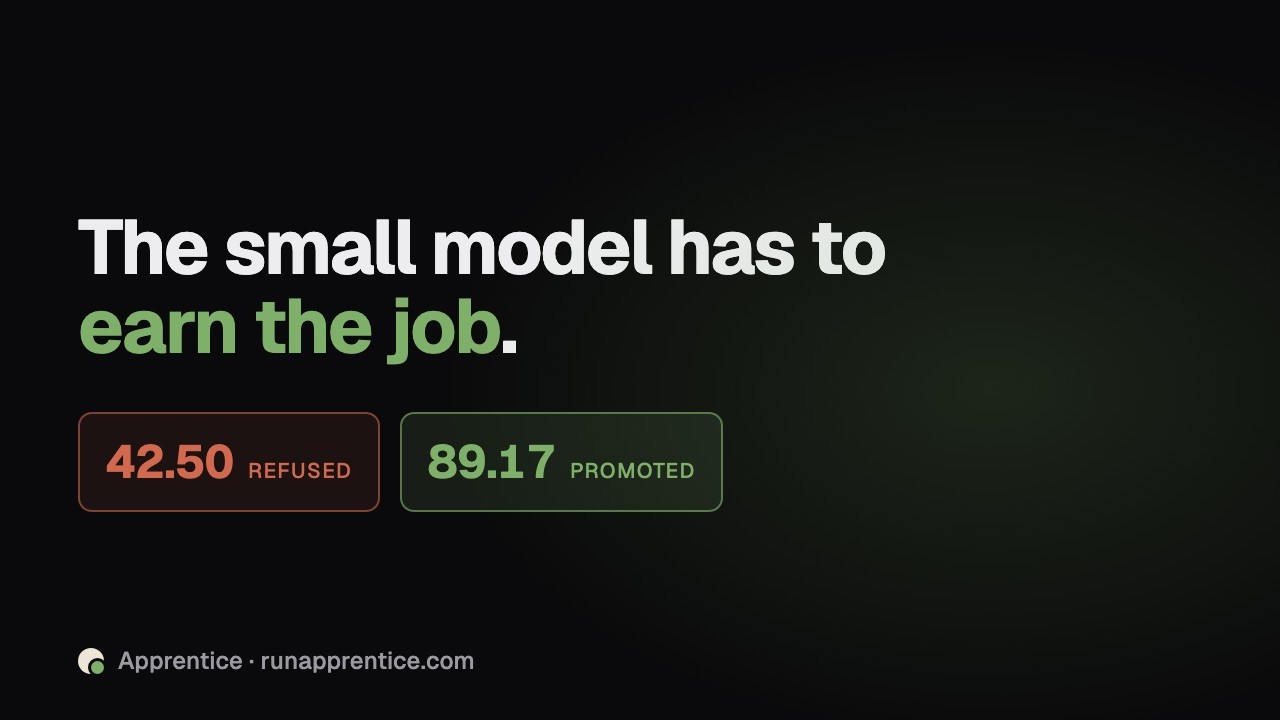
Apprentice watches a task your app already runs on a frontier model, then earns the job: Capture : two lines of SDK, and real production traffic starts landing. Verify : rows become gold (a human checked it) or silver (deterministic checks passed). Everything else stays raw and never counts. Optimize : DSPy GEPA rewrites the prompt against the verified set. Train : a small model is fine-tuned on gold rows only. Eval gate : every candidate is scored on held-out gold. It is promoted, or it is refused. There is no third option and no human override. Watch for drift : after takeover, the console charts captured traffic and the feedback your app reports, and offers a retrain only when enough new gold has arrived. The refuse path is the product. A model that fails the gate doesn't ship, and you keep paying the model that works. Everything else exists so we can say no with a straight face.
How we built it
Codex is the implementing engineer on the backend, not an autocomplete. The workflow is written into the repo's AGENTS.md and followed every time: a bounded contract (the exact unit, the files to mirror, the guardrails, the gate commands), work isolated in a git worktree, Codex implements and runs mypy/ruff/pytest itself, then a mandatory human review reads the diff before anything reaches main. Codex does not commit. 152 Codex sessions. Codex runs on gpt-5.6-sol. GPT-5.6 also runs inside the product: the GEPA optimizer's student and reflection models are configurable, and this submission's run uses gpt-5.6-luna for both. The feature built during the window is the drift panel the surface that catches a model going quietly wrong in production.
Challenges we ran into
The review kept catching what green tests could not. The retrain endpoint counted gold and silver rows as training data. Training reads gold only. Every test passed, because the tests encoded the same wrong contract I had handed to Codex. Two smaller bugs rode along: the cutoff used queue time instead of the moment the worker snapshots rows, and the eligibility flag ignored the minimum-rows gate so the panel would have offered a retrain the API rejects with a 400. A dead end, one click from the user. Then a worse one, and it was ours. The run report showed a cost of $0.796 next to token counts worth about $0.05. A DSPy cache hit is replayed from disk it never reaches the provider and costs nothing but the replayed entry still carries the original call's cost, and we were summing all of them. We had been billing for calls that never happened, on a panel whose entire job is to be trusted about money. Fixed; reported cost now matches the token math to the cent. And the thesis, demonstrated on us. Our public benchmark script first scored 72.92 instead of 100. GEPA rewrites a prompt from the feedback the metric returns, and ours only said "field names or values differ" so GEPA invented a separate key for each document type (po_number, receipt_number) while every gold answer uses invoice_id. It wrote a long, confident, carefully-reasoned, wrong prompt and was sure of itself. Naming the missing keys in the feedback took it to 100.00. A model optimizing against a vague signal converges on something plausible and wrong. That is exactly why the eval gate scores against human-verified data instead of a model's opinion of its own work.
Accomplishments we're proud of
The eval gate refusing a bad model is a first-class demo beat, not a footnote. And every number is real or labeled projected. When we found our own cost figure inflating — making us look more expensive than we are we still stopped and fixed it before shipping.
What we learned
Depth of agent collaboration is a review discipline, not a prompting trick. Codex ships production code when the brief carries the contract and a human reads the diff against the codebase instead of against the test output. Green gates prove the code ran. They do not prove it is right.
What's next
Design partners: three teams through a real migration, structured extraction first, eval-gated end to end. Then the fine-tuned models get published with their benchmarks so anyone can check our arithmetic. Reproduce everything: https://github.com/singhabhishekkk/apprentice-build-week drift-demo/ runs in one command. benchmark/ reproduces the GPT-5.6 numbers with nothing of ours in the loop: baseline 57.87 → 100.00 on a 12-row held-out split, $0.047, 67s. Codex Session ID: 019f5eb6-27b4-7e00-af1b-04285e89a907
Apprentice
The apprentice watches the expensive model work. Then earns the job.






OpenAI Build Week · Developer Tools
▶ Watch the demo film — 1:47, the whole loop, ending on the eval gate refusing a model.
About this repository
The production codebase is a private monorepo. This repository is the Build Week artifact, and it is public.
Saying that plainly up front, because the alternative would be to imply this is the whole system, and it is not. What is here is real and runnable:
- the feature we shipped during the submission window, running standalone,
- the benchmark that reproduces every GPT-5.6 number we claim, with nothing of ours in the loop,
- an honest account of how Codex was used, and which work is new this week.
The product itself is live. You do not need our source to test it: sign in at
runapprentice.com, pip install runapprentice, and the
console will show your own traffic. Instructions below.
What is in here
| Piece | What it does | Needs |
|---|---|---|
drift-demo/ | The feature built during the window, running standalone: the drift endpoints and the console page, over a seeded SQLite database. seed.py writes 30 days of traffic whose feedback score decays from 0.95 to 0.55, so you can watch a model quietly get worse. | nothing |
benchmark/ | Reproduces the GPT-5.6 numbers. Talks to OpenAI and DSPy directly. No Apprentice API, no account, no database. Bring a key and check our arithmetic. | OPENAI_API_KEY |
drift-panel/ | The production source of the two endpoints and their tests, lifted verbatim from the private monorepo, so the code being judged is the code that shipped. | reading only |
What Apprentice is
Everyone can make a model cheaper. Nobody can tell you when the cheap one is safe.
That is the whole problem. Swapping a frontier model for a small fine-tuned one is a two-hour job; convincing an engineering lead that quality will not quietly collapse on the 3% of inputs nobody looked at is the part that never happens. So teams keep paying frontier prices for extraction and classification work a 4B model could do in its sleep.
Apprentice watches a task your app already runs on a frontier model, then earns the job:
- Capture — two lines of SDK, and real production traffic starts landing.
- Verify — rows become gold (a human checked it) or silver (deterministic checks passed). Everything else stays raw and never counts.
- Optimize — DSPy GEPA rewrites the prompt against the verified set.
- Train — a small model is fine-tuned on gold rows only.
- Eval gate — every candidate is scored on held-out gold. It is promoted, or it is refused. There is no third option and no human override.
- Watch for drift — after takeover, the panel shows captured traffic, the feedback your app reports, and offers a retrain only when enough new gold has arrived to be worth it.
The refuse path is the product. A model that fails the gate does not ship, and you keep paying the model that works.
Built with Codex
Codex is the implementing engineer on the backend, not an autocomplete. The process is
written into the monorepo's AGENTS.md and followed every time:
- A bounded contract, not a vibe. The brief names the exact unit of work, the files to mirror, the hard guardrails, and the gate commands (mypy, ruff, pytest).
- Isolation. Feature work runs in a dedicated git worktree on its own branch, so a bad
run cannot touch
main. - Codex writes and verifies. It implements, runs the gates itself, and reports what passed. It does not commit; a human does.
- A senior review is mandatory. Green gates are necessary and never sufficient.
Codex Session ID: 019f5eb6-27b4-7e00-af1b-04285e89a907
(This is the Codex thread. The Devpost field calls it a "/feedback Session ID"; it has
nothing to do with this project's own POST /v1/feedback endpoint.)
Scale: 152 Codex sessions on the monorepo between 2026-06-10 and 2026-07-14.
The rule that earned its keep
On this very feature, Codex's tests went green and the code was still wrong three ways — all caught by the human review, none caught by the gates:
- The endpoint counted gold + silver rows toward retraining. Training reads gold only, so silver rows would never reach the model. The panel would have overstated the retrain payload — on a surface whose entire job is to be trusted.
- The cutoff used the job's queue time instead of the moment the worker snapshots rows, so rows created during a long training run were miscounted.
eligibleignored the minimum-rows gate, so the panel would have offered a one-click retrain that the API rejects with a 400. A dead end, one click away from the user.
The tests passed because they encoded the same wrong contract the brief did. The brief was mine, not Codex's. The lesson is that a spec must be written against the function that enforces the rule, not against a doc that describes it.
Codex is also a good engineer inside the thread. In the session above it root-caused its own failing test run (the reused venv's editable install pointed at the main checkout, so pytest was exercising the old API) and caught a UTC bucketing bug in its own diff during self-review, before handing anything back.
GPT-5.6 inside the product
The GEPA optimizer's student and reflection models are configurable. The submission run
uses gpt-5.6-luna for both. Reproduce it yourself: benchmark/.
Codex itself runs on gpt-5.6-sol at medium effort.
New this week, and what predates it
The rules require this distinction, so here it is without spin.
| Built during the window (Jul 13–21) | The drift panel. Two read-only endpoints and the console page that reads them. It wires the previously orphaned POST /v1/feedback signal into a surface a user can act on, and closes the loop after a model takes over. Written by driving Codex; see the session above. |
| Also in-window | The first scored GEPA run on gpt-5.6-luna, and a real bug it exposed: our run-cost accounting was billing for DSPy cache hits — LLM calls that never reached the provider — overstating cost ~15x. Fixed, and the run below is the verification. |
| Predates the window | Everything else: capture, the tier system, the GEPA optimizer, fine-tuning, the eval gate, the console, the SDK, the docs site. Apprentice has been in development since June 2026. |
The numbers
Measured on 2026-07-14. Nothing here is projected.
| Baseline prompt (held out) | 50.17 |
| GEPA-optimized (held out) | 100.00 |
| Rows improved / regressed | 12 of 12 / 0 |
| Wall time | 67 seconds |
| Cost | $0.047 |
| Models | gpt-5.6-luna, student and reflection |
| Metric | deterministic JSON field F1 — no LLM judge marks its own homework |
| Split | 24 rows, seed 42, 12-row holdout |
Those numbers come from Apprentice's own optimizer, which is in the private monorepo.
benchmark/ is a standalone reimplementation of the same idea — same 24
rows, same seed-42 split, same deterministic metric — so you can watch GEPA rewrite a prompt
on gpt-5.6-luna without trusting us or touching our API. It arrives at the same place:
| Apprentice's optimizer | benchmark/gepa_bench.py | |
|---|---|---|
| Baseline (held out) | 50.17 | 57.87 |
| Optimized (held out) | 100.00 | 100.00 |
| Wall time | 67s | 446s |
It takes longer because it runs a wider GEPA budget than the product's "quick" setting.
One thing here is worth more than the numbers. The first version of this script scored
72.92, not 100. GEPA rewrites the prompt from whatever feedback the metric hands back,
and that first version only said "field names or values differ". So GEPA invented a separate
key for each document type — po_number, receipt_number, invoice_number — while every
gold answer uses invoice_id. It wrote a long, confident, carefully-reasoned, wrong
prompt, and it was completely sure of itself.
Making the feedback name the missing keys took it to 100.00.
A model optimizing against a vague signal converges on something plausible and wrong. That is precisely why the eval gate scores candidates against human-verified data instead of a model's opinion of its own work — and we rediscovered it by getting it wrong, on ourselves, in this repo.
GEPA is stochastic and the baseline prompt is deliberately weak, so the starting score moves between runs (we have seen 50.2, 56.0 and 57.9). The optimized score has been 100.00 every time.
For judges: how to test this
1. The drift panel, running (one command)
cd drift-demo
uv run python seed.py          # 30 days of traffic, feedback decaying 0.95 -> 0.55
uv run uvicorn app:app         # http://localhost:8000
The feature shipped this week, standalone, over a seeded SQLite database. You will see captured traffic, a feedback score visibly falling, and a retrain card that only offers the button when a retrain would actually clear the training gate.
2. Reproduce the GPT-5.6 numbers
cd benchmark
export OPENAI_API_KEY=sk-...
uv run python gepa_bench.py     # ~7 min, a few cents
3. The live product
Sign in at runapprentice.com, create a task, then:
pip install runapprentice
from runapprentice import Apprentice

client = Apprentice(api_key="<from the console>", capture_async=False)
trace_id = client.capture(task="support-triage", input=question, output=answer)
if trace_id:                                  # capture is fail-open, never raises
    client.feedback(trace_id, good=True)      # or good=False, or score=0.4
Your calls appear in the console under Activity, and the Drift tab charts them.
Supported platforms: Python 3.11+ (SDK, macOS/Linux/Windows), any OS for the console.
Links
- Live product: runapprentice.com
- Docs: docs.runapprentice.com
- SDK: pypi.org/project/runapprentice
- Public benchmark: apprentice-benchmark
MIT licensed. The production monorepo is private.
Analysis
View
Metric
- 9

Figures cover GitHub contributors during the hackathon window. A co-authored commit counts in full for each author, so per-member totals add up to more than the whole-team figures.
Technology
- FastAPIIn code
- HTMLIn code
- OpenAIIn code
- PythonIn code
- Next.jsClaimed
- PostgreSQLClaimed
- ReactClaimed
- SupabaseClaimed
- Tailwind CSSClaimed
- TypeScriptClaimed
4 of 10 appear in the indexed code. 6 claimed on Devpost could not be matched to code, which may simply mean the tool leaves no trace in the repository.
AI coding agents
No AI coding agent signals were found in this repository.
Detected from committed agent config files and commit authorship. Absence of a signal is not proof an agent was unused.
Codebase size
Source size
53 KB
Source files
8
Counts recognized source files only; vendored directories, binaries and lockfiles are excluded, so this is smaller than the repository on disk.
Repository
singhabhishekkk/apprentice-build-week
20 files · 5.3 MB · @ 127a6cf
Structure
Application logic
7 files · 35%Domain rules, services and shared utilities.
Supporting
Layers are inferred from where files sit in the tree, not from reading the code. A project that names its directories unconventionally will read oddly here — open the file browser to check anything the diagram implies.
Languages
- Python58%
- Markdown21%
- HTML21%
Share of indexed source by file size. Binary and vendored files are excluded.
Dependencies
drift-demo/pyproject.toml
pypi · 3- fastapi
- sqlalchemy
- uvicorn
benchmark/pyproject.toml
pypi · 2- dspy
- openai
Declared in the repository’s manifests at the indexed commit. A declared package is not proof it is used, and runtime dependencies are listed first.
This project’s features have not been analysed yet.
Export this project's context (description, README, evidence, key source files) to chat with an AI agent elsewhere.