Project Info
Agent Arcade
An inspectable playground where AI agents solve logic and visual puzzles.
Live demo · Devpost project · Technical report
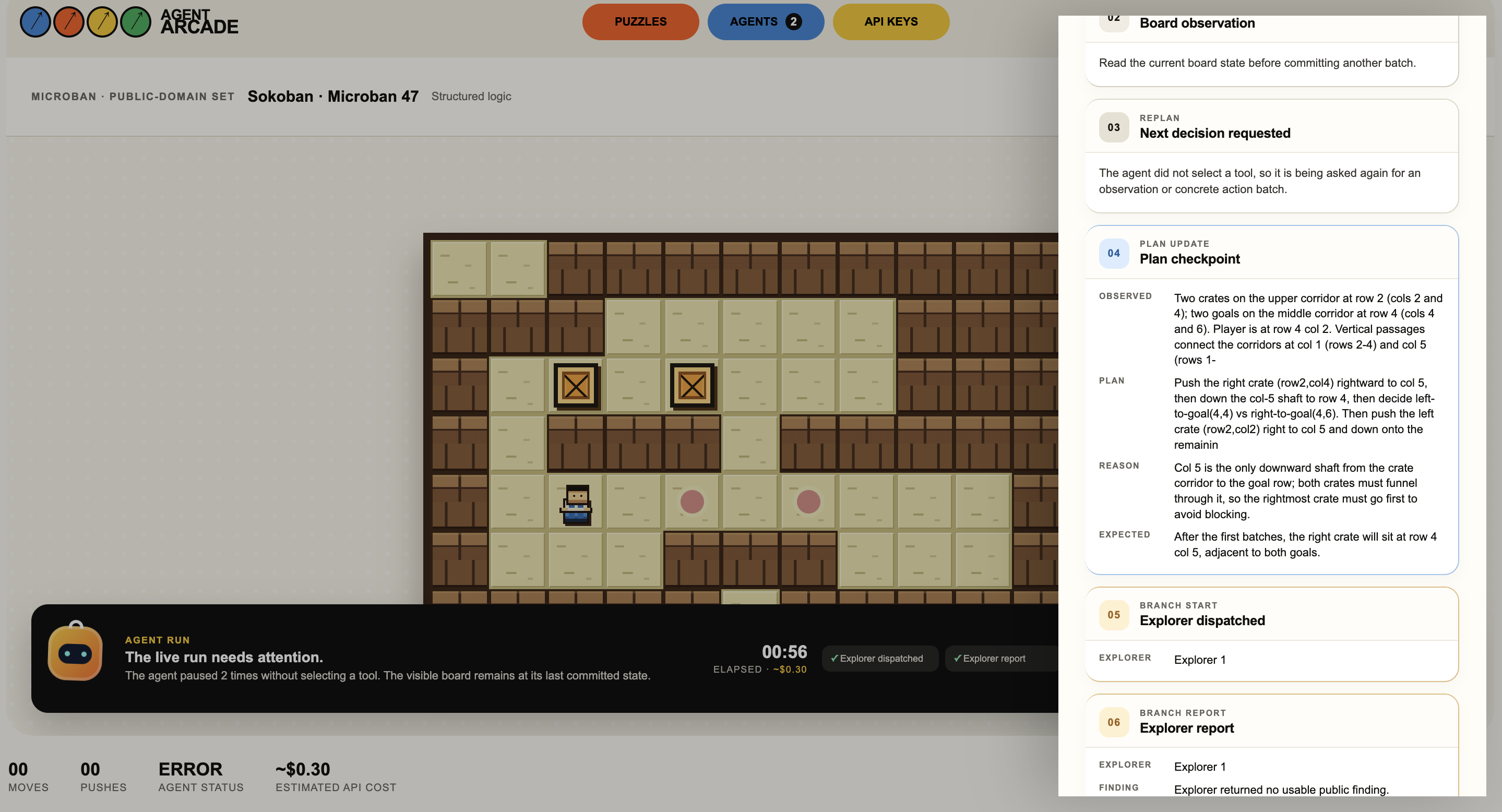
Agent Arcade turns puzzles into small, controlled environments for watching an agent work. Instead of showing only a final answer, it renders the puzzle board, validates each action, and records a concise public journal of observations, plans, explorer branches, helper work, action batches, token use, and estimated cost.
What it includes
- Logic worlds: Sokoban, maze, and Klotski with explicit, rule-validated actions.
- Visual worlds: real-image Jigsaw puzzles that require visible fragment matching.
- Computer-control worlds: cursor-driven Klotski and Jigsaw variants that accept literal validated drags on a virtual screen.
- Inspectable live runs: a model can observe, make a short public plan, create focused explorer branches, write/run a restricted Python helper, commit actions, and re-observe the result.
- Bring your own key: visitors use their own OpenAI or Anthropic key; public deployments do not contain an author key or store visitor keys.
Quick start
Requirements
- Node.js 20–24
- An Anthropic API key for live Claude puzzle runs; an OpenAI key may also be used for provider connection checks.
Run locally
git clone https://github.com/Gaurav17Joshi/AgentArcade.git
cd AgentArcade
npm install
cp .env.example .env.local
Open .env.local in a local editor and add only the keys you intend to use:
ANTHROPIC_API_KEY=your_anthropic_key
OPENAI_API_KEY=your_openai_key
Then start the app:
npm start
Open http://127.0.0.1:4173. If that port is busy, run PORT=4174 npm start instead. Never commit .env.local or paste a key into chat.
Run a live agent
- Choose a puzzle and level from Puzzles.
- Open API keys and add a personal key for the current browser tab, or use your local
.env.localsetup. - Open Agents, choose a provider/model and run mode, then start the agent.
- Watch the live board and open View trace to inspect the complete public journal. Explorer branches appear in the Agents panel.
The hosted app at agentarcade.onrender.com uses browser-session BYOK mode. A user key is sent only for that provider request, is not saved by Agent Arcade, and is cleared when the page reloads.
How the agent loop works
Every environment exposes a current observation, a restricted action surface, an action validator, a solved-state check, and a renderer. The runtime follows this loop:
observe → publish a concise public checkpoint → optionally explore or use a helper
       → propose a short action batch → validate → animate → observe again
Logic puzzles use structured moves. Visual cursor puzzles render a virtual screen and accept only valid mouse drags against its coordinates. The journal is deliberately a human-readable public trace, not hidden chain-of-thought. Boards update while the agent works and are marked solved only after the environment's actual solved-state check passes.
Small Python helpers may be written in an isolated temporary workspace for calculations such as search or board verification. The restricted runner has short CPU/memory limits and no filesystem, shell, browser, network, environment-variable, or API-key access.
Built with Codex and GPT-5.6
Agent Arcade was built end-to-end with Codex. Most implementation happened in a single Codex session using GPT-5.6 Terra at Extra High reasoning.
Codex accelerated the project from the initial product sketch through:
- designing the puzzle-environment and agent-loop contract;
- implementing the vanilla HTML/CSS/JavaScript interface and Node streaming server;
- adding Sokoban, maze, Klotski, Jigsaw, and virtual-cursor environments;
- building the public trace, explorer-branch, sandbox-helper, validation, and rendering flows;
- diagnosing real provider-run failures, testing in the browser, refining the UI, and deploying to Render;
- preparing the reports, demo video, captions, and AI-generated narration for the OpenAI Build Week submission.
GPT-5.6 Terra was used as the high-reasoning implementation partner inside Codex; the project itself remains a BYOK multi-provider playground. Anthropic currently powers the live puzzle-runner adapter, while the OpenAI connection is available for key/model validation and can be extended with a live puzzle adapter.
Verification
Run the lightweight syntax check before making a change:
npm run check
For a manual end-to-end check, start the server, select a Sokoban level, add a personal Anthropic key, run an agent, and verify that the board and View trace journal advance together.
Deploying
The repository contains a Render Blueprint for one HTTPS Node web service. It hosts both the browser client and Node agent server in BYOK mode; no author API key needs to be deployed. See RENDER_DEPLOY.md for the deployment flow.
Further documentation
Analysis
View
Metric
- 30

Figures cover GitHub contributors during the hackathon window. A co-authored commit counts in full for each author, so per-member totals add up to more than the whole-team figures.
Technology
- CSSIn code
- HTMLIn code
- JavaScriptIn code
- PythonIn code
- Node.jsClaimed
4 of 5 appear in the indexed code. 1 claimed on Devpost could not be matched to code, which may simply mean the tool leaves no trace in the repository.
AI coding agents
No AI coding agent signals were found in this repository.
Detected from committed agent config files and commit authorship. Absence of a signal is not proof an agent was unused.
Codebase size
Source size
191 KB
Source files
12
Counts recognized source files only; vendored directories, binaries and lockfiles are excluded, so this is smaller than the repository on disk.
Repository
Gaurav17Joshi/AgentArcade
26 files · 3.4 MB · @ 7c3e6bc
Structure
Interface
4 files · 15%Screens, components and styles rendered to the user.
Application logic
3 files · 12%Domain rules, services and shared utilities.
Supporting
Layers are inferred from where files sit in the tree, not from reading the code. A project that names its directories unconventionally will read oddly here — open the file browser to check anything the diagram implies.
Languages
- JavaScript39%
- Markdown23%
- CSS19%
- HTML16%
- Python2%
- YAML0%
Share of indexed source by file size. Binary and vendored files are excluded.
This project’s features have not been analysed yet.
Export this project's context (description, README, evidence, key source files) to chat with an AI agent elsewhere.