Project Info
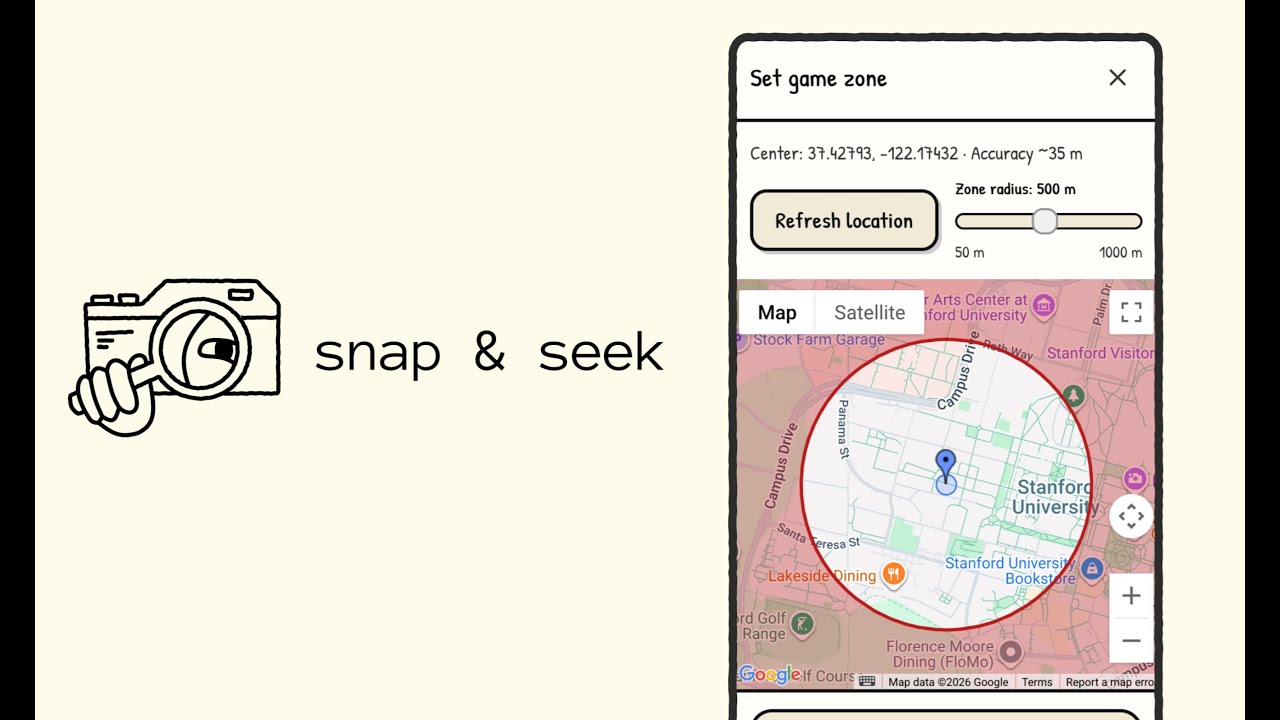
Watch a longer version of our game demo playtest here: https://youtu.be/F_hVs6-mK4M About Snap and Seek Snap and Seek is a whimsical real-world mobile game that combines the thrill of hide and seek with the excitement of scavenger hunts and geocaching. Designed for outdoor play, it encourages players to explore their surroundings (like the amazing Stanford campus) while engaging in a fun, competitive experience with lots of running around and touching grass! We designed it esthetically to be super fun and playful, and we made it accessible to new players! It was inspired by Jet Lag: The Game, a great YouTube show. Game Concept Players split into teams, and are tasked with choosing a a hidden location. The goal of the game is to find all the other teams' hidden spots using landmark photos relative to the location, and proximity clues. The first team to match every other team's hidden photos wins! Abilities Radar: Narrow down locations with questions like "Are you within 100 meters of me?" Thermometer: By comparing two of your positions, you can see if you're colder or hotter to the location Photo Landmark: Unlock different photos taken at the hidden location to reveal more context of the location, like the tallest visible tower, or the nearest tree. Technical Features This was our first time working with Vercel! It was super fun and easy to get started with, and we're so proud to have gotten our first app deployed, because you can't make a multiplayer online game run on localhost lol. Shipping was so fast that we had multiple fun playtests with our friends throughout TreeHacks! And from there, we're proud to announce that we've just launched the full app publicly to any number of players! You can play with your own friends at https://snap-and-seek-game.vercel.app/. We explain more there. So in this sense, we're already a product ;) We see you Neo. On other technical standpoints, we did lots of optimization for GPS tracking on phones, and just making the design nice and responsive. Things also work in real time via lots of updates so that people never have to reload tabs, and we worked a lot with the google maps api to overlay your current location, hiding zones, and information gained from hints!
Snap and Seek
About Snap and Seek
Hide. Seek. Snap. Find them all.
play free at snap-and-seek-game.vercel.app
Snap and Seek is a whimsical real-world mobile game that combines the thrill of hide and seek with the excitement of scavenger hunts and geocaching. Designed for outdoor play, it encourages players to explore their surroundings (like the amazing Stanford campus) while engaging in a fun, competitive experience with lots of running around and touching grass!
Game concept
Players split into teams and are tasked with choosing a hidden location. The goal is to find all the other teams' hidden spots using landmark photos relative to the location and proximity clues.
Core mechanics / abilities
- Radar: Narrow down locations with questions like "Are you within 100 meters of me?"
- Hot or Cold: By comparing two of your positions, you can see if you're colder or hotter to the location.
- Landmark: Unlock different photos taken at the hidden location to reveal more context—like the tallest visible tower or the nearest tree.
See it in action
Click to watch the hype short — or check the full game walkthrough on the website.
Quick start
npm install
npm run dev
Open http://localhost:3000.
Setup
- Supabase – Create a project, add the
gamestable (see repo docs), then copy Project URL and service_role key into.env.local. - Google Maps – Enable Maps JavaScript API + Geocoding API, create an API key, add to
.env.local.
Copy from .env.example and fill in:
NEXT_PUBLIC_SUPABASE_URLSUPABASE_SERVICE_ROLE_KEYNEXT_PUBLIC_GOOGLE_MAPS_API_KEY
Restart the dev server after editing env.
Scripts
npm run dev– dev servernpm run build– production buildnpm run start– run production build
Analysis
View
Metric
- 24
- 20


Figures cover GitHub contributors during the hackathon window. A co-authored commit counts in full for each author, so per-member totals add up to more than the whole-team figures.
Technology
- CSSIn code
- JavaScriptIn code
- Next.jsIn code
- ReactIn code
- SQLIn code
- SupabaseIn code
- Tailwind CSSIn code
- TypeScriptIn code
- VercelClaimed
8 of 9 appear in the indexed code. 1 claimed on Devpost could not be matched to code, which may simply mean the tool leaves no trace in the repository.
AI coding agents
- CursorConfig · Commits
Detected from committed agent config files and commit authorship. Absence of a signal is not proof an agent was unused.
Codebase size
Source size
470 KB
Source files
115
Counts recognized source files only; vendored directories, binaries and lockfiles are excluded, so this is smaller than the repository on disk.
Repository
SuperZooper3/snap-and-seek
139 files · 922 KB · @ 6b4dad4
Structure
Interface
53 files · 38%Screens, components and styles rendered to the user.
API & routing
19 files · 14%Request entry points: routes, handlers and controllers.
Application logic
15 files · 11%Domain rules, services and shared utilities.
Data & schema
1 file · 1%Schema definitions, migrations and data access.
Supporting
Layers are inferred from where files sit in the tree, not from reading the code. A project that names its directories unconventionally will read oddly here — open the file browser to check anything the diagram implies.
Languages
- TypeScript75%
- Markdown20%
- SQL2%
- CSS2%
- JavaScript0%
Share of indexed source by file size. Binary and vendored files are excluded.
Dependencies
package.json
npm · 13- @react-google-maps/api
- @supabase/supabase-js
- next
- react
- react-dom
- +8 more
Declared in the repository’s manifests at the indexed commit. A declared package is not proof it is used, and runtime dependencies are listed first.
This project’s features have not been analysed yet.
Export this project's context (description, README, evidence, key source files) to chat with an AI agent elsewhere.