Project Info
VisionZ+ is your data scientist. Our Team!!
Inspiration
We are mainly interested in Palmer Luckey's disruptive innovations in defense systems and Marc Andreessen's forward-thinking vision of technology, this project embraces American dynamism to empower military personnel. The aim is to leverage cutting-edge wearable tech to boost productivity and efficiency on the field.
What it does
VisionZ+ is a first-of-its-kind data visualization and analysis platform that lets users analyze any dataset through a simple drag-and-drop interface. With our dataset assistant, you can simply ask questions about your data and let the AI find patterns and insights for you. The platform is powered by a Multi-Agent AI Architecture that processes data through multiple specialized agents - from initial analysis and orchestration to planning, execution via mini-agent swarms, and validation. This makes sophisticated data analysis accessible to anyone, regardless of their technical background. Whether you're a medical researcher analyzing patient data, a military strategist evaluating operations, a financial advisor tracking markets, or a small business owner understanding operations, VisionZ+ eliminates the need for a dedicated data science team - just ask questions and get insights.
How we built it
VisionZ+ is powered by a sophisticated Multi-Agent AI Architecture leveraging OpenAI's API and Terra's API, enhanced with our custom chain-of-thought processing and specialized agents. At its core, we developed a hierarchical orchestration system where each agent serves a distinct purpose: Our Analysis Agent processes natural language queries and translates them into structured task specifications The Orchestrator Agent coordinates the workflow The Planning Engine decomposes complex analytical tasks into optimized sub-tasks for parallel processing The real innovation lies in our Multi-Agent Architecture - specialized mini-agents that work in parallel, each focused on specific aspects like data processing, visualization, pattern recognition, and statistical analysis. These agents communicate through a custom-built coordination layer, ensuring efficient task distribution and resource optimization. Every output passes through our Validator Agent, which performs rigorous quality assurance and cross-validation before delivering results. The frontend provides an intuitive drag-and-drop interface, while our robust backend handles the complex orchestration of these AI agents. This architecture enables us to process complex analytical tasks with high accuracy and computational efficiency through systematic decomposition and parallel processing.
Challenges we ran into
One of our biggest hurdles was working with the Terra API integration. The authentication flow required setting up our own SSH tunnel to generate and handle authorization links, which proved to be quite tricky. We spent considerable time troubleshooting the tunnel configuration and ensuring secure, reliable connections for our users' wearable data. The process taught us a lot about handling OAuth flows and secure data transmission in production environments. The implementation of our Multi-Agent Architecture presented its own set of complex challenges, particularly around processing time. We discovered that different types of data analysis required varying levels of computational resources and model capabilities. This led us to develop a dynamic approach where we utilize different models based on the specific analysis needs - from lightweight models for quick statistical analysis to more sophisticated reasoning model for complex pattern recognition. Integrating our dynamic frontend with the backend focused on formatting and passing payload history for wearable data into MongoDB. Managing state on wearable.js involved designing a payload structure that supports seamless, real-time data transfer. The main challenge was reliably passing the complete payload history while maintaining data consistency.
What's next
We're pursuing an ambitious vision: creating the world's first truly autonomous data scientist. Beyond just analyzing data, we're developing VisionZ+ to proactively identify opportunities, generate hypotheses, and conduct independent research - much like a human data scientist would. Our goal is to enable VisionZ+ to not just answer questions, but to ask the right questions and uncover insights that users might not even know to look for. Looking ahead, we're enhancing our Multi-Agent Architecture with more sophisticated reasoning capabilities and expanding into industry-specific solutions. We envision VisionZ+ becoming an indispensable partner in data-driven decision making across all sectors - from healthcare and scientific research to business strategy and public policy. The future of data science is autonomous, and VisionZ+ is leading the way.
VisionZ➕
VisionZ+, Your data scientist.

First of its kind data visualization and analysis platform powered by our groundbreaking Multi-Agent AI Architecture. Analyze any dataset with just a drag and drop.
Stanford TreeHacks 2025.
Team:
Youwei Zhen (Brown University), Taorui Huang (Stanford), Anni Zimina (Stanford), Nick Adesina (UC Berkeley)
What is VisionZ+
VisionZ+ is a first-of-its-kind data visualization and analysis platform that lets users analyze any dataset through a simple drag-and-drop interface. With our dataset assistant, you can simply ask questions about your data and let the AI find patterns and insights for you. The platform is powered by a Multi-Agent AI Architecture that processes data through multiple specialized agents - from initial analysis and orchestration to planning, execution via mini-agent swarms, and validation. This makes sophisticated data analysis accessible to anyone, regardless of their technical background. Whether you're a medical researcher analyzing patient data, a military strategist evaluating operations, a financial advisor tracking markets, or a small business owner understanding operations, VisionZ+ eliminates the need for a dedicated data science team - just ask questions and get insights.
Revolutionary Multi-Agent AI Architecture
VisionZ+ employs a sophisticated Multi-Agent AI system that processes your requests through a highly orchestrated pipeline:
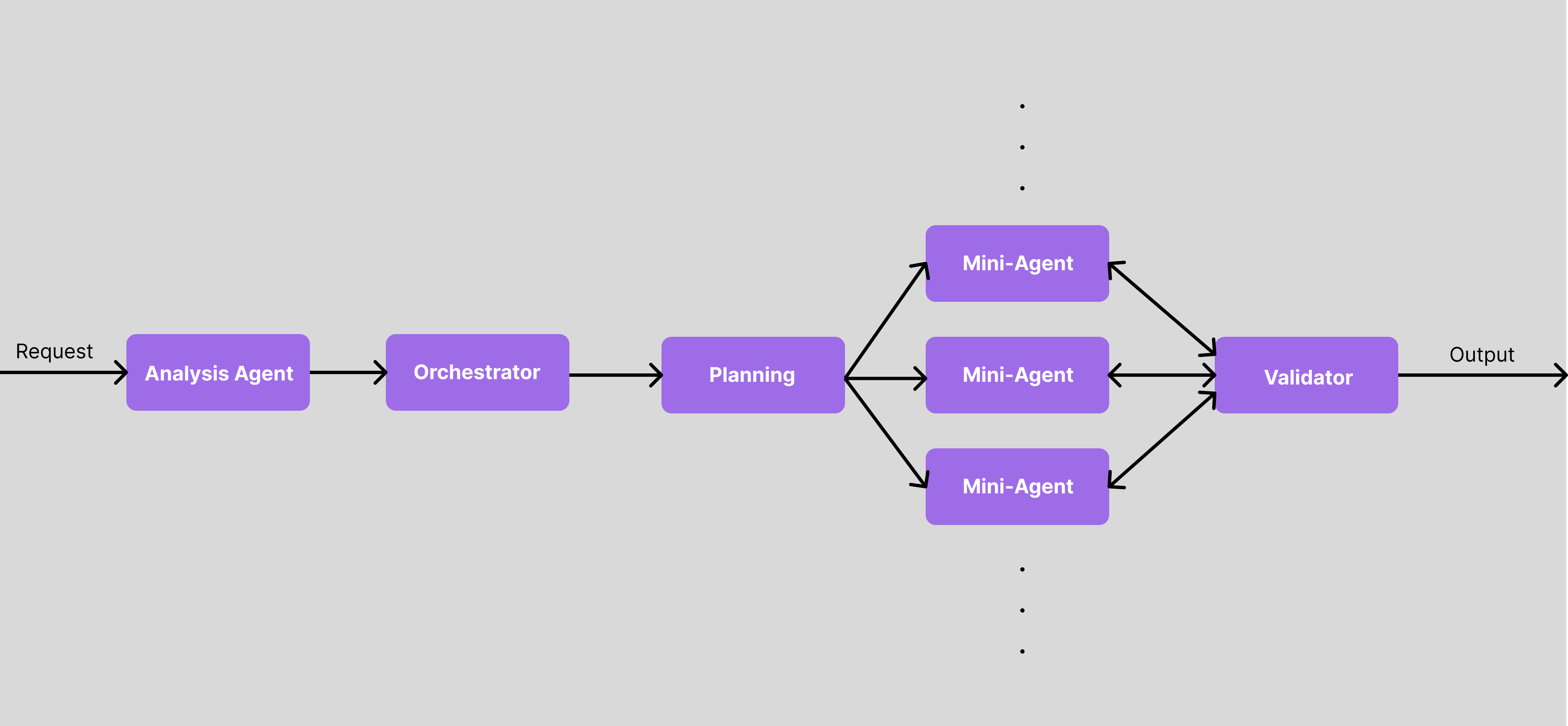
-
Analysis Agent 🔍
- First point of contact for all user requests
- Performs initial request analysis and requirement extraction
- Translates natural language into structured task specifications
-
Orchestrator Agent 🎮
- Central command center of the system
- Coordinates complex workflows between agents
- Manages resource allocation and task prioritization
-
Planning Engine 📋
- Breaks down complex tasks into smaller, manageable sub-tasks
- Develops execution strategies for optimal results
- Creates dynamic task graphs for parallel processing
-
Mini-Agents Swarm 🐝
- Specialized micro-agents working in parallel
- Each agent focuses on a specific sub-task:
- Data Processing Agents
- Visualization Agents
- Pattern Recognition Agents
- Statistical Analysis Agents
- Dynamic scaling based on task complexity
-
Validator Agent ✅
- Quality assurance and result verification
- Ensures consistency and accuracy of outputs
- Performs cross-validation of results
- Optimizes final output for user consumption
This advanced pipeline delivers:
- Highly accurate and validated results
- Parallel processing for faster insights
- Scalable architecture for complex tasks
- Robust error handling and quality control
- Real-time adaptive processing
Inspiration
We believe everyone deserves their own personal data scientist. In today's data-driven world, the ability to extract meaningful insights from data shouldn't be limited to those with technical expertise or resources to hire analysts. Whether you're a medical researcher analyzing patient outcomes, a military strategist evaluating field operations, or a financial advisor tracking market trends, understanding your data is crucial for making informed decisions.
This vision drove us to create VisionZ+. In healthcare, it can help doctors identify patterns in patient vitals and treatment responses. Military personnel can use it to analyze sensor data from equipment and personnel, enhancing operational efficiency and safety. Financial institutions can leverage it to detect market patterns and assess risk factors. Even small business owners can gain valuable insights about their operations without needing a dedicated data science team.
By combining cutting-edge AI with an intuitive interface, we're making sophisticated data analysis accessible to everyone, regardless of their technical background or industry.
Setup Instructions
Backend Setup
-
Navigate to the backend directory:
cd backend -
Install dependencies:
npm install -
Set up environment variables:
- Edit
.envand add your OpenAI API key:PORT = Server port (default: 5000) MONGODB_URI = MongoDB connection string OPENAI_API_KEY = Your OpenAI API key (required) NODE_ENV = Node environment (development/production)
- Update other environment variables as needed - Edit
-
Start the backend server:
npm start
Frontend Setup
-
Navigate to the frontend directory:
cd frontend -
Install dependencies:
npm install -
Start the development server:
npm run dev
Environment Variables
Backend (.env)
PORT: Server port (default: 5000)MONGODB_URI: MongoDB connection stringOPENAI_API_KEY: Your OpenAI API key (required)NODE_ENV: Node environment (development/production)
API Endpoints
AI Generation
POST /api/ai/generate- Generates AI-powered visualizations and analysis
- Requires valid OpenAI API key
- Request body:
{
  "prompt": "Your analysis prompt here"
}
Error Handling
The API includes comprehensive error handling for:
- Missing or invalid OpenAI API key
- API quota exceeded
- Invalid requests
- Server errors
Analysis
View
Metric
- 34
- 13
- 2


Figures cover GitHub contributors during the hackathon window. A co-authored commit counts in full for each author, so per-member totals add up to more than the whole-team figures.
Technology
- CSSIn code
- ExpressIn code
- JavaScriptIn code
- MongoDBIn code
- Next.jsIn code
- OpenAIIn code
- ReactIn code
- Tailwind CSSIn code
- HTMLClaimed
8 of 9 appear in the indexed code. 1 claimed on Devpost could not be matched to code, which may simply mean the tool leaves no trace in the repository.
AI coding agents
No AI coding agent signals were found in this repository.
Detected from committed agent config files and commit authorship. Absence of a signal is not proof an agent was unused.
Codebase size
Source size
570 KB
Source files
30
Counts recognized source files only; vendored directories, binaries and lockfiles are excluded, so this is smaller than the repository on disk.
Repository
AntoDono/visionzplus
53 files · 11.3 MB · @ 4da0c9c
Structure
Interface
15 files · 28%Screens, components and styles rendered to the user.
API & routing
3 files · 6%Request entry points: routes, handlers and controllers.
Application logic
5 files · 9%Domain rules, services and shared utilities.
Data & schema
3 files · 6%Schema definitions, migrations and data access.
Supporting
Layers are inferred from where files sit in the tree, not from reading the code. A project that names its directories unconventionally will read oddly here — open the file browser to check anything the diagram implies.
Languages
- JavaScript98%
- Markdown1%
- CSS1%
Share of indexed source by file size. Binary and vendored files are excluded.
Dependencies
frontend/package.json
npm · 14- autoprefixer
- framer-motion
- next
- openai
- react
- react-dom
- react-dropzone
- react-markdown
- +6 more
backend/package.json
npm · 8- cors
- dotenv
- express
- express-session
- mongoose
- openai
- terra-api
- +1 more
Declared in the repository’s manifests at the indexed commit. A declared package is not proof it is used, and runtime dependencies are listed first.
This project’s features have not been analysed yet.
Export this project's context (description, README, evidence, key source files) to chat with an AI agent elsewhere.