Project Info
Inspiration
In recent months, the world has witnessed several tragic aviation incidents in the US—heartbreaking events that remind us of the fragile nature of our interconnected world. Behind every route and every flight lies a story of lives, livelihoods, and human connections. These events deeply moved us, fueling a vision to build FlowScope:The Agentic Simulator for Predictive Flow Dynamics, so that the world can be modeled and predicted at unprecedented heights. Our platform seeks to bring clarity to the invisible patterns of movement that shape our world—marine and air transportation, refugee flows, and other logistical patterns—so that we can predict, prepare for, and prevent future disruptions.
What it does
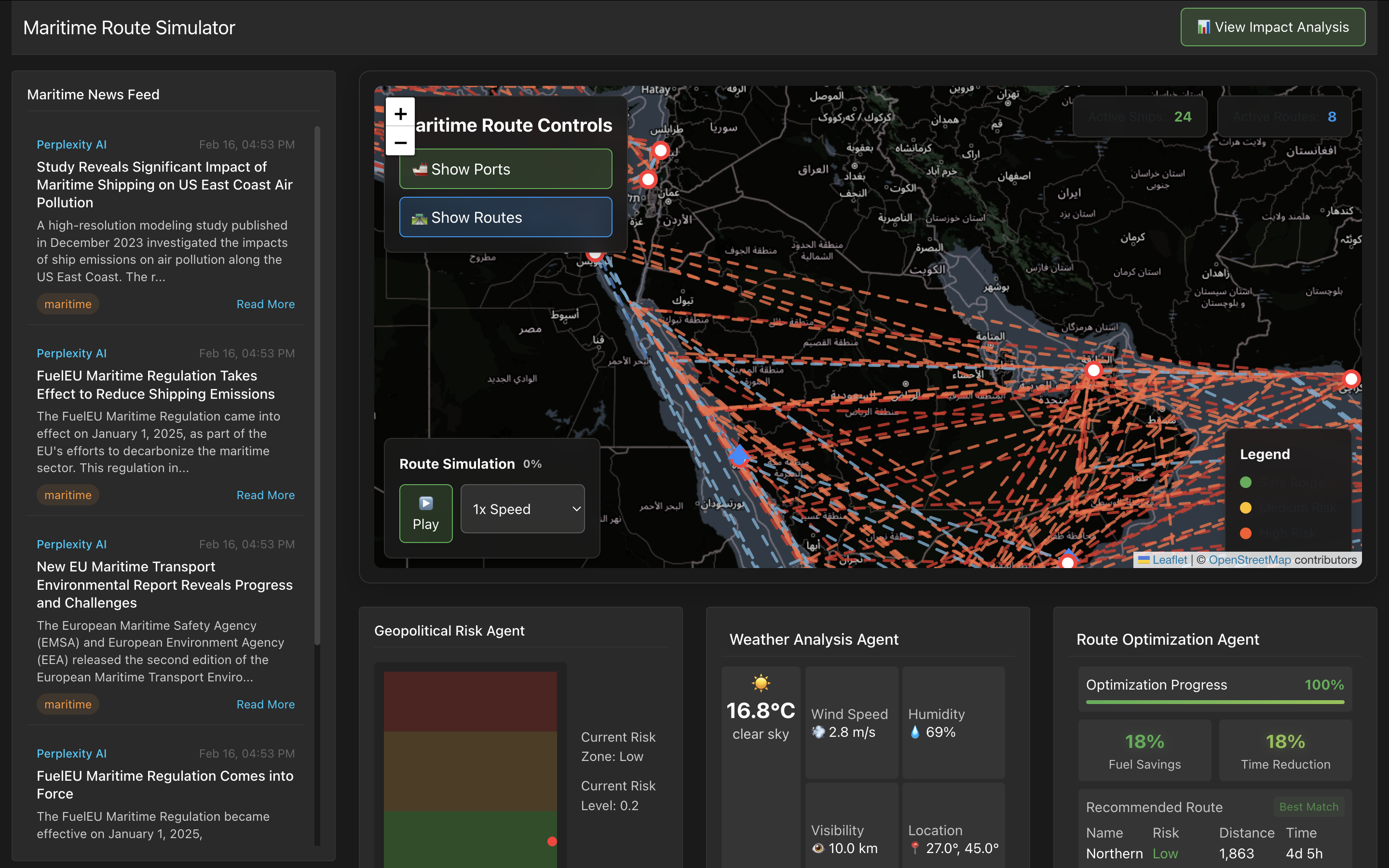
Imagine a world where transportation disruptions, refugee movements, and logistical challenges are no longer unpredictable mysteries. Introducing FlowScope --- your command center for global flows, an AI agent powered platform that forecasts, simulates, and visualizes dynamic movement patterns in real-time. In this demo, we focus on marine transportation, showing how FlowScope empowers decision-makers to anticipate weather disruptions, geopolitical tensions, and operational bottlenecks. Our platform isn't limited to one domain; it's designed to adapt and scale across industries, from aviation to humanitarian logistics.
How we built it
AI Agent Architecture: We use multiple AI agents powered by OpenAI's GPT models with LangChain, Perplexity Search, and real-time API calls. These agents work collaboratively to bridge the gap between static LLM task planning and the need for dynamic, real-time data. We also use existing marine traffic dataset (Automatic Identification System observation and dirways) to help with routing simulation. We use Leaflet map library for React to visualize maps. Intelligent Data Retrieval: Perplexity Search fetches relevant news based on location and keywords, providing our agents with context-aware insights. Path Planning and Prediction: We employ both LLM-based geopolitical risk assessment and traditional algorithms such as A* search to predict and simulate flows efficiently. We model ports and trade routes between them as nodes and edges in a graph dropping ports from this graph whenever critical ports or waterways are shut down like in the 2021 incident when the Suez Canal was obstructed for 6 days. Our ML model learns to assign weights to each of the edges in the graph, representing the cost of traversing that edge, based on a set of conditions: directional water ways, shallow water areas, sharp turns, vessel speeds in certain waters based on vessel class, geographic constraints, and historical route patterns. A* search is then used to traverse this graph and find the optimal route. Real-Time Updates: APIs like OpenWeatherMap feeds update our platform in real-time, enabling the AI agents to adjust predictions dynamically. We provide comprehensive data analysis across different metrics, including voyage types, fuel prices, and distances. Prompt Engineering: Crafting precise, contextual prompts allowed the agents to infer, reason, and respond accurately to new data inputs, enhancing reliability and interpretability. Key Features: Interactive Dashboard: Intuitive visualizations that resemble a Bloomberg Terminal for easy navigation and analysis. Agent Coordination: We developed a communication protocol that allowed agents to share intermediate results and coordinate decisions effectively. For example, a weather analysis agent would pass risk assessments to a route planning agent, ensuring context-aware decisions. Real-Time Data Synchronization: Integrating Perplexity Search with weather and transportation APIs ensured our models operated with the latest information. Challenges We Overcame: Our 4th teammate left us very last minute, but we were able to work in a team of three and brought the project together with almost no sleep.💪 Bridging multiple AI agents, path planning algorithms, and API calls is very challenging. Each component required different processes and data structures, demanding careful design and orchestration. To address this, we implemented a multi-agent framework with specialized roles for different tasks. What's Next: Extending the platform to simulate other flow types like air traffic, refugee movements, and global supply chains. Extending the platform to simulate other flow types like air traffic, refugee movements, and global supply chains. Enhancing the geopolitical risk assessment capabilities of our AI agents. Enhancing the geopolitical risk assessment capabilities of our AI agents. Introducing predictive maintenance features for transportation fleets. Introducing predictive maintenance features for transportation fleets.
What we learned
FlowScope is more than a transportation simulation tool; it's a step toward a future where global flows are predictable, manageable, and resilient against disruptions. Join us as we bring this vision to life!
Analysis
View
Metric
- 12
- 8
- 6


Figures cover GitHub contributors during the hackathon window. A co-authored commit counts in full for each author, so per-member totals add up to more than the whole-team figures.
Technology
- CSSIn code
- FastAPIIn code
- HTMLIn code
- JavaScriptIn code
- OpenAIIn code
- PythonIn code
- ReactIn code
- LangChainClaimed
7 of 8 appear in the indexed code. 1 claimed on Devpost could not be matched to code, which may simply mean the tool leaves no trace in the repository.
AI coding agents
No AI coding agent signals were found in this repository.
Detected from committed agent config files and commit authorship. Absence of a signal is not proof an agent was unused.
Codebase size
Source size
163 KB
Source files
27
Counts recognized source files only; vendored directories, binaries and lockfiles are excluded, so this is smaller than the repository on disk.
Repository
HowardHuang1/TreeHacks2025
57 files · 111.3 MB · @ 5235928
Structure
Interface
6 files · 11%Screens, components and styles rendered to the user.
Application logic
30 files · 53%Domain rules, services and shared utilities.
Supporting
Layers are inferred from where files sit in the tree, not from reading the code. A project that names its directories unconventionally will read oddly here — open the file browser to check anything the diagram implies.
Languages
- JavaScript48%
- Python41%
- CSS7%
- Markdown2%
- HTML1%
Share of indexed source by file size. Binary and vendored files are excluded.
Dependencies
treehacks2025/package.json
npm · 15- @testing-library/dom
- @testing-library/jest-dom
- @testing-library/react
- @testing-library/user-event
- axios
- bootstrap
- chart.js
- httpx
- leaflet
- react
- react-chartjs-2
- react-dom
- react-leaflet
- react-scripts
- web-vitals
treehacks2025/requirements.txt
pypi · 12- asyncio
- fastapi
- folium
- geopy
- httpx
- numpy
- openai
- pandas
- pydantic
- python-dotenv
- scikit-learn
- uvicorn
Declared in the repository’s manifests at the indexed commit. A declared package is not proof it is used, and runtime dependencies are listed first.
This project’s features have not been analysed yet.
Export this project's context (description, README, evidence, key source files) to chat with an AI agent elsewhere.