Project Info
Inspiration
Traditional learning lacks interactivity, making engagement difficult. Eduverse leverages AI to create an inclusive, accessible learning experience through speech transcription, natural language processing, and voice synthesis, pushing the boundaries of AI in education.
What it does
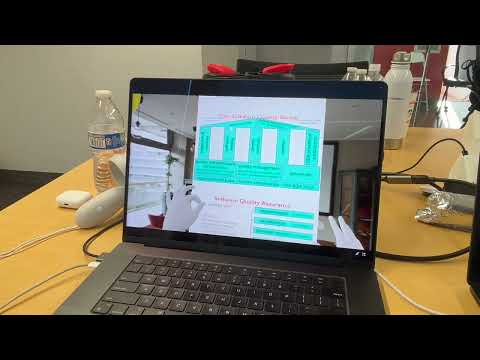
Eduverse enhances learning with AI-powered assistance for note-taking and interactive studying: AI Speech Transcription: Converts speech to text using Groq Whisper for seamless note capture. AI Tutor: Uses a visual LLM Agent to analyze and explain content on the screen. Speech Synthesis: Eleven Labs transforms text responses into natural speech. You can clone any voice! We cloned Grant Sanderson's voice: 3Blue1Brown Interactive Canvas: Displays notes, images, and educational materials with AI-driven explanations. Gesture-Based Controls: Scroll through content with hand gestures and clap to interact with the AI assistant.
How we built it
Developed for Meta Quest 2 integrated with ThreeJS WebVR. Groq Whisper for real-time speech-to-text conversion. OpenAI Visual LM for intelligent content interpretation. Eleven Labs for AI-generated speech responses. Interactive Canvas for real-time educational engagement.
Challenges we ran into
Our team had no prior experience developing in VR and had to start from scratch. We ended up pivoting from Unity to using ThreeJS after realizing that Unity had a lot of developmental overhead. Real-time AI responses were hard to achieve due to long inference times with LLMs. We minimized the latency by using the Groq API and by parallelizing steps in the AI agent. Hand gesture detection using the WebXR Device API, which was quite challenging due to its sparse and complex documentation. We overcame this by referencing community examples and by fine-tuning gesture recognition to ensure smooth and responsive interactions.
Accomplishments we're proud of
Successfully integrated AI for speech recognition, image comprehension, and voice synthesis. Created an interactive learning assistant that enhances engagement. Developed gesture-based controls for a more immersive learning experience. Designed an engaging VR-based educational assistant despite limited experience.
What we learned
AI voice technologies unlock new possibilities for interactive education. AI-driven note-taking and comprehension improve student engagement. Real-time speech and text processing enhance learning accessibility. Gesture-based interactions make VR learning more intuitive and effective.
What's next
Advanced AI Capabilities: Enhancing AI’s ability to handle complex educational queries. Expanded Learning Tools: Support more document formats such as spreadsheets and handwritten notes for real-time AI assistance. Personalized AI Tutors: We'd like to adapt AI model to cater towards different learning preferences. We could support different learning styles, whether visual, auditory, or kinesthetic. Study Tool Integration: Connecting with existing note-taking applications would improve the experience and allow for automatic tagging and organization of study materials for easier retrieval. Improved Gestures: Expanding the set of supported gestures, allowing users to navigate, select, and interact with AI more intuitively. Examples include having a laser pointer gesture as well as an ability to highlight notes directly within the VR world.
EDUVerse
Submission for TreeHacks 2025
Devpost: https://devpost.com/software/eduverse-nzuaqj
Installation
Frontend
yarn
Backend
pip install -r pip-freeze.txt
Run
Frontend
yarn run dev
Backend:
./run_server.sh
Analysis
View
Metric
- 33
- 20
- 19
- 15


Figures cover GitHub contributors during the hackathon window. A co-authored commit counts in full for each author, so per-member totals add up to more than the whole-team figures.
Technology
- C#In code
- CSSIn code
- FastAPIIn code
- HTMLIn code
- JavaScriptIn code
- OpenAIIn code
- PythonIn code
- ReactIn code
- TypeScriptIn code
- Node.jsClaimed
9 of 10 appear in the indexed code. 1 claimed on Devpost could not be matched to code, which may simply mean the tool leaves no trace in the repository.
AI coding agents
No AI coding agent signals were found in this repository.
Detected from committed agent config files and commit authorship. Absence of a signal is not proof an agent was unused.
Codebase size
Source size
65 KB
Source files
29
Counts recognized source files only; vendored directories, binaries and lockfiles are excluded, so this is smaller than the repository on disk.
Repository
pollyliu1/EDUVerse
190 files · 61.1 MB · @ 478ad04
Structure
Interface
1 file · 1%Screens, components and styles rendered to the user.
Application logic
47 files · 25%Domain rules, services and shared utilities.
Supporting
Layers are inferred from where files sit in the tree, not from reading the code. A project that names its directories unconventionally will read oddly here — open the file browser to check anything the diagram implies.
Languages
- TypeScript54%
- Python21%
- C#11%
- Markdown9%
- CSS2%
- Shell1%
- Other (2)2%
Share of indexed source by file size. Binary and vendored files are excluded.
Dependencies
python/requirements.txt
pypi · 47- annotated-types
- anyio
- Aspose.Slides
- cachetools
- certifi
- charset-normalizer
- click
- distro
- elevenlabs
- fastapi
- google-api-core
- google-api-python-client
- google-auth
- google-auth-httplib2
- googleapis-common-protos
- groq
- h11
- httpcore
- +29 more
eduverse/package.json
npm · 20- @dimforge/rapier3d
- axios
- howler
- pdfjs-dist
- react
- react-dom
- three
- three-stdlib
- +12 more
Declared in the repository’s manifests at the indexed commit. A declared package is not proof it is used, and runtime dependencies are listed first.
This project’s features have not been analysed yet.
Export this project's context (description, README, evidence, key source files) to chat with an AI agent elsewhere.