Project Info
This project did not submit a demo video on Devpost.
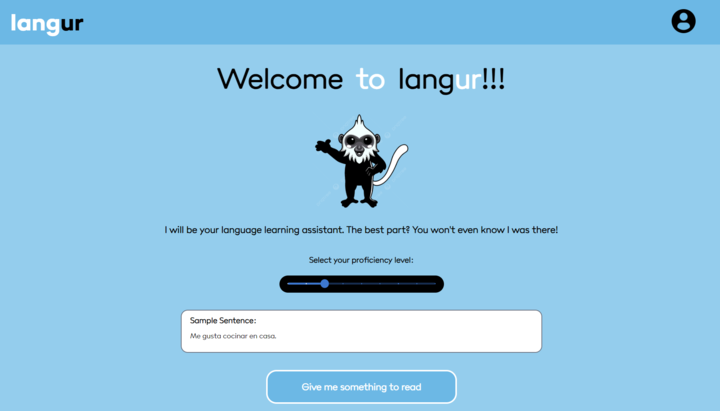
Learning languages is one thing, but what does it take to be fluent in them? LangUR is a groundbreaking project which bridges the difficult phases of learning languages. In a diverse business world with hundreds of languages being used in high commerical settings, modern applications serve to teach proficiency in langauges, but per a fluency study of Duolingo patrons learning French and Spanish, only 52.94% of 102 French learners reached a pre-intermediate level, and 66.03% of 156 Spanish speakers reached a similar level. (Jiang X, 2021) So the question stands: what helps set apart LangUR from language learning apps that help learners breach a beginner level of linguistic competence? Efficiency. Scalability. Practicality. Uses a grounded evaluation metric to measure your performance (LIX scoring algorithm) Application learns and adapts to individual learner's abilities Learning of language conveniently incorporated into daily workflow Reinforced learning of queries words through review quizzes PostmanAPI: Testing and Integrating API Endpoints Between Frontend and Backend-> enabled synchronous development by different teams Testing of MonsterAPI's inference engine-> enable quick iteration and testing of various baseline models and their associated hyperparameters Facilitated collaboration between Frontend and Backend Team with a shareable link detailing communication format PostmanAPI: Testing and Integrating API Endpoints Between Frontend and Backend-> enabled synchronous development by different teams Testing of MonsterAPI's inference engine-> enable quick iteration and testing of various baseline models and their associated hyperparameters Facilitated collaboration between Frontend and Backend Team with a shareable link detailing communication format Bun: Leveraging Bun as a JavaScript ecosystem for web deployment ultra fast and all in one bundler, runtime and package manager that saved us a lot of time Bun: Leveraging Bun as a JavaScript ecosystem for web deployment ultra fast and all in one bundler, runtime and package manager that saved us a lot of time MonsterAPI: Fine tuning the baseline models and using the inference engines easy to access deployment and fine-tuning platform greatly reduced the learning curve round-clock support by staff made development easier MonsterAPI: Fine tuning the baseline models and using the inference engines easy to access deployment and fine-tuning platform greatly reduced the learning curve round-clock support by staff made development easier Chroma Vector DB: Quick and reliable retrieval of semantic lists and articles for rapid processing with the LLM Engines. Chroma Vector DB: Quick and reliable retrieval of semantic lists and articles for rapid processing with the LLM Engines. Sample on a webpage Research The project's premise and continuity relies very heavily on social research. When Robin was learning his languages, he found that maintaining continuous performance on a daily basis aided his performance in learning a language, and such a trend is commonly correlated with higher testing proportions among students that are fed information on a consistent daily basis when studying, as demonstrated by the American Psychological Society (Mawhinney et al., 1971). Moreover, the concept of integrating language learning seamlessly into daily routines aligns with principles of habit formation and behavioral psychology. By embedding language practice within the natural flow of a user's day, LangUR capitalizes on the psychological phenomenon of habit stacking. This approach leverages existing habits as anchors for new behaviors, making language learning feel less like a burdensome task and more like an integrated aspect of daily life. Stacking habits is quintessential as evidenced for learning, so, how would one be able to consider a new approach to structuring a language learning app based off of this? Let's look back at the presented graph. In any instance, Distributed Practice and Practice Testing appear to be the largest factors associated with higher testing in general study areas, where we based our project idea off of: a gradual but slow streamline of language implementation, albeit slowly and consistently. By being passive and seamless, LangUR has the capability to gradually streamline language learning modes into a user's daily workflow, providing an excellent UI, with a diverse array of features such as translation, suggested articles based off of past history, and progressively improving the user's ability to take in the language with the readability algorithm. We often encounter the issue that learning a language is daunting, requiring continuous effort, where a lot of people simply don't have that time to invest, whereas the practicality of being fluent in languages has a high yield in business returns by eliminating barriers between multinational individuals and corporations. The idea behind LangUR had to critically emphasize the parallel and efficient nature of learning, which other applications failed to consider. Giving users a comfortable experience, automatically determining skill level through a customized LIX Algorithm, and structuring the application to cater to their learning pace was imperative during the building phase. In conclusion, taking into account human study patterns, the demanding needs of learning a language and daily time constraints, LangUR was built with the mindfulness that dedication is always on the users side, but we can do our job to make it as seamless as possible, accessible, and catered to the users.
What's next
LangUR's potential is unbelievable. It has the ability to drive a stake in the educational world, collectivizing language learners, teachers, students, and anyone through simplicity. As the project's development continues, more functions will be added such as social integrations, connecting learners across the world, and more advanced algorithms will be put in place to create more personalized suggestions, helping people learn their new languages.
LangUR: Linguistic Mastery at Your Fingertips
Learning languages is one thing, but what does it take to be fluent in them?
LangUR is a groundbreaking project which bridges the difficult phases of learning languages. In a diverse business world with hundreds of languages being used in high commerical settings, modern applications serve to teach proficiency in langauges, but per a fluency study of Duolingo patrons learning French and Spanish, only 52.94% of 102 French learners reached a pre-intermediate level, and 66.03% of 156 Spanish speakers reached a similar level. (Jiang X, 2021)


Submission
So the question stands: what helps set apart LangUR from language learning apps that help learners breach a beginner level of linguistic competence?
Efficiency. Scalability. Practicality.
Key Features
- Uses a grounded evaluation metric to measure your performance (LIX scoring algorithm)
- Application learns and adapts to individual learner's abilities
- Learning of language conveniently incorporated into daily workflow
- Reinforced learning of queries words through review quizzes

Development
This repository hosts the web dashboard of LangUR. The instructions to install and run the extension and LLM backend are in their individual repos.
Installation
- Clone the repository and install the required dependencies. Using Bun is optional but highly recommended!
git clone https://github.com/langur-treehacks/langur.git
cd langur-dashboard
bun i
- Run as needed!
bun run start
npm start
Research
The project's premise and continuity relies very heavily on social research. When Robin was learning his languages, he found that maintaining continuous performance on a daily basis aided his performance in learning a language, and such a trend is commonly correlated with higher testing proportions among students that are fed information on a consistent daily basis when studying, as demonstrated by the American Psychological Society (Mawhinney et al., 1971).

Moreover, the concept of integrating language learning seamlessly into daily routines aligns with principles of habit formation and behavioral psychology. By embedding language practice within the natural flow of a user's day, LangUR capitalizes on the psychological phenomenon of habit stacking. This approach leverages existing habits as anchors for new behaviors, making language learning feel less like a burdensome task and more like an integrated aspect of daily life. Stacking habits is quintessential as evidenced for learning, so, how would one be able to consider a new approach to structuring a language learning app based off of this? Let's look back at the presented graph.
In any instance, Distributed Practice and Practice Testing appear to be the largest factors associated with higher testing in general study areas, where we based our project idea off of: a gradual but slow streamline of language implementation, albeit slowly and consistently. By being passive and seamless, LangUR has the capability to gradually streamline language learning modes into a user's daily workflow, providing an excellent UI, with a diverse array of features such as translation, suggested articles based off of past history, and progressively improving the user's ability to take in the language with the readability algorithm.
We often encounter the issue that learning a language is daunting, requiring contiuous effort, where a lot of people simply don't have that time to invest, whereas the practicality of being fluent in languages has a high yield in business returns by eliminating barriers between multinational individuals and corporations. The idea behind LangUR had to critically emphasize the parallel and efficient nature of learning, which other applications failed to consider. Giving users a comfortable experience, automatically determining skill level through a customized LIX Algorithm, and structuring the application to cater to their learning pace was imperative during the building phase.
In conclusion, taking into account human study patterns, the demanding needs of learning a language and daily time constraints, LangUR was built with the mindfulness that dedication is always on the users side, but we can do our job to make it as seamless as possible, accessible, and catered to the users.
Gallery
Analysis
View
Metric
- 12
- 3
- 3
- 1


Figures cover GitHub contributors during the hackathon window. A co-authored commit counts in full for each author, so per-member totals add up to more than the whole-team figures.
Technology
- CSSIn code
- HTMLIn code
- JavaScriptIn code
- ReactIn code
- Tailwind CSSIn code
- TypeScriptIn code
- FlaskClaimed
- PythonClaimed
6 of 8 appear in the indexed code. 2 claimed on Devpost could not be matched to code, which may simply mean the tool leaves no trace in the repository.
AI coding agents
No AI coding agent signals were found in this repository.
Detected from committed agent config files and commit authorship. Absence of a signal is not proof an agent was unused.
Codebase size
Source size
33 KB
Source files
25
Counts recognized source files only; vendored directories, binaries and lockfiles are excluded, so this is smaller than the repository on disk.
Repository
langur-treehacks/langur
49 files · 1.8 MB · @ 45f1b0b
Structure
Interface
14 files · 29%Screens, components and styles rendered to the user.
Application logic
8 files · 16%Domain rules, services and shared utilities.
Supporting
Layers are inferred from where files sit in the tree, not from reading the code. A project that names its directories unconventionally will read oddly here — open the file browser to check anything the diagram implies.
Languages
- TypeScript55%
- CSS23%
- Markdown16%
- HTML5%
- JavaScript0%
Share of indexed source by file size. Binary and vendored files are excluded.
Dependencies
langur-dashboard/package.json
npm · 19- @emotion/react
- @emotion/styled
- @mui/material
- @testing-library/jest-dom
- @testing-library/react
- @testing-library/user-event
- @types/react
- @types/react-dom
- localforage
- match-sorter
- react
- react-card-flip
- react-dom
- react-router-dom
- react-scripts
- sort-by
- web-vitals
- +2 more
Declared in the repository’s manifests at the indexed commit. A declared package is not proof it is used, and runtime dependencies are listed first.
This project’s features have not been analysed yet.
Export this project's context (description, README, evidence, key source files) to chat with an AI agent elsewhere.