Project Info
This project did not submit a demo video on Devpost.
Inspiration
The Internet has become the backbone of modern society, and is used to share information and other things to everyone. Now more than ever, the Internet has become an invaluable resource for almost everything. With the increase in reliance on the Internet, there has also been an alarming increase in the spread of misinformation. We were inspired to build our project because we noticed how much misinformation has entered our daily lives in things like social media, news articles, and sometimes even informational websites. Our goal is help everyone figure out for themselves what the truth is.
What it does
Our tool helps users reveal the truth in their conversations. It records and transcribes speech in real time. Any sentence can be clicked and automatically fact-checked against multiple reputable sources, all of which are conveniently linked in a quick AI report for transparency.
How we built it
Our project is built off of Next.js infrastructure alongside a Flask RESTful API server. Our backend utilizes a queue system to handle requests, which query Gemini API alongside a local retriever model using Langchain & Ollama libraries. We source our information through Wikipedia’s API, as it gives easily obtainable sourcing and straight-to-the-point information.
Challenges we ran into
We overcame many challenges during the development process, the most difficult being optimizing the retrieval model and the entire pipeline for latency.
Accomplishments we're proud of
We are proud of the cohesive application that we've built, linking together a powerful backend, responsive and easy to use UI, all while leveraging Gemini and Ollama. It is a fully working project and the first step towards an important goal.
What we learned
We learned a great deal about the science behind RAG (Retrieval Augmented Generation), pipelining, and model optimization when working with webpage datasets. Additionally, our use of Gemini API taught us how to optimize our prompts for the best straightforward responses. Some of us were not familiar with React & Next, and learned about important React fundamentals (such as useState, references, and routing).
What's next
The path to bringing Verity to everyone will include extensive testing and fine tuning, user testing, and lots of sleepless nights trying to fix bugs. Our goal is to continue development of Verity to improve its performance, add new features, and most importantly scale it to a production version that we everyone can use.
Verity - Realtime Fact-Checking & Conversational Analysis
Verity combats misinformation through realtime retreival of sourced data, which is analyzed and applied to specific claims made during a conversation. The platform encourages research and sourcing claims, improving conversation productiveness and establishing baseline truths to arguments.
With Verity, users can get a realtime transcription of their conversation, analyze specific claims made, and get personalized feedback regardinging the validity of claims.
📸 Screenshots
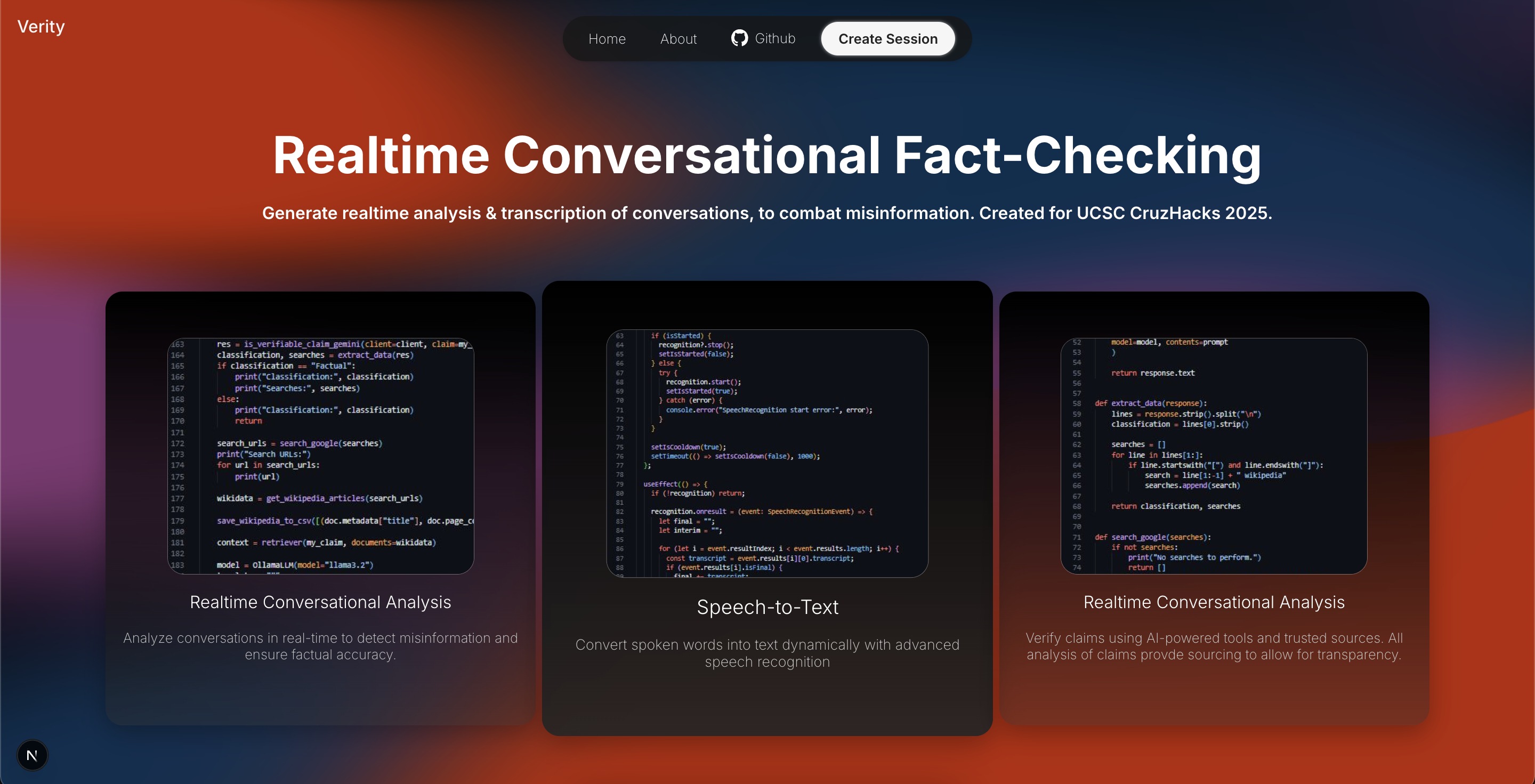 Home Page
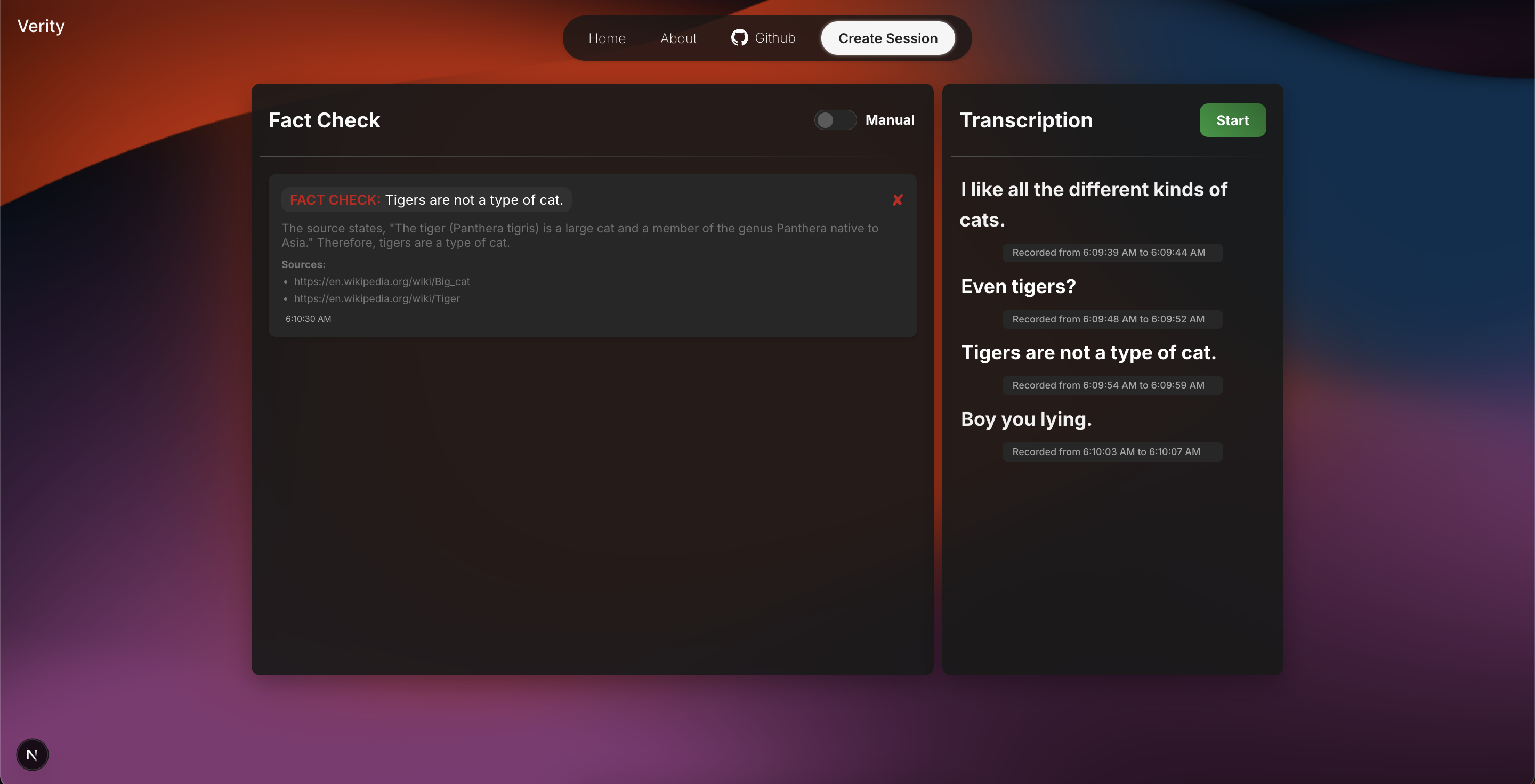 Interface for live conversational analysis
🚀 Getting Started
Prerequisites
- Node.js (v15.1.5 or higher)
- npm or yarn
- Python 3.7
Installation
-
Clone the repository:
git clone https://github.com/yourusername/speedfill.git cd cruzhacks2025 cd frontend -
Install dependencies:
npm install # or yarn install -
Create a \.env\.local file in the root directory and add your API keys:
GEMINI_API_KEY = "YOUR KEY" GOOGLESEARCH_API_KEY = "YOUR KEY" -
Run the development server:
npm run dev # or yarn dev -
Open http://localhost:3000 in your browser to view the application.
🛠️ Technology Stack
- Frontend: React.js, Next.js
- AI Integration: Google Gemini AI API, Ollama+Langchain Retreiver Models (nomic-embed-text)
- Backend API Flask
- Languages Python, TypeScript, HTML/CSS
📜 License
This project is licensed under the MIT License - see the LICENSE file for details.
Analysis
View
Metric
- 20
- 17
- 1


Figures cover GitHub contributors during the hackathon window. A co-authored commit counts in full for each author, so per-member totals add up to more than the whole-team figures.
Technology
- CSSIn code
- Next.jsIn code
- PythonIn code
- ReactIn code
- TypeScriptIn code
- FlaskClaimed
- Google GeminiClaimed
- LangChainClaimed
- OllamaClaimed
5 of 9 appear in the indexed code. 4 claimed on Devpost could not be matched to code, which may simply mean the tool leaves no trace in the repository.
AI coding agents
No AI coding agent signals were found in this repository.
Detected from committed agent config files and commit authorship. Absence of a signal is not proof an agent was unused.
Codebase size
Source size
56 KB
Source files
24
Counts recognized source files only; vendored directories, binaries and lockfiles are excluded, so this is smaller than the repository on disk.
Repository
0xcolinhenderson/cruzhacks2025
37 files · 2.8 MB · @ 0e835c3
Structure
Interface
14 files · 38%Screens, components and styles rendered to the user.
Application logic
8 files · 22%Domain rules, services and shared utilities.
Supporting
Layers are inferred from where files sit in the tree, not from reading the code. A project that names its directories unconventionally will read oddly here — open the file browser to check anything the diagram implies.
Languages
- TypeScript40%
- Python32%
- CSS22%
- Markdown6%
Share of indexed source by file size. Binary and vendored files are excluded.
Dependencies
frontend/package.json
npm · 11- next
- react
- react-dom
- whatamesh
- +7 more
Declared in the repository’s manifests at the indexed commit. A declared package is not proof it is used, and runtime dependencies are listed first.
This project’s features have not been analysed yet.
Export this project's context (description, README, evidence, key source files) to chat with an AI agent elsewhere.