Project Info
This project did not submit a demo video on Devpost.
Transforming calm thoughts into immersive VR journeys. SlugMeditate is a calming VR experience that turns your thoughts into immersive worlds. Just type in a peaceful idea, and we use AI to generate visuals, turn them into video, and transform it into a 3D scene you can explore in virtual reality — all in your browser. It’s like a personalized meditation space, built from your own imagination. 🌟
Inspiration
We wanted to explore how emerging generative AI and VR technologies could support mindfulness and mental well-being. Many college students deal with stress and burnout — what if we could turn a simple reflection or intention into a deeply personal, calming VR experience? Thus, SlugMeditate was born: a pipeline that transforms your thoughts into a 3D ambient escape. ✨ What It Does SlugMeditate takes a text input (like "a peaceful forest at dusk") and transforms it into: Image Generation – Using Google Imagen 3, powered by Google AI Gemini, we generate visually rich and vivid images from the user’s prompt. Video Creation – These images are animated into smooth, cinematic video loops using Google AI Gemini Veo 2. 3D Scene Mapping – The generated video is converted into a volumetric 3D scene using Gaussian Splatting. VR Immersion – We render the 3D environment in-browser using Niantic Studio WebXR, paired with ambient music for a fully immersive and relaxing VR experience. Ambient Music Generation – Using Google MusicFX, we generate peaceful background music tailored to your prompt, completing the meditative vibe. 🧠 How We Built It Text-to-Image: Generated with Imagen 3, part of Google AI Gemini's generative capabilities. Image-to-Video: Animated using Gemini AI Veo 2 for cinematic smoothness and style. 3D Reconstruction: Used Gaussian Splatting to map video into a navigable 3D environment. VR Deployment: Built and displayed the immersive world using Niantic Studio WebXR. Sound Design: Integrated calming ambient tracks to enhance the meditative experience. 🧗 Challenges We Ran Into A lot of the API documentation for Google tools (like Imagen 3 and Veo 2) was either outdated or didn’t work as expected, so we had to piece things together from multiple sources and experiment through trial and error. We tried multiple methods of Gaussian Splatting, but hit limitations due to hardware constraints and time. It was tricky to get the image-to-video prompting just right. If the camera motion didn’t pan correctly or stayed too static, the 3D reconstruction would break or look flat. We were all new to Niantic Studio WebXR, so learning the ecosystem and figuring out how to display our 3D scene in a browser-based VR environment took some digging. CruzHacks had unreliable Wi-Fi, which made working with cloud-based AI tools extra tough — we had to sync and generate assets whenever the connection let us. 🏆 Accomplishments We're Proud Of Built a complete text-to-VR pipeline using cutting-edge generative AI in under 48 hours. Successfully integrated Google AI Gemini tools with VR rendering frameworks. Created an emotionally resonant experience combining creativity, tech, and wellness. Learned and operationalized advanced tools like Imagen 3, Veo 2, and Gaussian Splatting quickly. 📚 What We Learned Practical use of Google AI Gemini for generative media workflows. How to bridge AI media generation with 3D spatial computing and VR rendering. Rapid prototyping, team collaboration, and problem-solving under pressure. 🔮 What's Next Interactive environments – Let users explore within the VR space. Customization – Personalize music, ambient sounds, or guided meditations. Performance tuning – Reduce generation and render time for real-time feedback. Community gallery – Share and explore others' meditative scenes. Built with love, curiosity, and caffeine by the SlugMeditate team at CruzHacks 2025 Powered by Google AI Gemini, Niantic Studio WebXR, and Gaussian Splatting.
🐌 SlugMeditate
Transforming calm thoughts into immersive VR journeys.
SlugMeditate is a calming VR experience that turns your thoughts into immersive worlds. Just type in a peaceful idea, and we use AI to generate visuals, turn them into video, and transform it into a 3D scene you can explore in virtual reality — all in your browser. It’s like a personalized meditation space, built from your own imagination.
🌟 Inspiration
We wanted to explore how emerging generative AI and VR technologies could support mindfulness and mental well-being. Many college students deal with stress and burnout — what if we could turn a simple reflection or intention into a deeply personal, calming VR experience?
Thus, SlugMeditate was born: a pipeline that transforms your thoughts into a 3D ambient escape.
✨ What It Does
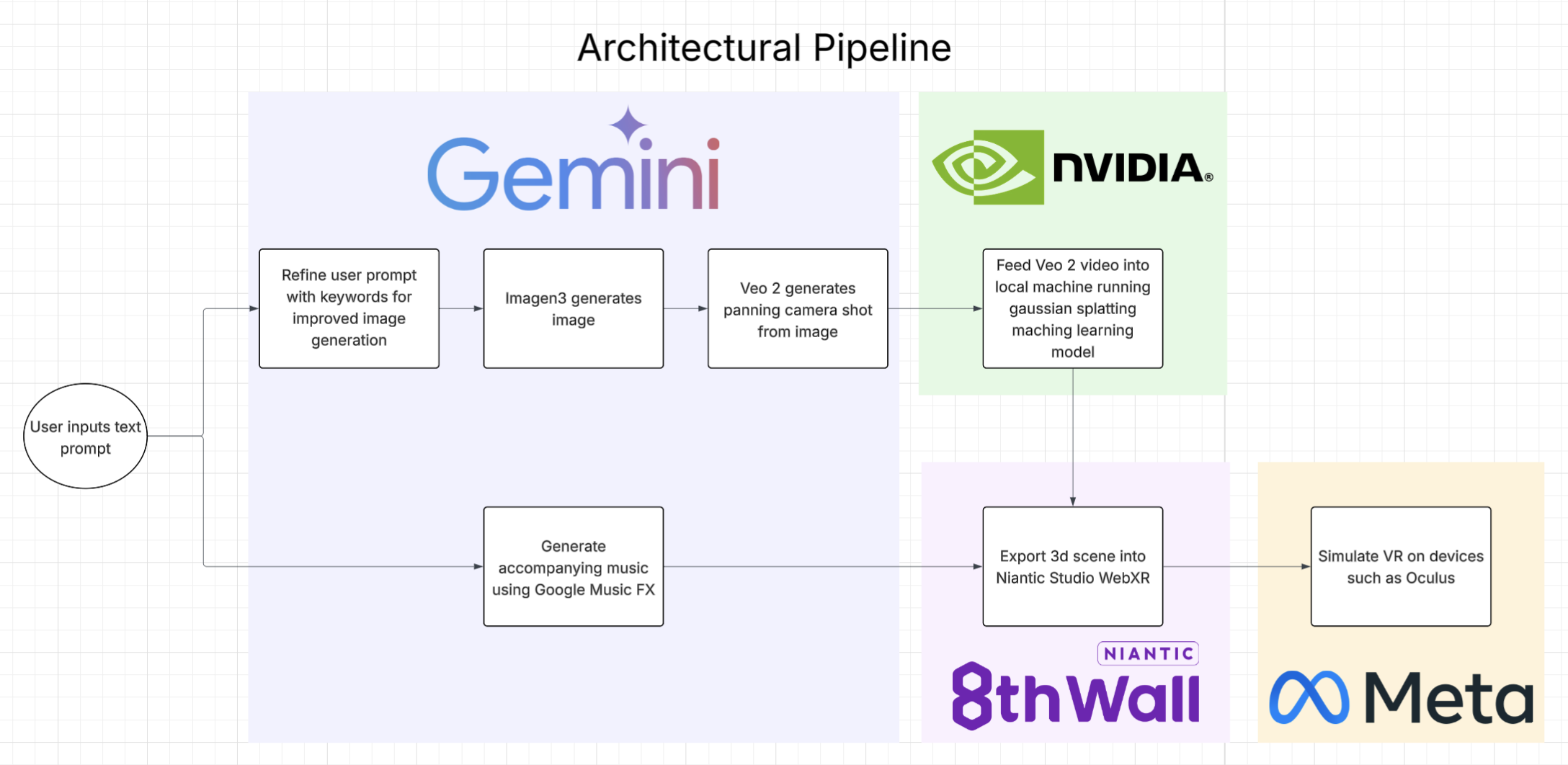
SlugMeditate takes a text input (like "a peaceful forest at dusk") and transforms it into:
- Image Generation – Using Google Imagen 3, powered by Google AI Gemini, we generate visually rich and vivid images from the user’s prompt.
- Video Creation – These images are animated into smooth, cinematic video loops using Google AI Gemini Veo 2.
- 3D Scene Mapping – The generated video is converted into a volumetric 3D scene using Gaussian Splatting.
- VR Immersion – We render the 3D environment in-browser using Niantic Studio WebXR, paired with ambient music for a fully immersive and relaxing VR experience.
- Ambient Music Generation – Using Google MusicFX, we generate peaceful background music tailored to your prompt, completing the meditative vibe.
🧠 How We Built It
- Text-to-Image: Generated with Imagen 3, part of Google AI Gemini's generative capabilities.
- Image-to-Video: Animated using Gemini AI Veo 2 for cinematic smoothness and style.
- 3D Reconstruction: Used Gaussian Splatting to map video into a navigable 3D environment.
- Trained an AI 3D Gaussian Splatting model locally on our laptop GPUs implementing the paper "3D Gaussian Splatting for Real-Time Radiance Field Rendering ": https://github.com/graphdeco-inria/gaussian-splatting
- VR Deployment: Built and displayed the immersive world using Niantic Studio WebXR.
- Sound Design: Integrated calming ambient tracks to enhance the meditative experience.
🧗 Challenges We Ran Into
- A lot of the API documentation for Google tools (like Imagen 3 and Veo 2) was either outdated or didn’t work as expected, so we had to piece things together from multiple sources and experiment through trial and error.
- We tried multiple methods of Gaussian Splatting, but hit limitations due to hardware constraints and time.
- It was tricky to get the image-to-video prompting just right. If the camera motion didn’t pan correctly or stayed too static, the 3D reconstruction would break or look flat.
- We were all new to Niantic Studio WebXR, so learning the ecosystem and figuring out how to display our 3D scene in a browser-based VR environment took some digging.
- CruzHacks had unreliable Wi-Fi, which made working with cloud-based AI tools extra tough — we had to sync and generate assets whenever the connection let us.
🏆 Accomplishments We're Proud Of
- Built a complete text-to-VR pipeline using cutting-edge generative AI in under 48 hours.
- Successfully integrated Google AI Gemini tools with VR rendering frameworks.
- Created an emotionally resonant experience combining creativity, tech, and wellness.
- Learned and operationalized advanced tools like Imagen 3, Veo 2, and Gaussian Splatting quickly.
📚 What We Learned
- Practical use of Google AI Gemini for generative media workflows.
- How to bridge AI media generation with 3D spatial computing and VR rendering.
- Rapid prototyping, team collaboration, and problem-solving under pressure.
🔮 What's Next
- Interactive environments – Let users explore within the VR space.
- Customization – Personalize music, ambient sounds, or guided meditations.
- Performance tuning – Reduce generation and render time for real-time feedback.
- Community gallery – Share and explore others' meditative scenes.
Built with love, curiosity, and caffeine by the SlugMeditate team at CruzHacks 2025
Powered by Google AI Gemini, Niantic Studio WebXR, and Gaussian Splatting.
Docker Setup:
- Run
docker build -t python-env . - docker run -it --rm -v "$(your path to directory):/app" python-env
- for mac: docker run -it --rm -v "$PWD:/app" python-env
- windows: docker run -it --rm -v "/$(pwd | sed 's/^C:\//; s/\///g'):/app" python-env
Analysis
View
Metric
- 10
- 10
- 4
- 4


Figures cover GitHub contributors during the hackathon window. A co-authored commit counts in full for each author, so per-member totals add up to more than the whole-team figures.
Technology
- HTMLIn code
- PythonIn code
- Google GeminiClaimed
- Next.jsClaimed
2 of 4 appear in the indexed code. 2 claimed on Devpost could not be matched to code, which may simply mean the tool leaves no trace in the repository.
AI coding agents
No AI coding agent signals were found in this repository.
Detected from committed agent config files and commit authorship. Absence of a signal is not proof an agent was unused.
Codebase size
Source size
59 KB
Source files
19
Counts recognized source files only; vendored directories, binaries and lockfiles are excluded, so this is smaller than the repository on disk.
Repository
briankhoi/slugmeditate
759 files · 836.7 MB · @ 4515b7b
Structure
Interface
1 file · 0%Screens, components and styles rendered to the user.
Application logic
23 files · 3%Domain rules, services and shared utilities.
Data & schema
1 file · 0%Schema definitions, migrations and data access.
Supporting
Layers are inferred from where files sit in the tree, not from reading the code. A project that names its directories unconventionally will read oddly here — open the file browser to check anything the diagram implies.
Languages
- Python59%
- YAML16%
- HTML13%
- Markdown8%
- Shell3%
Share of indexed source by file size. Binary and vendored files are excluded.
Dependencies
requirements.txt
pypi · 14- certifi
- charset-normalizer
- colorama
- google-genai
- idna
- iniconfig
- ipython
- packaging
- Pillow
- pluggy
- pytest
- python-dotenv
- requests
- urllib3
package.json
npm · 1- spz-js
Declared in the repository’s manifests at the indexed commit. A declared package is not proof it is used, and runtime dependencies are listed first.
This project’s features have not been analysed yet.
Export this project's context (description, README, evidence, key source files) to chat with an AI agent elsewhere.